What is the linden tree?
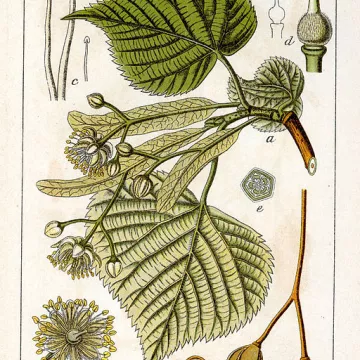
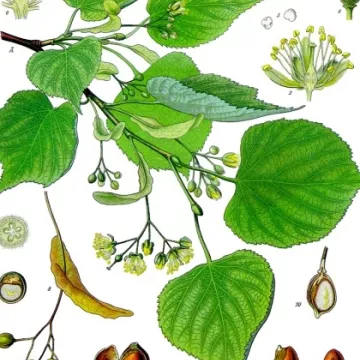
The linden tree (Tilia cordata and Tilia platyphyllos) is a tall European tree with fragrant flowers and heart-shaped leaves that has been used for centuries in traditional herbal medicine. Two distinct parts are valued: the flowers and bracts (soothing and digestive effects) andthe sapwood (inner bark, which promotes liver and kidney drainage).
Recognized by the European Medicines Agency (EMA) for its traditional use in relieving mild mental stress and promoting sleep, linden is one of the most accessible pillars of Western herbal medicine. Additional resources are available for herbal medicine in general.
What are its recognized benefits?
Linden is traditionally used to:
- Relieve mildstress and nervousness
- Help you fall asleep and improve sleep quality
- Relieve minordigestive issues (bloating, heaviness, spasms)
- Support liver and kidney drainage through the sapwood
- Relieve tension headaches and mild stress-related palpitations
- Supporting flu-likefeverish conditions (mild diaphoretic effect)
A mild and well-tolerated herb, linden is suitable for a wide range of people, including children as young as 1 year old when taken in an appropriate dosage. For lemon balm, chamomile, and passionflower in general, specific resources are available.
How to use the flowers and sapwood?
Several complementary forms are available:
- Herbal tea made from flowers and bracts: 1 tablespoon per 250 ml of simmering water; cover and let steep for 10 minutes; drink 1 to 3 cups per day in the evening
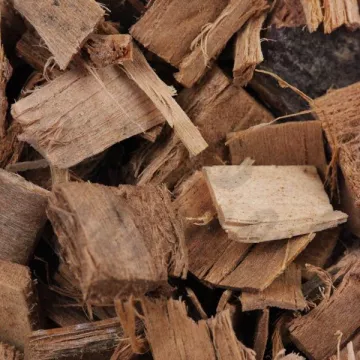
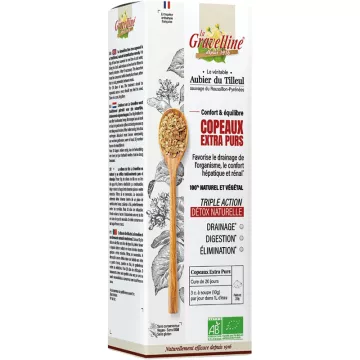
- Sapwood decoction: 30 g of sapwood per 1 L of water, simmer gently for 15 minutes; drink in small amounts throughout the day for 20 days
- Dry extract capsules for stress and sleep, as recommended by a pharmacist
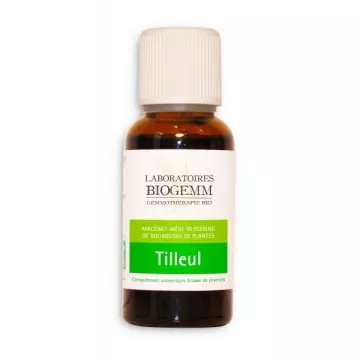
- Bud macerate (gemmotherapy): 5 to 15 drops per day in a glass of water to regulate the nervous system
- Relaxing bath: concentrated infusion added to bathwater for a skin-soothing effect
- Traditionalcombinations: linden + chamomile + lemon balm for sleep; linden + verbena for digestion
Seasonal 3-week treatment courses with a break in between are recommended.Sapwood is particularly well-suited for spring and fall treatment courses. Specific remedies are available to improve digestion and sleep in general.
Flowers or sapwood: what’s the difference?
Both parts offer complementary uses:
- Flowers and bracts: soothing, mildly sedative, and digestive; traditionally consumed as an evening infusion
- Sapwood (inner bark): promotes liver and kidney detoxification, supports toxin elimination, traditionally taken as a decoction over 3 weeks
- Buds: overall balancing effect on the nervous system; gentle gemmotherapy suitable for many profiles
A combined approach can be recommended as needed: flowers in the evening to promote sleep, sapwood as an occasional treatment for detoxification. Specific remedies are available to strengthen natural immunity in general.
What precautions should be taken?
Although mild, linden requires a few standard precautions:
- Severehypotension: exercise caution with prolonged use (mild blood-pressure-lowering effect has been documented)
- Allergies to the Tiliaceae family: strictly avoid
- Pregnancy and breastfeeding: flower tea is generally well-tolerated; sapwood is not recommended without medical advice
- Young children: May be given as a mild infusion starting atage 1, with pediatric approval
- Bark as a course of treatment: do not exceed 3 consecutive weeks without a break
- Possibleinteractions with antihypertensives and sedatives: consultation with a pharmacist is recommended
To benefit from the preserved active ingredients, choose organic linden (harvested without pesticides), ideally of European or French origin, harvested using traditional methods. Your licensed pharmacist remains a valuable resource for guiding your choice based on your needs (flowers, sapwood, gemmotherapy) and identifying any contraindications, in addition to appropriate medical follow-up. Forhawthorn and valerian in general, specific resources are available.