What is osteoarthritis, and how does it progress through its stages?
Osteoarthritis is a degenerative joint disease characterized by the progressive destruction of cartilage, followed by reactive bone remodeling and inflammation of the synovial membrane. Its progression through radiographic stages guides treatment decisions. Discover our range of joint pain relief products to support your comfort at every stage.
- Stage 1: Mild cartilage irregularities—often asymptomatic—chondroprotective supplements (glucosamine, chondroitin, collagen) are most effective at this stage
- Stage 2: early-stage joint impingement—intermittent mechanical pain—brief morning stiffness (< 30 min)—supplements + lifestyle changes
- Stage 3: marked joint impingement + osteophytes + erosions — daily pain — supplements + hyaluronic acid or corticosteroid injections
- Stage 4: Total cartilage destruction, bone-on-bone — disabling pain, joint deformity — joint replacement as first-line treatment
- Radiological and clinical diagnosis is essential for tailoring treatment to the stage of the disease—chronic joint pain warrants a rheumatology evaluation
Which supplements should be taken based on the stage and location of osteoarthritis?
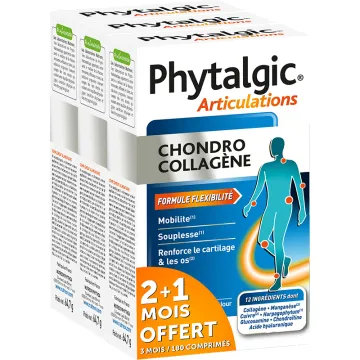
Chondroprotective agents are most effective in stages 1 and 2—their effectiveness decreases when the cartilage is severely damaged. Find the complete formulas in our joint comfort line.
- Glucosamine 1,500 mg/day: a precursor to cartilage glycosaminoglycans—proven efficacy in stage 1–2 knee and hip osteoarthritis—minimum 3-month treatment course
- Chondroitin 800–1,200 mg/day: inhibits degradative metalloproteinases—works synergistically with glucosamine— chondroitin line
- Oralhyaluronic acid: improves the viscosity of synovial fluid — documented bioavailability of low-molecular-weight oral forms — complementary to prescription intra-articular injections
- Hydrolyzed marine collagen: peptides for the synthesis of type II collagen in cartilage — joint collagen product line
- Turmeric + boswellia: complementary natural anti-inflammatories — COX-2 (turmeric) and 5-LOX (boswellia) pathways — comparative efficacy to certain NSAIDs in studies on knee osteoarthritis
Where does osteoarthritis occur, and what are its specific characteristics?
Each location of osteoarthritis has its own aggravating factors and specific treatment approaches—in addition to the basic treatment provided by our joint pain product lines.
- Knee osteoarthritis (gonarthrosis): the most common site — exacerbated by excess weight (3- to 5-fold increase in pressure with each step) — strengthening the quadriceps is a priority — risk of fracture if associated with osteoporosis
- Hip osteoarthritis (coxarthrosis): progressive limping, groin pain radiating to the thigh—often hereditary—total hip replacement is among the most effective surgeries (90% satisfaction rate)
- Cervical osteoarthritis: cervicogenic headaches, dizziness, cervicobrachial neuralgia—specific details covered on our page on cervical osteoarthritis
- Osteoarthritis of the fingers (distal interphalangeal joints): Heberden’s nodes — common in postmenopausal women — affects function (writing, sewing) but is rarely disabling
- Rhizarthrosis (osteoarthritis of the base of the thumb): very common, causes difficulty opening jars—rest splint, injections, surgery if these fail
When should injections and surgery be considered for osteoarthritis?
Medical treatments for advanced osteoarthritis often make it possible to delay or avoid surgery—a decision to be made with a rheumatologist or orthopedic surgeon based on the radiographic stage and functional impact.
- Corticosteroid injections: rapid anti-inflammatory effect — 3–4 weeks of relief — maximumof 3–4 injections per year per joint (risk of long-term cartilage damage)
- Viscosupplementation (injectable hyaluronic acid): restores the lubricating properties of synovial fluid—1 to 5 injections depending on the formulation—proven efficacy in stage 2–3 knee osteoarthritis—available by prescription
- Platelet-rich plasma (PRP): an emerging technique — injection of autologous growth factors — promising results in knee osteoarthritis — studies ongoing
- Joint replacement: indicated for stage 4 — primarily for the knee and hip — lifespan of 15–25 years — 3–6 months of rehabilitation — dramatic improvement in quality of life for disabling forms
- Our joint comfort product line provides complementary support before and after surgical procedures