NOTICE
ANSM - Updated on : 30/09/2024
Product name
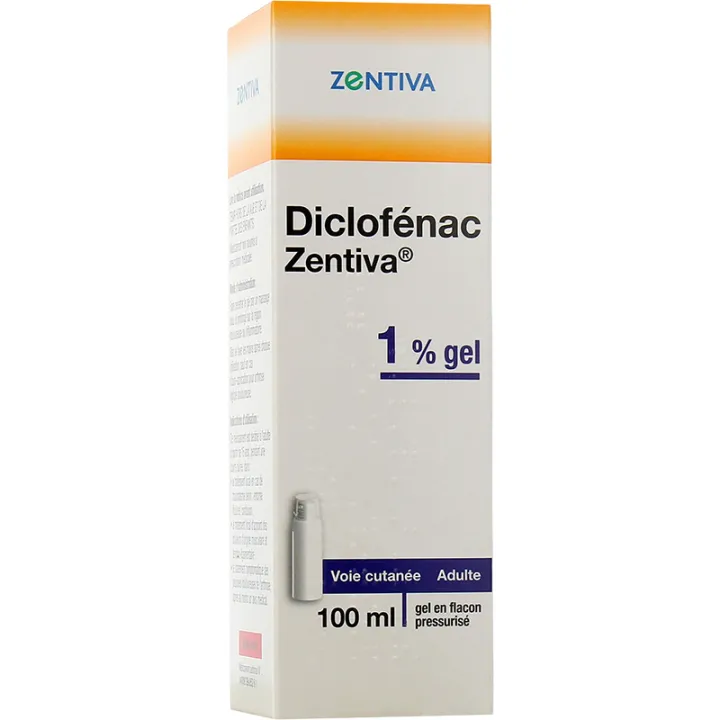
DICLOFENAC ZENTIVA 1%, gel in pressurized bottle
Diclofenac
Box
Please read this leaflet carefully before using this medicine, as it contains important information for you.
Always use this medicine exactly as it is described in this leaflet or by your doctor or pharmacist.
- Keep this leaflet. You may need to read it again.
- Ask your pharmacist for any advice or information you may need.
- If you experience any of the side effects listed above, please tell your doctor or pharmacist. This also applies to any side effects not mentioned in this leaflet. See section 4.
- You should contact your doctor if you do not feel any improvement or if you feel less well:
o after 4 days in case of minor trauma: sprain, contusion,
o after 7 days for muscular and tendino-ligamentary pain,
o after a maximum of 14 days in case of painful arthrosis.
Keep out of the reach of children.
What does this leaflet contain?
1. What is DICLOFENAC ZENTIVA 1%, gel in pressurized bottle and what is it used for?
2. What do I need to know before using DICLOFENAC ZENTIVA 1%, gel in pressurized bottle?
3. How do I use DICLOFENAC ZENTIVA 1%, gel pressurized bottle?
4. What are the possible side effects?
5. How do I keep DICLOFENAC ZENTIVA 1%, gel in pressurized bottle?
6. Package contents and other information.
1. WHAT IS DICLOFENAC ZENTIVA 1%, gel in pressurized bottle AND WHAT IS IT USED FOR?
Pharmacotherapeutic class - ATC code: M02AA15.
This medicine is an anti-inflammatory and analgesic (pain-relieving) gel for application to the skin, over the painful area only.
This medicine is intended for adults (15 years and over), for short periods, in :
- local treatment of minor trauma: sprains, contusions;
- local treatment of pain of muscular and tendino-ligamentary origin;
- symptomatic treatment of painful flare-ups of arthrosis, after at least one medical consultation.
2. WHAT DO I HAVE TO KNOW BEFORE USING DICLOFENAC ZENTIVA 1%, gel in pressurized bottle?
Never use DICLOFENAC ZENTIVA 1%, gel in pressurized bottle in the following cases:
- if you are allergic to the active substance or to any of the other ingredients of this product, as listed in section 6.
- if you are pregnant, from the beginning of the 6th month of pregnancy (beyond 24 weeks of amenorrhea),
- on damaged skin, whatever the lesion: oozing lesions, eczema, infected lesions, burns or wounds.
- In the event of a history of allergy or hypersensitivity (occurrence of asthma, angiodema, urticaria or acute rhinitis) triggered by a drug containing diclofenac, acetylsalicylic acid or other non-steroidal anti-inflammatory drugs (NSAIDs).
- in children under 15 years of age.
IF IN DOUBT, ASK YOUR DOCTOR OR PHARMACIST.
Warnings and precautions
Take special care with DICLOFENAC ZENTIVA 1%, gel in pressurized bottle.
Special warnings
- Do not swallow. Do not apply to mucous membranes or eyes. Apply only to the painful area, on intact, healthy skin free of sores, open lesions, rashes or eczema.
- Rinse eyes thoroughly with water if product comes into contact with eyes. Consult your doctor or pharmacist if discomfort persists.
- If a rash appears after application, discontinue use immediately. If this occurs, contact your doctor or pharmacist.
- After application:
o Hands should be wiped with absorbent paper (for example), then washed, except if the site to be treated is involved. Absorbent paper should be disposed of in the garbage can after use.
o Wait for DICLOFENAC ZENTIVA 1% gel in pressurized bottle to dry before taking a shower or bath.
- Do not apply to a large area of skin, at a higher dosage than recommended, or for a prolonged period without medical advice.
- This product contains propylene glycol (50 mg/g gel) and may cause skin irritation.
The gel form is reserved for adults (15 years and over).
In adolescents aged 15 and over, if symptoms worsen, it is advisable to seek your doctor's advice.
For intensive use, the physiotherapist should wear gloves.
IF IN DOUBT, ASK YOUR DOCTOR OR PHARMACIST FOR ADVICE.
If you are pregnant or breast-feeding:
Do not use this product on your own initiative. Ask your doctor or pharmacist for advice.
Children under 15 years of age
This medicine must not be used in children under 15 years of age (see "Never use DICLOFENAC ZENTIVA 1%, gel in pressurized bottle in the following cases").
Other medicines and DICLOFENAC ZENTIVA 1%, gel in pressurized bottle
Tell your doctor or pharmacist if you are taking or have recently taken any other medicines, including medicines obtained without a prescription.
This medicine contains diclofenac. Other medicines contain diclofenac, in particular certain oral medicines. Do not combine them, so as not to exceed the maximum recommended doses (see Dosage and Administration).
DICLOFENAC ZENTIVA 1%, gel in pressurized bottle with food, drink and alcohol
Not applicable.
Pregnancy, breast-feeding and fertility
If you are pregnant or breastfeeding, think you may be pregnant or are planning to become pregnant, ask your doctor or pharmacist for advice before taking any medicine.
Pregnancy
Before the beginning of the 6th month of pregnancy (up to the 24th week of amenorrhea), you should not take this medicine unless absolutely necessary, as determined by your doctor, due to the potential risk of miscarriage or malformations. In such cases, the dose should be kept as low as possible and the duration of treatment as short as possible.
From the beginning of the 6th month to the end of pregnancy (beyond the 24th week of amenorrhea), this medicine is contraindicated. You should NEVER take this medicine, as its effects on your child may have serious or even fatal consequences, particularly on the heart, lungs and/or kidneys, even with a single dose.
Oral forms (e.g. tablets) of DICLOFENAC may cause undesirable effects in your unborn child. With DICLOFENAC ZENTIVA 1%, gel in pressurized bottle, when used on the skin, this risk is unknown.
If you have taken this medicine while you were pregnant, tell your obstetrician-gynecologist immediately, so that appropriate monitoring can be offered to you if necessary.
Breast-feeding
As this drug passes into breast milk, it is not recommended to use it while breast-feeding.
If you are breast-feeding, do not apply this product to your breasts.
Fertility
This drug, like all non-steroidal anti-inflammatory drugs (NSAIDs), may impair fertility in women, leading to difficulties in becoming pregnant, which may be reversible on discontinuation of treatment. Inform your doctor if you are planning a pregnancy or have difficulty conceiving.
Driving and use of machinery
Not applicable.
DICLOFENAC ZENTIVA 1%, gel in pressurized bottle contains propylene glycol.
3. HOW DO I USE DICLOFENAC ZENTIVA 1%, gel in pressurized bottle?
Dosage and duration of treatment
For adults only (15 years and over).
Dosage depends on indication.
The occurrence of adverse effects can be minimized by using the lowest possible dose for the shortest duration of treatment necessary to relieve symptoms.
Minor trauma: sprain, contusion
1 local application, 2 to 3 times a day, for a maximum of 4 days. If pain persists beyond this period, a doctor should be consulted.
The dose for each application should not exceed 2.5 g of gel. This maximum dose corresponds to a 6 cm ribbon of gel (see scale diagram).
Pain of muscular and tendino-ligamentary origin
As adjunctive treatment: 1 local application, 3 to 4 times a day, for a maximum of 7 days. If pain persists beyond this period, a doctor should be consulted.
The dose for each application should not exceed 2.5 g of gel. This maximum dose corresponds to a 6 cm ribbon (see scale diagram).
Painful flare-ups of arthrosis
Only after initial medical advice.
Symptomatic treatment: 1 local application, 3 to 4 times a day, for 7 days. Treatment may be continued, if necessary, for up to 14 days. If pain persists beyond this period, a doctor should be consulted.
The dose administered per application should not exceed 4 g of gel. This corresponds to a ribbon of about 10 cm (see scale diagram).
Special populations
Children under 15 years of age
This medicine must not be used in children under 15 years of age (see "Never use DICLOFENAC ZENTIVA 1%, gel in pressurized bottle").
Elderly subjects
This drug should be used with caution in the elderly, who are more prone to adverse reactions.
Method of administration
DICLOFENAC ZENTIVA 1% gel is for cutaneous use only. Gently massage the gel into the painful or inflammatory area over a long period of time, applying a thin layer.
After application:
- Hands should be wiped with a paper towel and then washed, unless the hands are the areas to be treated.
- If too much gel is accidentally applied, the excess should be wiped off with a paper towel.
- The paper towel should be disposed of in the household waste after use, to prevent unused product from contaminating the aquatic environment.
- Before applying a dressing, allow DICLOFENAC ZENTIVA 1% gel in a pressurized bottle to dry on the skin for a few minutes.
- Wait for DICLOFENAC ZENTIVA 1%, gel in pressurized bottle to dry before taking a shower or bath.
If you have used more DICLOFENAC ZENTIVA 1%, gel in pressurized bottle than you should have
In the event of overdose or accidental poisoning, wipe off any excess gel with absorbent paper, then rinse off with plenty of water and consult your doctor or pharmacist immediately.
If you forget to use DICLOFENAC ZENTIVA 1%, gel in pressurized bottle
If you accidentally miss a dose, wait until your next dose and continue your treatment as usual. Do not take a double dose to make up for the one you have missed.
If you stop using DICLOFENAC ZENTIVA 1%, gel in pressurized bottle
Not applicable.
4. WHAT ARE THE POSSIBLE SIDE EFFECTS?
Like all medicines, this product may cause undesirable effects, but these do not always occur in everyone.
In exceptional cases, reactions which may be severe may occur:
- allergic skin reactions: rash (with or without pimples), urticaria, bullae,
- asthma-like respiratory problems (short, noisy breath, impression of reduced respiratory capacity),
- general anaphylaxis-like symptoms (swelling of face, lips, tongue, throat).
Discontinue treatment immediately and inform your doctor or pharmacist.
More frequent side effects are generally mild and transient:
- local skin effects such as redness, itching, skin irritation, erosion or local ulceration,
Very exceptionally, increased sensitivity to sunlight.
Other general effects of non-steroidal anti-inflammatory drugs, depending on the quantity of gel applied, the surface treated and its condition, the duration of treatment and whether or not a closed dressing is used.
Your doctor or pharmacist should be informed.
Reporting side effects
If you experience any side effects, please tell your doctor or pharmacist. This also applies to any side effect not mentioned in this leaflet. You can also report adverse reactions directly via the national reporting system: Agence nationale de sécurité du médicament et des produits de santé (ANSM) and the network of Centres Régionaux de Pharmacovigilance - Website: https://signalement.social-sante.gouv.fr/
By reporting adverse reactions, you contribute to providing more information on drug safety.
5. HOW TO CONSERVE DICLOFENAC ZENTIVA 1%, gel in pressurized bottle?
Keep out of sight and reach of children.
Do not use this medicine after the expiration date indicated on the bottle after "EXP". The expiration date refers to the last day of that month.
Pressurized container :
- Protect from sunlight, do not expose to temperatures exceeding 30°C.
- Do not pierce or burn, even after use.
Do not dispose of any medicine down the drain or in the household waste. Ask your pharmacist to dispose of any medicines you no longer use. These measures will help protect the environment.
6. CONTENTS AND OTHER INFORMATION
What DICLOFENAC ZENTIVA 1% gel in pressurized bottle contains
- The active substance is :
Diethylamine diclofenac..................................................................................................... 1.16 g
Quantity corresponding to diclofenac sodium.......................................................................... 1.00 g
For 100 g of gel.
- Other components include:
Diethylamine, carbomer 974P, cetomacrogol 1000, caprylic and capric acid ester, isopropyl alcohol, liquid kerosene, propylene glycol, purified water.
What DICLOFENAC ZENTIVA 1% gel in pressurized bottle is and what it contains
This medicine comes in the form of a gel. 100 ml pressurized bottle.
Marketing authorization holder
ZENTIVA FRANCE
35 RUE DU VAL DE MARNE
75013 PARIS
Marketing authorization holder
ZENTIVA FRANCE
35 RUE DU VAL DE MARNE
75013 PARIS
Manufacturer
LABORATOIRES CHEMINEAU
93 ROUTE DE MONNAIE
37210 VOUVRAY
Or
LABORATOIRES M. RICHARD
RUE DU PROGRES
ZI DES REYS DE SAULCE
26270 SAULCE SUR RHONE
Product names in member states of the European Economic Area
Not applicable.
The last date on which this leaflet was revised was :
[to be completed subsequently by the holder].
Other
Detailed information on this drug is available on the ANSM (France) website.
HEALTH EDUCATION ADVICE
Caution: whatever the indication for which you are using this medicine, if there is complete functional impotence, i.e. if you cannot use the limb, and in the event of a significant haematoma ("bruise"), you must consult your doctor without delay.
Minor trauma: sprain, contusion
If you have just suffered a trauma or contusion, you can use the gel for up to 4 days to relieve your pain. Do not resume sports or strenuous exercise until the pain has completely disappeared.
In addition, in the event of :
Ankle sprain
You should consult your doctor, who will decide whether an X-ray and orthopedic treatment are necessary:
- if you can't stand on your leg at all to take four steps,
- or if a hematoma (bruise) appears within 24 to 48 hours,
- or if there is severe deformity or swelling.
Knee injury
You should consult your doctor, who will determine the need for an X-ray and orthopaedic treatment:
- in case of severe knee swelling, with or without hematoma,
- and/or in case of inability to bear weight.
Pain of muscular and tendino-ligamentary origin
If you are unable to use the painful limb, or if the pain persists for more than 7 days, you should consult a doctor.
Painful flare-up of arthrosis
Arthrosis must be diagnosed by a doctor, who alone can distinguish it from other diseases.
You can use this medicine to relieve the pain associated with a flare-up of arthrosis. However, you should consult your doctor without delay:
- if the pain lasts for more than 14 days,
- or if the pain tends to occur at night,
- or if accompanied by redness, rash, severe swelling, fever, discomfort or if pain is diffuse.