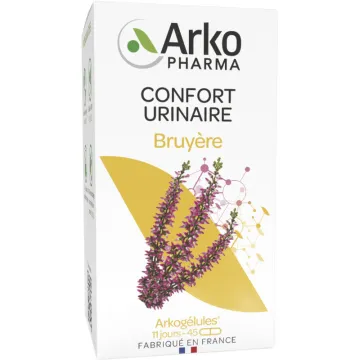
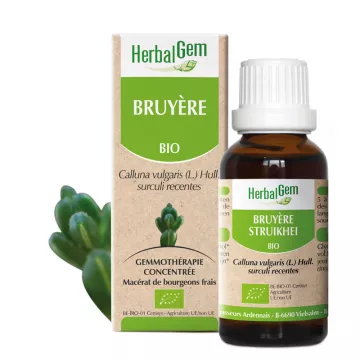
What is medicinal heather?
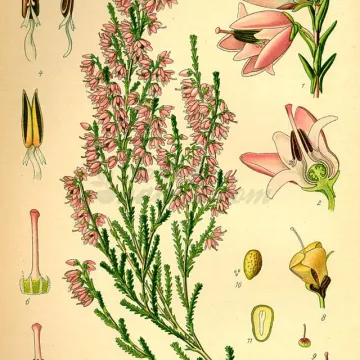
The medicinal heather most commonly used in herbal medicine is common heather (Calluna vulgaris), of the Ericaceae family. A cousin of the lingonberry and the blueberry, it carpets the Atlantic heathlands of Europe, Brittany, Scotland, and Scandinavia, giving the landscapes their pinkish-purple undulations in late summer. The flowering tops contain the highest concentration of active compounds: arbutin (a phenolic glycoside), flavonoids (quercetol, rutoside), tannins, and phenolic acids. This chemical profile explains its traditional use for urinary health and as a blood purifier.
What benefits does heather offer in herbal medicine?
Its traditional uses point to a gentle detoxifying profile:
- Support for urinary comfort and a mild antibacterial effect on the urinary tract;
- Mild diuretic effect via flavonoids;
- Support for functional urinary disorders and temporary urinary discomfort;
- Supports renal drainage as a follow-up to a detoxifying treatment;
- Traditionally recognized for soothing certain joint discomforts.
Heather is a plant best suited for maintenance and follow-up rather than for immediate treatment, making it ideal for long-term approaches as well as short courses of treatment.
Why does it support the urinary system?
Its urinary properties are based on three converging mechanisms:arbutin exerts a gentle antibacterial action after being metabolized by the liver and kidneys into hydroquinone; flavonoids provide a mild diuretic and antioxidant effect; tannins offer a soothing astringent effect on irritated mucous membranes. This versatility makes it a particularly valuable herb for urinary comfort in herbal medicine, used as an adjunct (never as a substitute) to medical treatment when it is required.
How does arbutin work in the urinary tract?
Arbutin is inactive in its native form. Once ingested, it crosses the intestinal barrier, passes through the liver where it is partially metabolized, and then concentrates in the urine, where it releases its active metabolite,hydroquinone. This compound exerts a moderate local antibacterial effect on pathogenic urinary flora. The effect is optimal in alkaline urine, which explains the traditional use of bicarbonate-rich mineral waters or alkalizing foods during treatment. This mechanism limits the duration of use: no more than 1 to 2 weeks without a break.
How should it be used as a treatment or as a tea?
The dosage forms depend on the intended use:
- Infusion of dried flowers: 1 to 2 teaspoons per 250 ml of simmering water, steep for 10 minutes, 2 to 3 cups per day;
- A mild decoction for a more concentrated effect;
- Capsules of standardized dry extract containing arbutin for a measured course of treatment;
- Mother tincture: 30 drops in a glass of water, 2 to 3 times a day;
- Typical treatment course: 7 to 10 days per month, to be repeated depending on the individual’s constitution, with plenty of fluids throughout the treatment;
- Available in organic herbal tea blends with other compatible purifying herbs.
What precautions should be taken with heather?
- Treatment should be limited to 1 to 2 weeks due to the presence of arbutin (which is metabolized into hydroquinone);
- Not recommended for pregnant or breastfeeding women or for children under 12 years of age;
- Contraindicated in cases ofrenal insufficiency or edema associated with decompensated cardiac or renal disease;
- Caution is advised when taking diuretics, antihypertensives, or anticoagulants;
- Known allergy to the Ericaceae family: avoid;
- Persistent burning sensation during urination, lower back pain, fever, or blood in the urine: seek medical attention immediately. Heather is not a treatment for confirmed urinary tract infections;
- Possible side effects (excessive use): digestive upset, nausea.
Which plants can be combined with heather?
Synergistic effects for urinary and detoxifying purposes depend on the individual’s condition:
- Bearberry as a short-term intensive treatment for highly recurrent conditions (but do not use it for extended periods: same arbutin mechanism);
- Cranberry to support overall urinary comfort over the long term;
- Hawkweed and goldenrod to enhance the diuretic and anti-inflammatory effects on the urinary tract;
- Orthosiphon and meadowsweet for conditions involving fluid retention;
- D-mannose for a targeted approach to preventing bacterial adhesion.