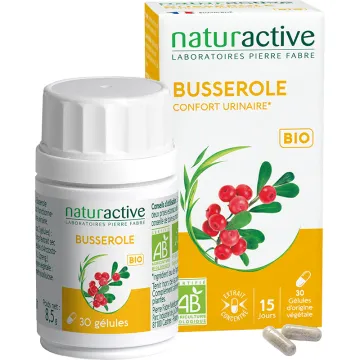
What is bearberry?
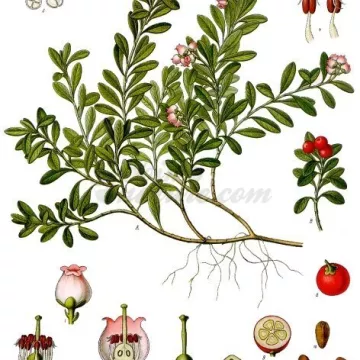
Bearberry, also known as bear’s grape or uva-ursi (Arctostaphylos uva-ursi), is a small evergreen shrub in the heath family ( Ericaceae) found in the poor, acidic soils of mountainous and northern regions of Europe. Its dark green, leathery, evergreen leaves contain up to 10–12% arbutin, one of the highest concentrations known in the plant kingdom. Together with gallic tannins, flavonoids (quercetol, myricitrin), and iridoids, these compounds make up the plant’s pharmacological profile. Bearberry has a dedicated EMA monograph for the treatment of benign urinary disorders in adult women.
What benefits does bearberry leaf offer?
Its traditional uses are narrowly focused:
- Support for mild, uncomplicated bacterial cystitis in adult women;
- Support for urinary comfort in cases of uncomfortable urination;
- Targeted antibacterial action in the urinary tract via arbutin;
- Mild astringent effect on urinary discomfort;
- Provides additional antioxidant support thanks to flavonoids.
Why is it considered the “queen of arbutin” plants?
No other medicinal plant contains as much arbutin as bearberry. Inactive in its natural form, arbutin is absorbed in the intestine, passes through the liver, and then concentrates in the urine, where it releases its active metabolite,hydroquinone. This compound exerts a local antibacterial effect on urinary tract bacteria (E. coli, Proteus, Staphylococcus). To maximize the effect, urine must be alkaline: avoid acidic fruit juices, coffee, and alcohol during the treatment; opt for bicarbonate-rich mineral water and green vegetables.
Does it really relieve mild cystitis?
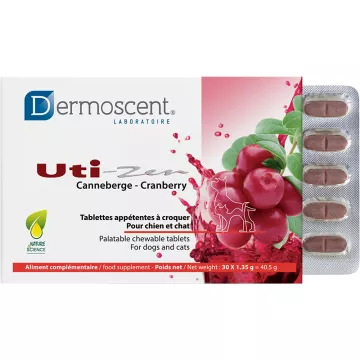
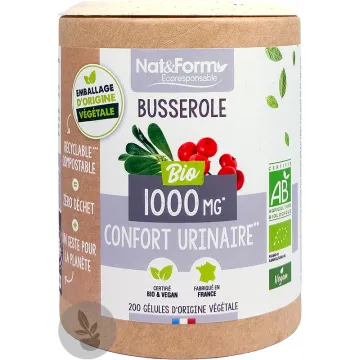
Yes, as part of a short, well-supervised initial treatment. The literature supports its use for simple bacterial cystitis in adult women, when combined with ample hydration. For recurrent urinary tract disorders, it can be part of a strategy that also includes cranberry (anti-adhesion effect) andlingonberry (general support). Any case of cystitis accompanied by fever, hematuria, or occurring in men, children, pregnant women, or as a recurrence requires immediate medical consultation—not self-treatment with bearberry.
How should bearberry be used as a short-term treatment?
Several dosage forms are available:
- Herbal tea made from dried leaves: 1 to 2 teaspoons per 250 ml of simmering (not boiling) water, steeped for 15 minutes, 2 to 3 cups per day;
- Cold maceration: 12 hours at room temperature, to limit the extraction of irritating tannins;
- Capsules of dry extract standardized to arbutin: 400 to 500 mg 2 to 3 times a day depending on the product, or approximately 400 to 700 mg of total arbutin per day;
- Mother tincture: 30 to 50 drops in a glass of water, 2 to 3 times a day;
- Maximum duration: 7 to 10 days per treatment course, up to 5 courses per year, with plenty of fluids (1.5 to 2 liters of water per day).
What precautions should be taken with bearberry?
- Strict duration: never exceed 7 to 10 days per treatment course (hydroquinone may be hepatotoxic at high doses or with prolonged use);
- Contraindicated for pregnant or breastfeeding women andchildren under 12 years of age;
- Contraindicated in cases ofrenal or hepaticinsufficiency;
- Caution is advised when taking diuretics, anti-inflammatory drugs, or anticoagulants;
- Possible side effects: nausea, vomiting (related to tannins), greenish discoloration of urine (benign);
- Topical application: Hydroquinone is prohibited for cosmetic use in the European Union (Regulation 1223/2009). Do not apply directly to the skin;
- Fever, lower back pain, blood in the urine: seek immediate medical attention.
Which plants can be combined with bearberry?
Urinary synergies depend on the phase:
- Cranberry to enhance the antibacterial effect during an initial treatment course;
- Heather as a gentle follow-up treatment (but do not combine them in the same treatment window: they share the same arbutin mechanism);
- Hawkweed and goldenseal to enhance urinary drainage and anti-inflammatory effects;
- Stinging nettle for diuretic and remineralizing effects;
- Acerola or vitamin C to support the immune system;
- D-mannose taken concurrently for cases of recurrent E. coli infection.