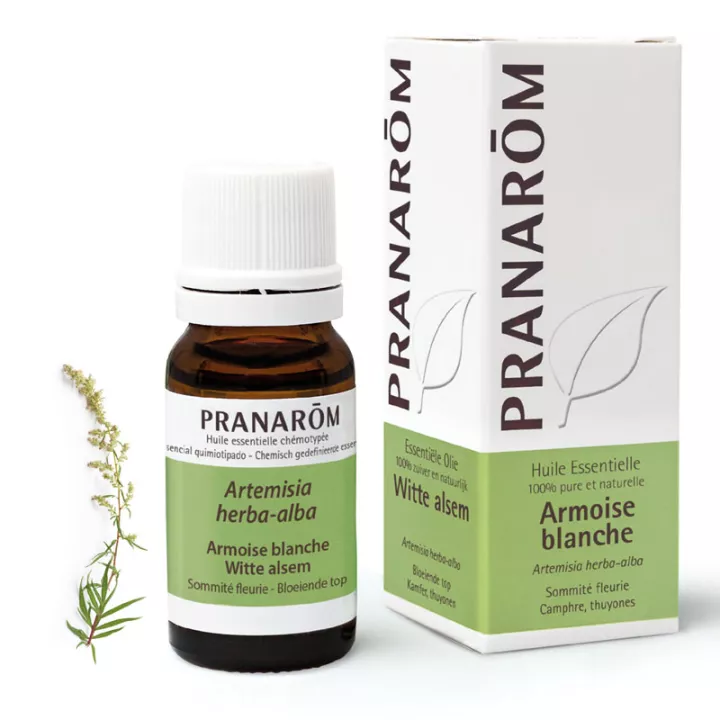
What is Pranarom White Mugwort Essential Oil used for?
Warning: This essential oil is subject to the pharmaceutical monopoly; it has a negative benefit-risk ratio according to Article D4211-13, Amended by Decree No. 2007-1198 of August 3, 2007—Art. 1 () JORF August 8, 2007; corrigendum in JORF August 18, 2007.
A large number of medicinal plants possess very interesting biological properties that find applications in various fields, namely: food (flavoring), perfumery (fragrant molecules), therapeutics (active ingredients), and cosmetics. The importance of medicinal plants stems from the extraction of the substances they contain, including essential oils.
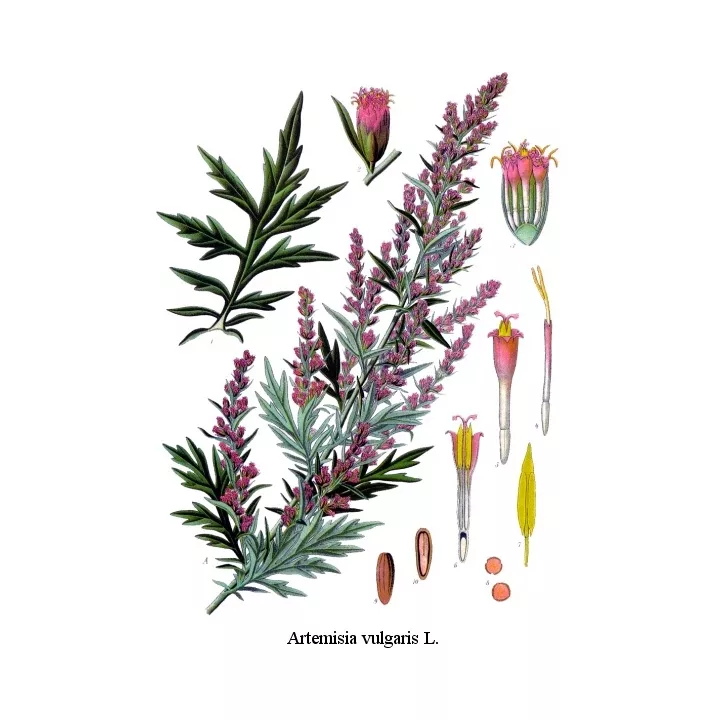
Known for millennia,white wormwood, orwhite mugwort, was described by the Greek historian Xenophon as early as the beginning ofthe 4thcentury B.C. in the steppes of Mesopotamia. It was cataloged in 1779 by the Spanish botanist Ignacio Jordán Claudio de Asso y del Río. It is primarily a forage plant, highly valued by livestock as winter pasture. It has a characteristic scent of thymol oil and a bitter taste, which gives it its astringent quality.
Pranarom’s White Mugwort essential oil is traditionally used for several conditions, including:
- Leucorrhea and Amenorrhea: This essential oil is often recommended to help regulate hormonal imbalances associated with excessive vaginal discharge and the absence of menstruation.
- Warts: It is also used for its antiviral properties in the treatment of skin warts.
- Respiratory Catarrhal Infections: White Mugwort is renowned for its effectiveness in treating respiratory infections, both in the upper respiratory tract (rhinitis, sinusitis) and the lower respiratory tract (bronchitis, pneumonia).
- Intestinal Parasitic Infections: It is often used to combat intestinal parasitic infections, particularly pinworm infection.
These traditional uses demonstrate the versatility of white mugwort essential oil in the field of natural health.
We also offercelery essential oil from Pranarom, a laboratory specializing in aromatherapy, at the best price in our online pharmacy.
How should this essential oil be used?
For topical use, diluted to a maximum of 10% in a vegetable oil.
Possible side effects and precautions
- Contraindicated for pregnant or breastfeeding women
- Do not swallow— Do not diffuse—Do not inhale—Never use undiluted—Never add to a bath.
- May cause skin sensitization upon contact. Avoid direct skin contact with the undiluted oil
- May cause lung damage if swallowed. If swallowed, do not induce vomiting: consult a doctor and show them the packaging
- For adult use only
- Use with caution in individuals with autoimmune diseases, epilepsy, asthma, the elderly, or those with Parkinson’s disease, as well as in individuals with sensitivity to essential oils
- Recommended for topical use only
- Risk of drug interactions; consult your pharmacist
- Do not use for prolonged periods without consulting a healthcare professional
- Keep out of reach of children
- Avoid contact with the eyes
- Never apply undiluted essential oils to the nose, ears, or anogenital mucous membranes
If you have hypersensitivity or a history of allergies, test the essential oil before use:
- Apply 1 to 2 drops of the selected essential oil to the crook of the elbow,
- wait 10 minutes,
- check for any skin reaction
- Do not expose yourself to the sun after applying an essential oil containing furocoumarins (essential oils extracted from citrus peels: lemon, mandarin, sweet orange, etc.). These essential oils are photosensitizing and greatly increase the risk of sunburn and skin burns.
- Essential oils containing phenols or rich in aldehydes are dermocaustic (harsh on the skin) and must be diluted in a vegetable oil at a ratio of 85% vegetable oil to 15% essential oil.
- Internal use of essential oils requires professional advice. In case of accidental ingestion: swallow vegetable oil and contact a poison control center.
- Essential oils are not soluble in water. For an aromatic bath, use a suitable dispersant (Labrafil, Labrasol, Disper) in an amount four times greater than the amount of essential oil. Do not exceed 10 drops of essential oil per 100 liters of water.
FAQ – Frequently Asked Questions
Can White Mugwort essential oil be used in a diffuser?
No, this oil is not suitable for diffusion. It is intended for diluted topical use or oral use only under medical supervision.
Is it safe for use by pregnant women?
No, this oil is strictly contraindicated during pregnancy and while breastfeeding.
Does it need to be diluted before applying it to the skin?
Yes, always. It must be diluted in a vegetable oil (at least a 90% dilution) due to its high content of potentially neurotoxic ketones.
Can it be taken orally?
Only under medical supervision. Oral use must be strictly monitored due to its complex biochemical composition.
What is its composition?
Ingredients:
Pranarom White Mugwort Essential Oil
Artemisia herba alba
Aromatic compounds: Camphor, thujones
Distilled parts: Aerial parts, inflorescences, flower heads
Packaging:
10 mL dropper bottle. Available at the best price in our pharmacy