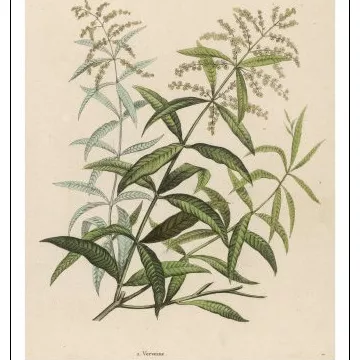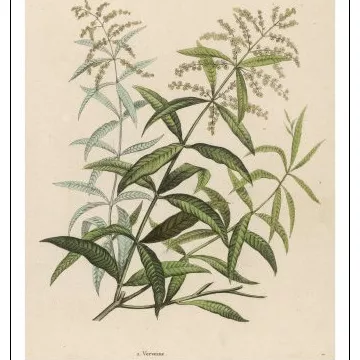
The name “verbena” refers to two very different plants in practice—and confusing them completely changes their uses and what you can expect from them.
Verbena officinalis (common verbena) is the classic medicinal verbena. Its leaves have a mild, almost bitter taste. It is recognized by the EMA/HMPC for supporting the body’s natural defenses and as a mild analgesic. This is the verbena listed in European pharmacopoeias—rarely used in herbal tea due to its taste, but found in extracts and mother tinctures.
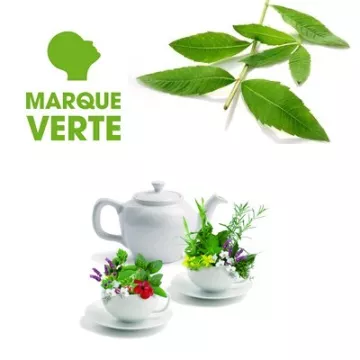
Aloysia citrodora (lemon verbena, lemon verbena, fragrant verbena) is the verbena that everyone knows as a herbal tea. Its intense lemony fragrance, digestive and soothing properties, and pleasant taste make it the verbena of choice in kitchens and herbal shops. It is also the source of the essential oil “exotic verbena”—see our exotic verbena page for aromatherapeutic uses.
This is the most commonly consumed form in France—and the one for which uses are most extensively documented in traditional herbal medicine.
Lemon verbena’s high content of flavonoids, verbascoside, and citrus-scented essential oils (citral, limonene) gives it a threefold action: digestive support, nervous system calming, and mild antioxidant properties. As an evening herbal tea, it combines a mild aroma with effectiveness—a rare balance among medicinal plants.
This is the oldest known use of verbena—and one of the most deeply rooted in European tradition.
The citral and geraniol in the leaves relax the smooth muscles of the digestive tract. Flavonoids and chlorogenic acid help support gastric motility. In practical terms, lemon verbena is the herb for “bellies that rumble after a good meal”—a mild carminative and moderate antispasmodic.
The herbal tea (A. citrodora, leaves) and “exotic verbena” essential oil are two products with very different profiles—even though their aromas are similar.
The herbal tea contains water-soluble compounds (flavonoids, verbascoside, chlorogenic acid)—mild, with no risk of photosensitization, and suitable for everyone.A. citrodora essential oil contains concentrated terpene aldehydes (citral 30–40%)—it is photosensitizing, potent, and must be used with precision. For skin care in the sun or during intensive diffusion, the essential oil requires precautions that the herbal tea does not.
Lemon verbena as a herbal tea is among the safest plants—precautions mainly concern concentrated extracts and the essential oil.