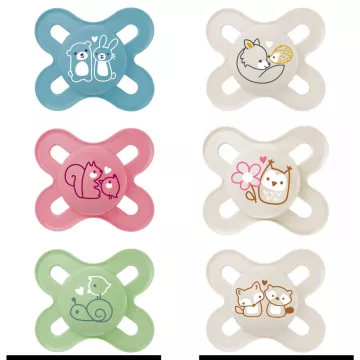
An orthodontic pacifier is a pacifier specifically designed to reduce the risk of misaligned teeth and support the proper development of the palate. Its nipple is flatter and thinner than those of traditional round pacifiers, with a slightly domed upper surface that rests against the palate and a flattened underside that accommodates the tongue.
This design distributes pressure more evenly across the dental arches, the palate, and the tongue. It is modeled after the physiological position of the mother’s breast during breastfeeding, promoting a sucking motion similar to that observed at the breast. While not entirely orthodontically neutral, it minimizes the impact of repeated sucking compared to traditional round models. For infants and infant colic in general, additional resources are available.
There are several reasons to choose an orthodontic pacifier. Preserving dental alignment remains the main reason: the flat shape of the nipple exerts less pressure on the incisors and reduces the risk of an open bite or high arch, which are common with prolonged use of traditional round pacifiers.
The orthodontic shape also supports proper tongue positioning in the mouth, which contributes to healthy oral development and swallowing. It also facilitates a more natural transition from the breast to the pacifier for breastfed babies, replicating sensations similar to those experienced during breastfeeding. Regardless of the model, no pacifier is completely neutral in terms of oral development: the benefit depends as much on the chosen shape as on the duration of use and the weaning schedule. Specific resources are available forbreastfeeding and for babies who tend to overeat in general.
An orthodontic pacifier can be introduced as early as the first few months, with some precautions depending on the feeding method. For breastfed babies, it’s generally recommended to wait until breastfeeding is well established (3 to 6 weeks, sometimes up to 1 month depending on the guidelines) to avoid nipple-pacifier confusion. For bottle-fed babies, it can be introduced earlier without any particular drawbacks.
Choosing a size appropriate for the baby’s age is essential for comfort and safety. Manufacturers generally offer three sizes: 0–6 months, 6–18 months, and 18 months and older, each designed to accommodate oral growth. A pediatrician’s advice is helpful when introducing a pacifier for the first time, particularly in cases of prematurity or sucking difficulties. For general regurgitation, specific resources are available.
The two types of pacifiers differ mainly in the shape of the nipple. The classic round pacifier has a spherical nipple that is identical on all sides and takes up more space in the mouth. It can exert continuous pressure on the incisors and, with prolonged use, may contribute to dental misalignment.
The orthodontic pacifier has a flattened, asymmetrical nipple that mimics the shape of the nipple in the mouth during breastfeeding. This design promotes a more physiological tongue position, more natural swallowing, and limits pressure on the dental arches. For everyday use, the orthodontic pacifier is now recommended by most pediatricians and pediatric dentists, though it is not an absolute requirement: the baby’s acceptance of it remains a decisive factor.
Several criteria ensure the quality and safety of an orthodontic pacifier:
Pacifiers sold at very low prices in supermarkets do not always meet all of these criteria: purchasing one at a pharmacy offers an additional guarantee of quality and safety. For infant formula and organic infant formula in general, specific resources are available.
Impeccable hygiene is essential for the child’s health and safety:
Signs requiring immediate replacement include significant discoloration, deformation of the nipple, cracks, tears, or loss of elasticity. Having several identical pacifiers to rotate between makes maintenance easier and reduces the risk of breakage.
Using an orthodontic pacifier during the teething period (generally from 4–6 months to 2–3 years) is safe and can even provide comfort in addition to appropriate teething rings. The gentle pressure on the gums from the nipple temporarily soothes gum pain.
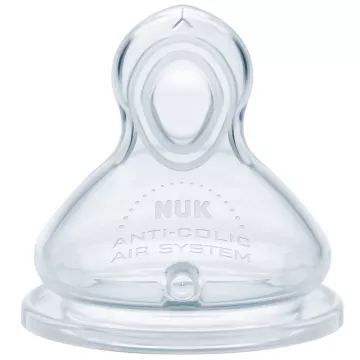
However, the teething period requires extra vigilance: emerging teeth can damage the nipple more quickly. Daily inspection is necessary to check for cracks, punctures, or loss of integrity. Replacement should then be more frequent, sometimes every 3 to 4 weeks. For babies who chew vigorously, some brands offer teats with reinforced durability.
If gum irritation is severe, well-tolerated alternatives include refrigerated food-grade silicone teething rings, gently massaging the gums with a clean, damp, cold washcloth, and consulting a pediatrician in case of persistent crying to adjust the care plan. Specific resources are available for irritated gums and sensitive gums in general.
Gradual weaning is recommended between the ages of 2 and 4 at the latest, according to recommendations from pediatric dentists. Beyond this age, even with an orthodontic pacifier, the risk of oral and dental complications increases significantly: open bite, high-arched palate, delayed speech development, impaired articulation of sounds, and recurrent middle ear infections.
Several strategies for gradual weaning can ease the transition:
A visit to a pediatric dentist around age 2–3 allows for an assessment of any potential oral health impacts and helps tailor the weaning schedule. Specific resources are available to support children’s sleep in general. Your pharmacist remains a valuable resource to help guide you through these different stages, in addition to regular pediatric checkups.