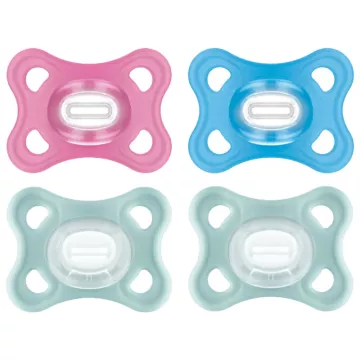
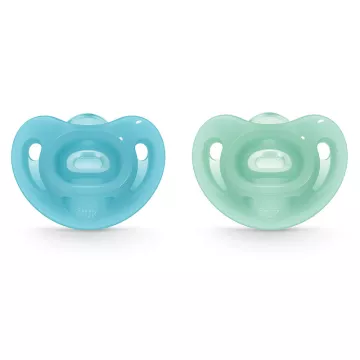
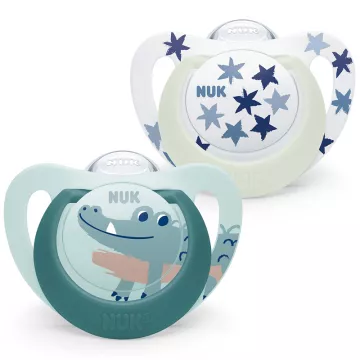
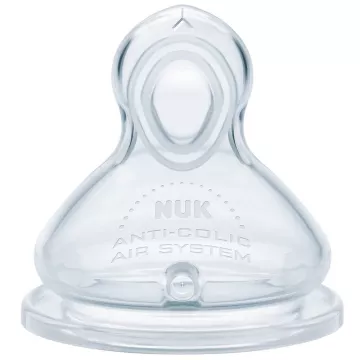
A physiognomic pacifier is a pacifier specifically designed to respect the natural anatomy of an infant’s mouth. Its nipple is shaped to conform to the palate, tongue, and gums in their physiological positions, without placing excessive pressure on the developing dental arches. The term “physiognomic” is often used as a marketing synonym for “anatomical” or “orthodontic,” depending on the brand, with no major difference in everyday usage.
Specifically, the nipple has an asymmetrical shape: a flat or slightly concave side facing the tongue and a convex side facing the palate. This design supports harmonious oral and dental development and minimizes the risk of malocclusion associated with prolonged use. For infants and infant colic in general, additional resources are available.
There are several reasons to choose a physiognomic pacifier. Preserving oral and dental development remains the main argument: the adapted shape limits pressure on the incisors, supports the physiological positioning of the tongue, and promotes harmonious swallowing. This reduces the risk of an open bite or a high-arched palate associated with prolonged use of traditional round pacifiers.
In terms of breathing, the orthodontic pacifier promotes proper mouth closure, which supports physiological nasal breathing. Chronic mouth breathing, on the other hand, can impair sleep quality and contribute to certain disorders. Comfort of use remains another key benefit: the nipple fits naturally in the mouth, without forcing or constricting, which helps the baby accept it. No pacifier, even an orthodontically designed one, is completely neutral from an orthodontic standpoint: the benefit depends as much on the shape as on the duration of use. For spitting up in general, specific solutions are available.
An anatomically shaped pacifier can be introduced as early as the first few weeks of life, with some precautions depending on the feeding method. For breastfed babies, it is recommended to wait until breastfeeding is well established (3 to 6 weeks, sometimes up to 1 month) to avoid nipple confusion. For bottle-fed babies, the pacifier can be introduced earlier without any particular drawbacks.
The need for non-nutritive sucking appears in the first few weeks and manifests as empty sucking motions or the baby seeking the breast between feedings. A pacifier can then provide useful comfort, in addition to other soothing methods (carrying, cuddling, rocking). Specific resources are available for babies who feed voraciously and forbreastfeeding in general.
Manufacturers generally offer three sizes tailored to the baby’s age and size:
Choosing the correct size is essential for safety (a pacifier that’s too large for a newborn can interfere with breathing or be positioned incorrectly) and for comfort. Switching to the next size at the recommended age supports natural development. A pacifier that is too small for an older child may also be ineffective or even swallowed.
Several criteria ensure the quality and safety of an ergonomically designed pacifier:
Pacifiers sold at very low prices in supermarkets do not always meet all of these criteria. Purchasing from a pharmacy offers an additional guarantee of quality and compliance with current standards. For infant formula in general, specific resources are available.
Impeccable hygiene is essential for the child’s health and safety:
Having several identical pacifiers on rotation makes maintenance easier and reduces the risk of breakage. Signs requiring immediate replacement include significant discoloration, deformation of the nipple, cracks, tears, or loss of elasticity. For irritated gums and sensitive gums in general, specific products are available.
Current guidelines consider the nighttime use of an anatomically shaped pacifier to be safe and may even offer protection against sudden infant death syndrome when used to help the baby fall asleep. However, several precautions must be taken.
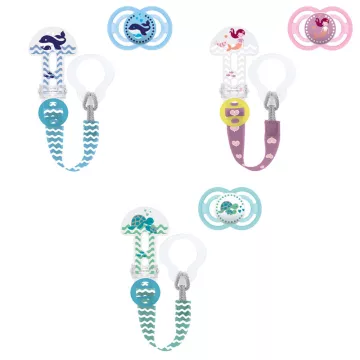
No string, chain, or fastener should be placed around the neck while sleeping: serious risk of strangulation. The baby should sleep on their back in a separate crib in the parents’ room during the first few months, without stuffed animals or thick blankets. Regularly checking the condition of the pacifier ensures safety. If the pacifier falls out during the night, quietly replacing it without fully waking the baby is ideal. Models with a flange or a glow-in-the-dark ring make it easier to find the pacifier in the dark. Specific resources are available for children’s sleep in general.
Pediatric dentists recommend gradually weaning the child off the pacifier between the ages of 2 and 4 at the latest. Beyond this age, even with an anatomically correct pacifier, the risk of oral and dental complications increases significantly: open bite, high arch, delayed speech development, impaired articulation, and recurrent middle ear infections.
Several gradual weaning strategies can ease the transition:
A visit to a pediatric dentist around age 2–3 allows for an assessment of any potential oral health impacts and helps tailor the weaning schedule. Your pharmacist remains a valuable resource to support these different stages, in addition to regular pediatric follow-ups.