What is molluscum contagiosum?
Molluscum contagiosum is a common viral skin infection caused by the molluscum contagiosum virus (MCV), a DNA poxvirus. It presents as small, round, firm, pearl-like, flesh-colored, shiny papules measuring 2 to 5 mm in diameter. A central depression (umbilication) is often visible at the center of the papule—this is the most characteristic clinical feature. The lesions may occur singly or in clusters. They primarily affectchildren between the ages of 1 and 10, but can also affect infants, adolescents, and adults (particularly those who are immunocompromised or in a sexual context).
This infection is benign and most often resolves spontaneously within a few months to 18–24 months, sometimes longer. It generally does not leave scars, unless the lesions have been repeatedly scratched or have developed a secondary infection.
How is molluscum contagiosum transmitted?
MCV is transmitted through several routes:
- Direct skin-to-skincontact with an infected person, primarily through contact with the lesions.
- Indirect contact via contaminated objects: towels, washcloths, sheets, linens, clothing, toys, sports equipment, tatami mats, and gym mats.
- Self-inoculation through scratching: spread of lesions to other areas of the same person’s body (viral Koebner phenomenon, common in children).
- Sexual transmission in adults with lesions on the genitals, pubic area, lower abdomen, or thighs—an STI screening is recommended in such cases.
- Water play and swimming contexts: transmission occurs primarily through shared towels, water toys, and surfaces, not through the water itself.
The incubation period is long (2 weeks to 6 months), which explains why the source of infection is not always identifiable. For the care of sensitive skin following exposure, gentle skincare routines that avoid scratching help limit the spread.
What are the symptoms of molluscum contagiosum?
Typical clinical signs:
- Round, firm, pearl-like, shiny papules, 2 to 5 mm (sometimes up to 10 mm) in diameter.
- Flesh-colored, pearly white, or pale pink.
- Characteristic central depression.
- Common sites in children: trunk, armpits, elbow and knee creases, face, legs, and sometimes the scalp. Less commonly, the palms and soles.
- In adults with sexually transmitted infection: genitals, pubic area, lower abdomen, buttocks, and inner thighs.
- Lesions are usually painless, though they may sometimes be itchy or irritated by friction from clothing.
- Molluscum contagiosum: an eczematous reaction around one or more papules (redness, scaling, localized itching)—common, can be misleading, and may be mistaken for isolated eczema.
- Course: New papules continue to appear until the immune system controls the infection, followed by gradual spontaneous resolution with a transient inflammatory reaction as each lesion heals.
Severe itching and scratching promote the spread of the infection—an important point to explain to the family.
How is molluscum contagiosum diagnosed?
The diagnosis is clinically straightforward in the vast majority of cases:
- Visual examination: typical appearance of a pearl-like papule with a central depression.
- Dermoscopy if there is any doubt (peripheral blood vessels, amorphous yellowish central structure).
- Skin biopsy or expression of the contents (central whitish corpuscle): rarely necessary.
- Differential diagnosis: common warts (rough, without a central depression), milia (white microcysts), juvenile xanthogranuloma, nevus, sebaceous cyst. In adults with multiple and atypical lesions: consider compromised immunity (particularly advanced HIV)—extensive forms with papules >1 cm are suggestive.
No systemic workup is necessary in the classic form seen in immunocompetent young children. In adults with anogenital lesions, an STI workup is recommended.
What are the treatment options for molluscum contagiosum?
Management is tailored according to age, immune status, location, number of lesions, discomfort, and cosmetic or social impact:
- Watchful waiting in immunocompetent children with few, well-tolerated lesions: spontaneous resolution is the norm. This option is often the most appropriate and avoids uncomfortable procedures on lesions that will resolve on their own.
- Curettage with a Brocq curette: the standard procedure in France for children, following the application of an EMLA anesthetic patch or cream (lidocaine + prilocaine) under occlusion for approximately 1 hour prior to the procedure. Performed by a dermatologist or pediatrician, by prescription. Highly effective and relatively painless thanks to local anesthesia.
- Cryotherapy with liquid nitrogen in a doctor’s office: brief application to each lesion. A temporary burning sensation may occur, sometimes accompanied by blisters. Several sessions may be necessary. Less suitable for very young children.
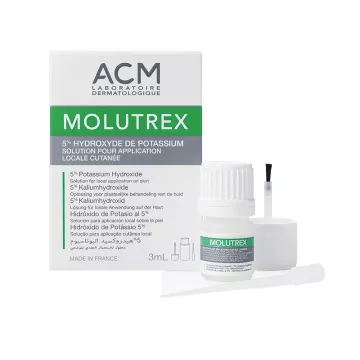
- 5–10% potassium hydroxide topical solution (e.g., Molutrex, available at pharmacies): Apply to each lesion 1 to 2 times a day until inflammation occurs, followed by scabbing. Use with caution, on limited areas, without spreading onto healthy skin. Careful reading of the package insert and consultation with a pharmacist are recommended.
- Imiquimod 5% cream: off-label use for this indication, by prescription, in certain specific situations. Efficacy data are controversial.
- Topical tretinoin, salicylic acid, podophyllotoxin (genital lesions in adults): by prescription, for specific indications.
- Cantharidin, cidofovir: options available outside France or reserved for specific cases in specialized settings.
Routine treatment is now being questioned in international guidelines: the benefit-risk balance of a procedure on a child must always be weighed together with the child and their parents, given that the lesions will resolve spontaneously. Conversely, active treatment is more readily recommended in cases of numerous, bothersome lesions on visible areas, in cases of underlying atopic eczema, or in cases of widespread involvement in adults or immunocompromised individuals.
How can the spread of molluscum contagiosum be prevented?
Several simple measures can limit transmission:
- Do not scratch, pierce, or squeeze the lesions (to prevent self-inoculation and spread).
- Cover exposed lesions with a soft bandage when participating in group activities (sports, swimming, pool, gym).
- Wash your hands regularly with soap and water, especially after contact with the lesions.
- Keep nails short to minimize scratching.
- Do not share personal items: towels, washcloths, bath linens, clothing, or water toys.
- Wash laundry at a minimum of 60°C whenever possible.
- Moisturize the skin regularly to maintain the skin barrier (important for atopic skin).
- Avoid swimming in public pools if the condition is widespread or there are numerous lesions; otherwise, cover them with a waterproof bandage.
- Occasional antisepsis of an accidentally eroded lesion (for example, with aqueous chlorhexidine).
- In adults with genital lesions: use protection during sexual intercourse, inform the partner(s), and undergo STI screening.
Which age group is most commonly affected by molluscum contagiosum?
The age groups most commonly affected:
- Children aged 1 to 10: peak incidence, due to social interactions, swimming pools, water play, and close contact.
- Infants andtoddlers: rarer before age 1, but possible—closely monitor without causing alarm.
- Adolescents and young adults: transmission is possible through skin-to-skin or sexual contact.
- Immunocompetent adults: uncommon, usually through family or sexual contact.
- Immunocompromised individuals (advanced, untreated HIV; transplant recipients; chemotherapy patients; severe atopic dermatitis): more extensive, persistent, and sometimes atypical forms (papules >1 cm = clinical sign).
Can molluscum contagiosum lead to complications?
The prognosis is generally excellent, but a few complications may occur:
- Bacterial superinfection (staphylococcus, streptococcus) on a scratched lesion: pustules, crusts, pain, and sometimes fever. See also “Infected Wounds” for treatment guidelines.
- Molluscum eczema: an eczematous reaction around the lesions; common; may require a short course of prescription topical corticosteroids.
- Scarring: rare when left to resolve on its own; possible after repeated scratching, secondary infection, or aggressive treatments.
- Spread through self-inoculation in children who scratch.
- Extensive, persistent, or atypical forms in immunocompromised patients: warrant further medical evaluation.
- Ocular and periocular involvement: may lead to follicular conjunctivitis or keratitis—an ophthalmological evaluation is recommended in cases of lesions on the eyelids.
Can you catch molluscum contagiosum at the pool?
Swimming is a reported mode of transmission, especially among children. However:
- The main risk is not the water itself but skin-to-skin contact, sharing towels and water toys, as well as surfaces around the pool (locker rooms, showers).
- There is no mandatory ban on swimming pool use under current regulations. It is recommended to cover lesions with a waterproof bandage, avoid sharing towels, swimsuits, or toys, and dry the skin thoroughly after swimming.
- For children with numerous lesions or lesions in areas that are difficult to cover, temporarily suspending group swimming may help limit the spread to other children.
- Wearing pool shoes, showering after each swim, and using your own towel are simple yet helpful precautions.
How can you tell the difference between molluscum contagiosum and warts?
Some useful clinical clues:
- Molluscum contagiosum: smooth, pearl-like, shiny papules with a central depression, flesh-colored, painless; caused by a virus of the poxvirus family.
- Commonwarts: rough, keratotic surface, sometimes cauliflower-like, without a central depression, more common on the fingers, the backs of the hands, and the knees. Caused by the HPV virus.
- Plantar warts: embedded in the sole, sometimes painful when weight is applied, with black dots (thrombosed capillaries).
- Flat warts: very small, barely raised, often multiple on the face and the backs of the hands.
- Other possibilities: milia, juvenile xanthogranuloma, nevus, epidermal cyst, lichen planus, and condylomas for genital lesions in adults.
In cases of clinical uncertainty, a dermatology consultation allows for an accurate diagnosis and guides the appropriate course of action.
Are there any natural treatments for molluscum contagiosum?
A few approaches are mentioned in popular cosmetic literature, with varying levels of evidence. None of these replace a medical consultation in cases of discomfort, spreading lesions, or diagnostic uncertainty:
- Tea tree essential oil: antiviral activity studied in vitro; limited clinical data. **Contraindicated in children under 7 years of age**; for older children, apply strictly to the affected area only, diluted to a maximum of 1% in a carrier oil; perform a patch test on the inner elbow for 24 to 48 hours. Take standard precautions for pregnant and breastfeeding women.
- Purealoe vera gel: has a soothing effect around the lesion, but no proven antiviral action.
- Regular skin moisturization with a well-tolerated emollient to preserve the skin barrier and reduce itching (particularly useful in atopic skin).
- Gentle cleansing with water and soap, without aggressive scrubbing.
Avoid:
- Pure apple cider vinegar, pure lemon juice, topical garlic: risk of chemical burns, irritation, and contact allergy, particularly on children’s skin.
- Attempts to manually extract lesions (with tweezers or fingernails): painful and likely to cause spread of the infection and secondary infection.
- Repeated application of alcohol-based antiseptics to large areas of a child’s skin.
- Pure essential oils on a child’s skin.
In cases of discomfort, spreading lesions, problematic locations, associated eczema, or simply a need for reassurance, consulting a doctor or dermatologist is the best course of action.