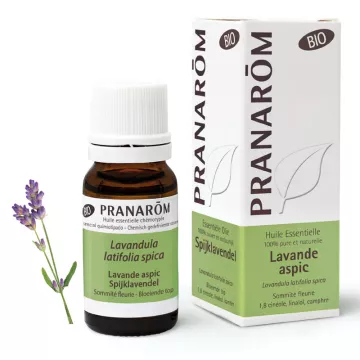
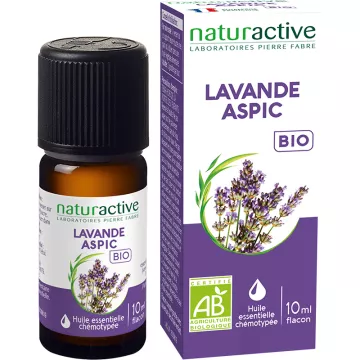
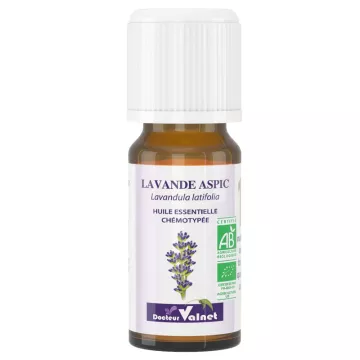
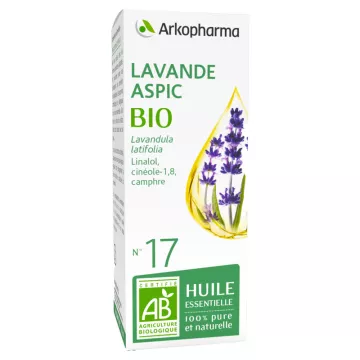
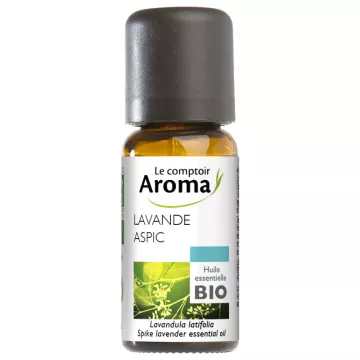
Spike lavender (Lavandula latifolia) is the lavender you reach for in a pinch: insect bites, minor burns, and muscle soreness after exercise. Its chemical profile—1,8-cineole (30–40%) + camphor (15–20%) + linalool—gives it a potency not found in true lavender —and that’s exactly why it belongs in your first-aid kit. Check out our range of products for burns and bruises and our essential oils for aromatherapy.
Spike lavender vs. true lavender: what’s the difference?
Same family, very different characteristics—it’s important to distinguish between them clearly.
- Spearmint lavender (L. latifolia): 1,8-cineole 30–40% + camphor 15–20% + linalool—a strong, camphor-like scent—active ingredients for muscles, emergency skin care, and respiratory health— not recommended for children or pregnant women
- True lavender (L. angustifolia): linalool + linalyl acetate 70–85% — sweet floral scent — sleep, stress, children as young as 3 months — very well-tolerated
- Aspic camphor can be neurotoxic in young children and infants—never use on children under 6 years of age
- Spike lavender is more concentrated and less expensive—it is not a substitute for regular lavender, but rather a complementary variety
Spike lavender and insect bites?
This is its most popular use—and one of the few instances where you can apply the pure essential oil topically and directly to the affected area.
- 1 to 2 drops undiluted directly on the affected area—provides rapid relief from itching and redness
- Mosquito, bee, and wasp stings—the combination of cineole and camphor instantly cools and soothes
- Multiple bites or large areas: dilute to 5% in a neutral vegetable oil—cover the entire area
- See our line of soothing gels for bites and insect repellents
- In case of a severe allergic reaction (significant swelling, difficulty breathing): call 15—essential oil is not a substitute for emergency medical care
Spearmint and muscle comfort?
The camphor in spike lavender makes it superior to true lavender for muscular applications.
- Muscle relaxant: 3–5% in arnica or St. John’s wort oil—massage with deep, gliding strokes on areas of muscle tension
- Post-workout soreness: camphor and cineole penetrate the tissues quickly—a cooling sensation followed by gradual relaxation
- Sports blend: spike lavender + wintergreen + lemon eucalyptus (3 + 2 + 2 drops) in 30 mL of arnica oil—complete recovery massage
- Muscle bath: 10 drops in a solubilizing base, warm bath for 15–20 minutes — deep relaxation after intense exercise
Spike lavender and skincare?
Its combination of cineole and camphor gives it a more potent purifying effect than true lavender.
- Minor burns and scrapes: 1–2 drops undiluted on the affected area — immediate cooling and relief for the skin
- Oily and acne-prone skin: 1% in jojoba oil — purifying and mildly astringent
- Oily or irritated scalp: 2–3 drops in shampoo — a keratoregulatory and purifying action more powerful than true lavender
- Repel lice naturally: a few drops behind the ears and on the nape of the neck, diluted in a light oil—see our anti-parasitic products
Spearmint and respiratory comfort?
Its 1,8-cineole makes it a significant respiratory active ingredient—less potent than eucalyptus, but with the added bonus of a floral note.
- A gentle expectorant and decongestant thanks to its cineole content—supports respiratory comfort during seasonal congestion
- Synergizes witheucalyptus radiata or ravintsara —diffuse for 20 minutes or use diluted for a chest massage
- Diffusion: 6 drops in a diffuser—purifies the air and releases a pleasant woody-camphor scent
- Inhalation: 3 drops in a bowl of hot water for 10 minutes—clears the upper nasal passages
Precautions to keep in mind?
- Children under 6 years old: strictly contraindicated—camphor can be neurotoxic—use true lavender instead
- Pregnant and breastfeeding women: not recommended—camphor and cineole cross the placental barrier
- Epilepsy: contraindicated—camphor can induce seizures at high doses
- Undiluted application: only on specific localized areas (insect bites, minor burns) — never on large areas without dilution
- Storage: in a dark bottle, away from heat — 2–3 years (monoterpenes are stable; camphor is less volatile)