Platelet aggregation inhibitor
aspirin
. Presentations . Composition . Indications . Contraindications . Be careful . Drug interactions . Pregnancy and lactation . Instructions for use and dosage . Tips . Adverse effects . Lexicon
KARDÉGIC 75: powder for oral solution (mandarin aroma); box of 30 sachets.
Reimbursed at 65%. - price: 2.05 euro (s).
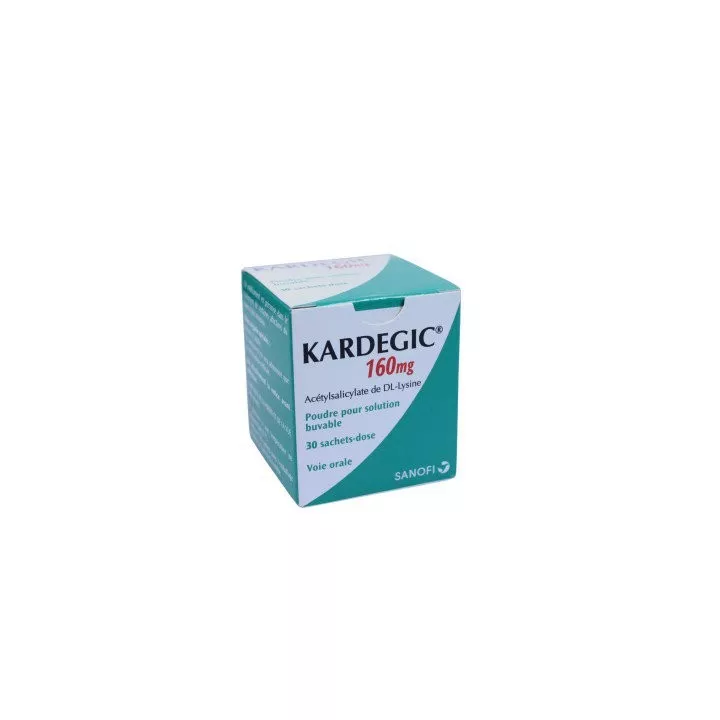
KARDÉGIC 160: powder for oral solution (mandarin aroma); box of 30 sachets.
Reimbursed at 65%. - price: 2.05 euro (s).
KARDÉGIC 300: powder for oral solution (mandarin aroma); box of 30 sachets.
Reimbursed at 65%. - price: 2.05 euro (s).
Sanofi-Aventis France Laboratory
| p bag | p bag | p bag |
| Lysine acetylsalicylate | 135 mg | 288 mg | 540 mg |
| either Acetylsalicylic acid (aspirin) | 75 mg | 160 mg | 300 mg |
This medicine contains aspirin, which has, among other properties, that of thinning the blood. This effect persists 4 to 8 days after stopping treatment.
It is used to prevent:
- recurrences of cardiovascular diseases caused by a blood clot in an artery ( myocardial infarction , stroke, etc.);
- complications after coronary bypass surgery.
This medicine should not be used in the following cases:
Aspirin is not a trivial medicine. Only your doctor can decide whether taking this medicine for a long time is justified by your condition.
Precautions are necessary in case of
history of stomach
ulcer or
duodenum , even old,
asthma ,
gout , moderate
renal or hepatic
insufficiency and in women who wear an IUD.
Aspirin can increase the length or amount of bleeding during menstruation.
Avoid taking this medication during the week before a tooth extraction or operation: increased risk of
bleeding .
This drug may interact with other drugs, including:
Also tell your doctor or pharmacist if you are taking a
corticosteroid or a medicine containing pentoxifylline or interferon alfa.
Pregnancy : Adverse effects on the mother and the unborn child have been demonstrated when aspirin (at a dose greater than 100 mg per day), like other
NSAIDs , is used during the last 4 months of pregnancy; the risk exists even with a single dose and even if the pregnancy is at term.
Consequently, apart from certain very specific medical situations requiring a low dose of aspirin (less than 100 mg per day), aspirin can only be used on an ad hoc basis during the first 5 months, and its use is contraindicated. indicated from the 6th month.
Feeding with milk : This medicine passes into breast milk. Breast-feeding is not recommended during treatment.
The contents of the sachet should be dissolved in a glass of water.
This medication can be taken before, during, or between meals, in 1 daily dose.
Usual dosage:
- Adult :
- Treatment of the acute phase of myocardial infarction or cerebrovascular accident : 1 sachet of KARDÉGIC 160 mg or 300 mg per day.
- Prevention in cardiology: 1 sachet of KARDÉGIC 75 mg or 160 mg or 300 mg per day.
- Prevention of cerebrovascular accidents: 1 sachet of KARDÉGIC 160 mg or 300 mg per day. Higher doses are in some cases necessary.
Regular use of this medication does not contraindicate the occasional intake of higher dose aspirin, during a headache or fever for example.
Gastritis , abdominal pain, bleeding from the nose or gums.
Rare and sometimes serious:
- bleeding from the digestive tract: bloody vomiting, black stools, or more often imperceptible blood loss, responsible for the gradual onset of anemia ;
- allergic accidents: urticaria , edema , asthma .
stroke
Damage to the brain caused by hemorrhage or sudden blockage of an artery. Depending on the extent of the lesion, the consequences are more or less serious: temporary discomfort, paralysis, coma.
Abbreviation: AVC.
NSAIDs
Abbreviation of nonsteroidal anti-inflammatory drug. A family of anti-inflammatory drugs that are not derived from cortisone (steroids), the best known of which is aspirin.
allergy
Skin reaction (itching, pimples, swelling) or general discomfort appearing after contact with a particular substance, use of a medicine or ingestion of food. The main forms of allergy are eczema, urticaria, asthma, angioedema and allergic shock (anaphylactic shock). Food allergy can also result in digestive problems.
anemia
Low level of hemoglobin in the blood, which most often results in a low number of red blood cells. Iron is essential for the synthesis of hemoglobin. Iron deficiency during pregnancy, a vegetarian diet, heavy or repeated bleeding (menstruation) is a common cause of anemia. Other, rarer causes are linked to deficiencies in group B vitamins.
antecedent
Affection cured or still evolving. The antecedent can be personal or family. History is the history of a person's health.
antiplatelet drugs
Medication that prevents platelets from sticking together and therefore clots from forming. The oldest antiplatelet agent is aspirin taken in small doses.
Antiaggregants should not be confused with anticoagulants which have a different mechanism of action.
anti coagulants
Drug that prevents the blood from clotting and therefore prevents the formation of clots in the blood vessels.
Anticoagulants are used to treat or prevent phlebitis, pulmonary embolism, certain heart attacks. They also help prevent blood clots from forming in the heart during rhythm disorders such as atrial fibrillation or in the event of an artificial heart valve.
There are two main types of anticoagulants:
- oral anticoagulants, which block the action of vitamin K (antivitamin K, or AVK) and whose effectiveness is monitored by a blood test: INR (formerly TP);
- injectable anticoagulants, heparin derivatives, the effectiveness of which can be monitored by the blood dosage of anti-Xa activity, Howell's time (TH) or Cephalin Kaolin time (TCK) depending on the products used. Regular dosage of blood platelets is necessary throughout the duration of use of a heparin derivative.
asthma
A disease characterized by difficulty in breathing, often resulting in wheezing. Asthma, permanent or seizure, is due to narrowing and inflammation of the bronchi.
corticosteroid
Substance close to cortisone. Natural corticosteroids, necessary for the body to function, are made by the adrenal glands. Synthetic corticosteroids, chemical derivatives of cortisone, are used as powerful anti-inflammatory drugs.
duodenum
Part of the intestine into which food from the stomach enters.
Gastritis
Inflammation of the stomach favored by stress, tobacco, alcohol and certain drugs such as aspirin or anti-inflammatory drugs.
drop
Disease manifested by redness and sharp pain affecting a joint (most often that of the big toe), due to an accumulation of uric acid crystals.
hemorrhage
Loss of blood from an artery or vein. Bleeding can be external, but also internal and go unnoticed.
myocardial infarction
Destruction of part of the heart muscle (myocardium), deprived of blood by obstruction of its arteries.
heart failure
Inability of the heart to perform its pump function. The main symptoms of heart failure are fatigue and shortness of breath during exertion.
Hepatic insufficiency
Inability of the liver to perform its function, which is essentially the elimination of certain waste, but also the synthesis of many biological substances essential to the body: albumin, cholesterol and coagulation factors (vitamin K, etc.).
renal failure
Inability of the kidneys to eliminate wastes or drugs. Advanced kidney disease does not necessarily result in a decrease in the amount of urine passed. Only a blood test and the determination of creatinine can reveal this disease.
edema
Accumulation of water or lymph causing localized swelling.
salicylates
Family of drugs, the best known of which is acetylsalicylic acid (aspirin).
ulcer
Hollow lesion of the skin, mucous membranes or cornea.
- Leg ulcer: chronic wound caused by poor blood circulation.
- Peptic ulcer: localized wound in the lining of the stomach or duodenum, due to excess acidity and very often to the presence of bacteria (Helicobacter pylori). The ulcer is favored by stress, alcohol, smoking and taking certain medications (aspirin, NSAIDs, etc.).
urticaria
Rash of pimples on the skin, the origin of which is most often allergic. The pimples look like nettle stings and vary in color from pale pink to red.