Introduction to Apis mellifica in Single-Dose Form
Apis Mellifica is an effective homeopathic remedy for treating various inflammatory and edematous conditions, as well as symptoms similar to a bee sting. Its indications are wide-ranging, from skin problems to eye and urinary tract conditions. The dosage varies depending on the severity and type of symptoms, but it is essential to consult a healthcare professional to obtain an appropriate and personalized treatment plan.
The scientific name Apis mellifica refers to the honeybee. For thousands of years, honeybees have been used in various fields.
The Egyptians treated several types of ailments using Apis mellifica. Having proven effective, this bee-based remedy has a wide range of applications.
Apis mellifica single-dose homeopathic remedy by Boiron: 4CH, 5CH, 7CH, 9CH, 12CH, 15CH, 30CH
French name: BEE (
) Authorized medication: Aut. 0678
Listed in the pharmacopoeia
Origin: Animal
Homeopathic medicine derived from the honeybee (Apis mellifica).
Properties of Apis mellifica in single-dose form
Apis mellifica is used in homeopathy to relieve pain.
This product is also indicated for treating rheumatism and has a wide range of applications in ENT to treat conjunctivitis and otitis.
Other Indications
Apis mellifica is also effective for treating:
- Fever: sudden onset, without thirst, accompanied by decreased urine output and infrequent urination. The skin is dry and hot.
- Sunstroke in the initial phase.
- Congestive headaches, meningeal reactions.
- Pain and inflammation of the ovaries, ovarian cysts, especially on the right side.
Indications for Apis mellifica as a single remedy
Apis mellifica is recommended for certain types of skin problems that may be related to insect bites. Apis mellifica is also effective against certain allergies such as hay fever or hives.
Apis mellifica is also used for: rheumatism, sore throat, burns, and conjunctivitis.
Indications in ENT
Apis mellifica has a wide range of applications in ENT.
This remedy is indicated for treating severe ear infections in children and adults, as well as ear discharge.
It is particularly effective and is the primary remedy indicated for treating several types of infections.
At the first signs of an ear infection—such as itching or the presence of a foreign object—it is recommended to seek treatment with Apis mellifica.
During treatment, strict hygiene must be observed.
In children, Apis mellifica is particularly effective for treating seromucous and viral ear infections.
Applications in Ophthalmology
Apis mellifica is indicated for individuals suffering from occasional and chronic conjunctivitis accompanied by chemosis, an inflammatory edema.
Note that these symptoms may be associated with eyelid deformity. Apis mellifica is also indicated for allergic and viral conjunctivitis, as well as conjunctivitis in infants.
In the latter case, it is imperative to consult a doctor immediately.
Apis mellifica is also recommended for the treatment of cysts, various forms of chalazion, or eyelid infections.
The remedy is recommended for several types of lacrimal duct infections.
Apis mellifica has proven particularly effective in treating styes.
If the condition worsens, consult a doctor immediately.
Use in Gynecology
In gynecology, Apis mellifica is used to treat ovarian inflammation.
Generally, these symptoms are caused by salpingitis (inflammation of the fallopian tubes) or ovarian cysts. When the patient reports pain in the ovaries, the remedy is particularly effective.
However, it is best to consult a specialist, especially if the woman is pregnant and experiencing pain in her ovaries.
Depending on the condition being treated, the dose of Apis mellifica can vary considerably.
Indications in Urology
Apis mellifica is indicated in urology, particularly for people experiencing difficulty urinating.
When the urine is dark in color, if the frequency of urination decreases, and the last few drops cause a burning sensation, the patient has urethritis or cystitis.
Note that urethritis is the most common condition.
Treatment in Traumatology and ENT
Apis mellifica is highly effective in treating pain caused by various conditions.
A patient who is exhausted, has a sore body, and experiences pain that intensifies with any touch should take Apis mellifica.
Furthermore, if the pain feels like a sting and the patient feels these stings suddenly shift location, treatment with Apis mellifica is essential.
Other Uses of Apis mellifica
Apis mellifica is effective against several types of conditions, such as sore throat and tonsillitis.
A patient with an inflamed glottis and throat, a “chestnut collar,” and difficulty swallowing should take Apis mellifica.
Guidelines for Using Apis mellifica
Regardless of the condition, Apis mellifica should not be taken in combination with any stimulating or excitatory substances such as coffee, tobacco, or mint.
Apis mellifica should also be taken between meals.
Single-dose packets and globules should be allowed to dissolve under the tongue.
Formulations administered to infants must be diluted in water.
Dosage of Apis mellifica
If the patient is experiencing acute episodes, take 5 globules in 9C or 15C at 10- to 15-minute intervals.
As the patient’s condition improves, the dosing intervals should be extended.
In chronic and subacute cases, administer 5 globules in 9 or 15 Ch, 2 to 4 times daily.
Apis mellifica Packaging and Contents
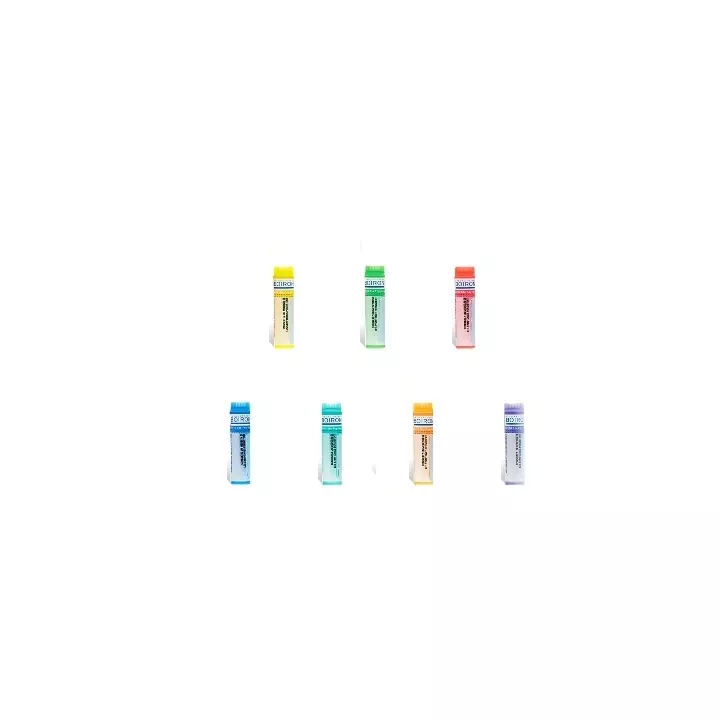
Translucent single-dose tube (allows you to see the remaining globules).
Each tube color corresponds to a dilution
Yellow 4CH, Green 5CH, Red 7CH, Blue 9CH, Sea Green 12CH, Orange 15CH, Purple 30CH
Weight: 1 g.
Precautions for Use of Apis mellifica
Warning
Contains sucrose. Store Apis mellifica homeopathic remedies away from light, heat, and moisture.
Administering Apis mellifica homeopathic globules to infants and children
For Apis mellifica globules or alcohol-based drops, dissolve them in 100 ml of water. Since the globules take a long time to dissolve, you should prepare the mixture in advance.
Homeopathy and Pregnancy
Homeopathic remedies have no chemical toxicity, no contraindications, no interactions with other medications, and no adverse effects related to the amount ingested. Pregnant women can use them without any known risk to themselves or their unborn child, but it is best to seek advice.
Frequency of Homeopathic Use
For acute conditions, it is recommended to take Apis mellifica homeopathic remedies every hour until symptoms improve. Once symptoms improve, doses should be spaced out to 3 or 4 times a day, then gradually discontinued.
For chronic conditions, Apis mellifica remedies in low dilutions (>9CH) are taken 1 to 2 times a day, while Apis mellifica constitutional remedies are taken once a week or even once a month. This decision is up to the homeopath.
What to Do If There Is No Improvement with Apis mellifica Within 24 Hours
Certain conditions cannot be treated homeopathically through self-medication alone. Their severity requires medical advice, which can be provided by a homeopathic physician. This physician will determine whether your condition can be treated with homeopathy alone or if your treatment needs to be supplemented with allopathic medicine.