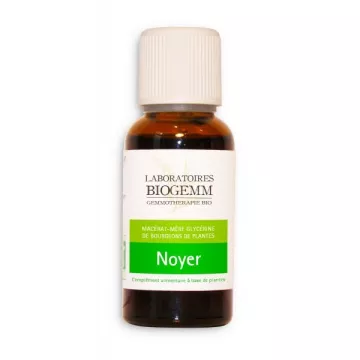
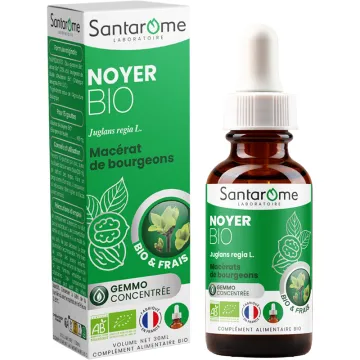
The common walnut tree (Juglans regia) is a large tree in the Juglandaceae family, native to Central Asia and Iran, and cultivated in Europe since Roman times. Growing up to 25 meters tall, it provides herbal medicine with several valuable parts: its leaves, bark, husks (the green outer shell of the nut), buds, and, of course, its nuts. Its chemical signature is based on juglone (a naphthoquinone characteristic of the family), along with gallic tannins, flavonoids, and phenolic acids. It is listed in the European Pharmacopoeia.
Its traditional and nutritional uses cover a wide range:
Juglone (5-hydroxy-1,4-naphthoquinone) is the signature molecule of the walnut tree. Naturally present in the leaves, twigs, and roots, it has recognized antibacterial, antifungal, and antiparasitic properties, which have been studied in particular against Candida albicans and certain intestinal parasites. This characteristic explains the traditional use of walnut leaves to treat digestive fungal infections, intestinal imbalances, and certain superficial skin fungal infections. At high doses, juglone can be irritating; this is why treatment courses are always short.
Walnuts are one of the few plant-based foods that naturally contain high concentrations ofalpha-linolenic acid (omega-3 ALA): approximately 9 g per 100 g, which is more than other nuts. This essential fatty acid, along with polyphenols (ellagitannins) and vitamin E, helps maintain healthy blood lipid levels as part of a varied diet. The EFSA recognizes the claim “ALA helps maintain normal cholesterol levels” at a dose of 2 g/day, which can be achieved by consuming about 25 to 30 g of walnuts.
Yes, through a two-fold mechanism. Astringent tannins tighten the intestinal lining and soothe mild diarrhea and feelings of irritation. Juglone provides a beneficial local antimicrobial effect in cases of intestinal imbalance. The leaves are thus part of phytotherapeutic approaches for sensitive digestion, used as an adjunct (never as a substitute) to medical care in cases of persistent symptoms.
Yes. Walnut husk—the green shell that surrounds the nut—is rich in juglone and highly pigmented tannins. When macerated in alcohol or used as a decoction, it has been used for centuries to color brown or auburn hair, intensify highlights, and conceal the first gray hairs without resorting to chemical dyes. It is also used in certain natural textile dyes and even in the production of the traditional liqueur “ratafia” and the Italian “nocino.”
The dosage forms depend on the intended use:
Synergies depend on the specific area being treated: