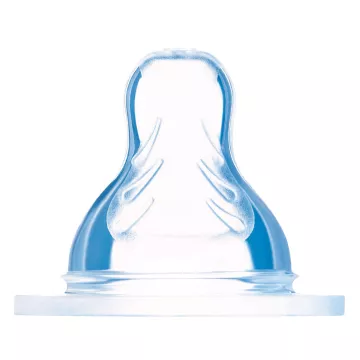
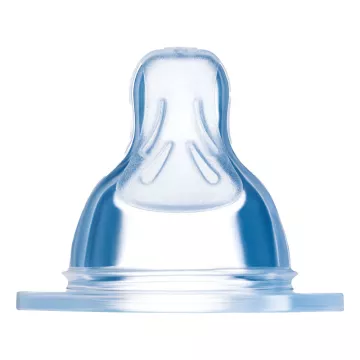
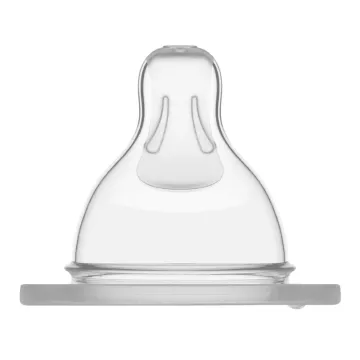
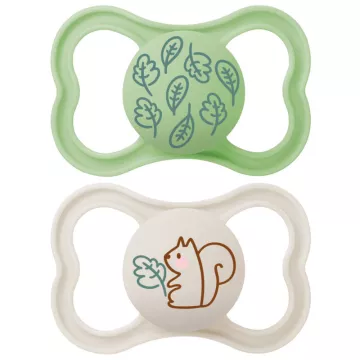
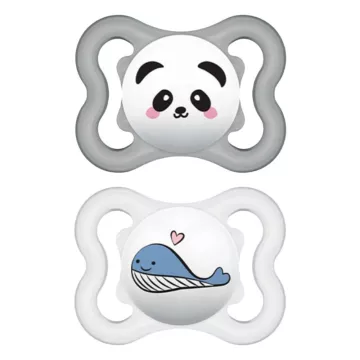
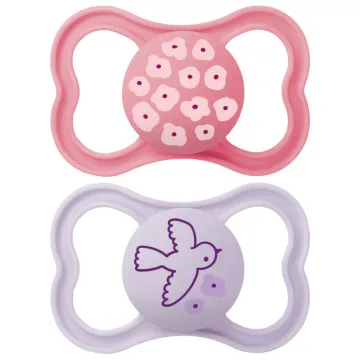
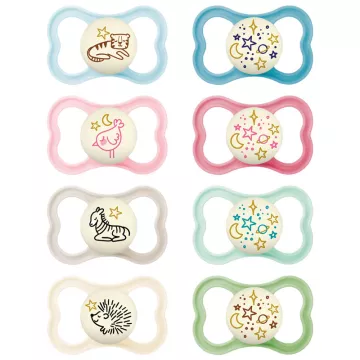
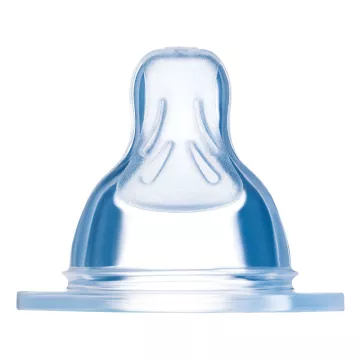
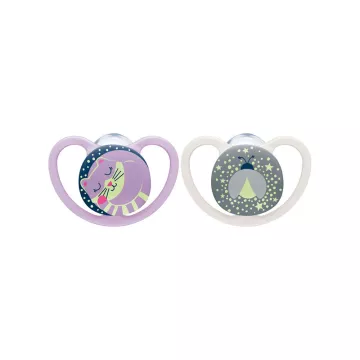
A pacifier, also known as a dummy, is a baby care accessory designed to satisfy an infant’s non-nutritive sucking need. It consists of a silicone or natural latex nipple attached to a flat base and a grip ring. Its design ensures comfort, soothing, and safety for the baby.
Beyond its soothing role, the pacifier fulfills a fundamental physiological need: sucking provides comfort, a sense of security, helps the baby fall asleep, and supports the infant’s emotional regulation. Several studies have also documented a protective effect of pacifiers used at bedtime against sudden infant death syndrome (SIDS). While not essential, pacifiers can be a useful tool to complement other soothing methods (carrying, cuddling, rocking). For infants and infant colic in general, additional resources are available.
Several criteria guide the choice of a suitable pacifier:
It’s often necessary to try several models before finding one that your baby accepts. The right shape and material vary depending on individual preferences. For babies who are big eaters or who frequently spit up, specific products are available.
When introducing a bottle, most pediatricians and lactation consultants recommend waiting until breastfeeding is well established—3 to 6 weeks after birth—to avoid nipple confusion in breastfed babies. For bottle-fed babies, pacifiers can be introduced earlier without any particular drawbacks.
For weaning, pediatric dentists recommend a gradual approach between the ages of 2 and 4 at the latest. Beyond that age, prolonged use can contribute to an open bite, a high-arched palate, delayed language development, impaired articulation, and recurrent middle ear infections. The gradual approach involves first limiting pacifier use to bedtime, then to naps only, and finally discontinuing it completely, while involving the child in the process through symbolic rituals. Specific resources are available regardingbreastfeeding in general.
Impeccable hygiene is essential for the infant’s health and safety:
Having several identical pacifiers on rotation makes maintenance easier and minimizes breakage. For infant formula in general, specific resources are available.
Several international studies have documented a protective effect of pacifiers used at bedtime against sudden infant death syndrome (SIDS). The mechanisms suggested include maintaining a favorable airway position, a lower arousal threshold in the event of apnea, and shallower REM sleep. This protective effect is now included in official prevention guidelines.
Several precautions apply to this nighttime use:
For breastfed infants, it is recommended to introduce a pacifier once breastfeeding is well established to avoid nipple-pacifier confusion. Specific resources are available regarding children’s sleep in general.
A pacifier should be replaced regularly, on average every 4 to 8 weeks, and immediately upon the first signs of wear. Several signs indicate the need for immediate replacement:
The teething period requires extra care: emerging teeth can damage the nipple more quickly, sometimes making replacement necessary every 3 to 4 weeks. For irritated gums and sensitive gums in general, specific products are available.
Moderate and time-limited use of a pacifier does not significantly affect an infant’s dentition. Orthodontic risks primarily arise with prolonged use beyond 2–3 years, and are more pronounced beyond 4 years of age. Possible consequences include an anterior open bite (where the front teeth no longer touch), a high-arched palate, crooked teeth, delayed speech development, and impaired articulation.
Choosing a physiognomic or orthodontic-shaped pacifier limits these effects compared to traditional round models, thanks to a more even distribution of pressure on the palate and dental arches. However, the duration of use remains the most decisive factor. A consultation with a pediatric dentist around age 2–3 allows for an assessment of any potential effects and helps tailor the weaning schedule.
Several precautions should be followed regarding daily pacifier use:
Your pharmacist remains a valuable resource to help you choose and use the right pacifier for your child, in addition to regular pediatric follow-up.