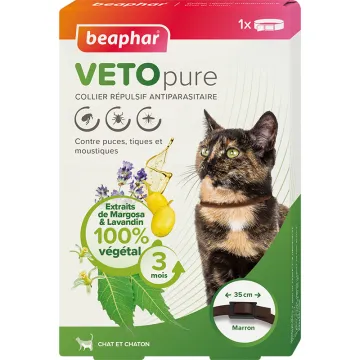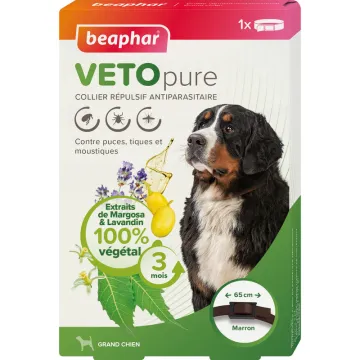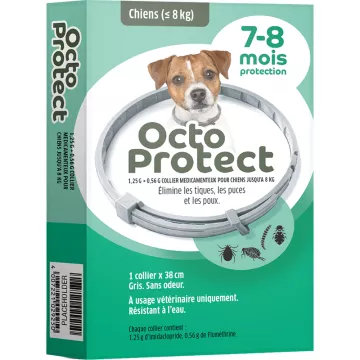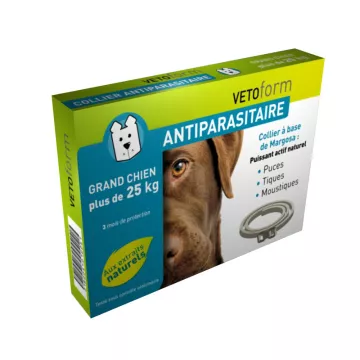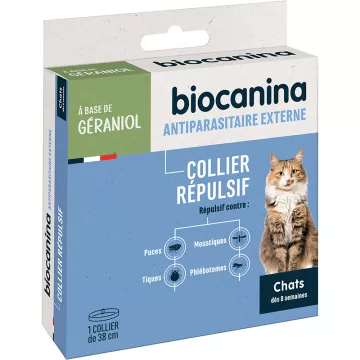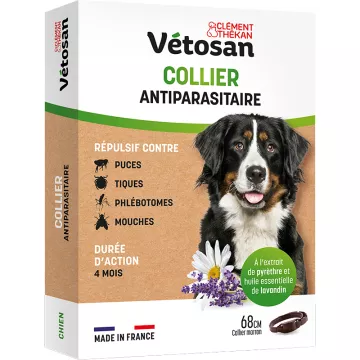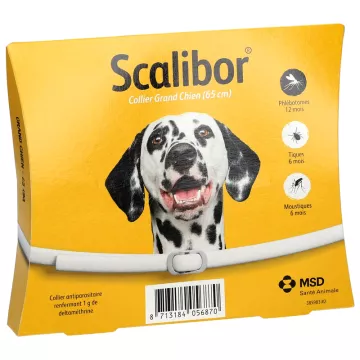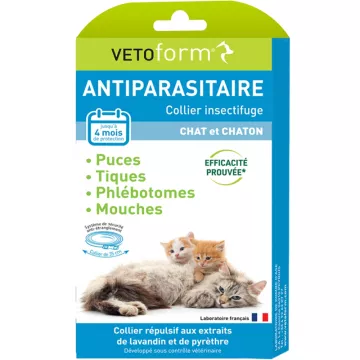
Pest-repellent collars continuously release an active ingredient from an impregnated polymer matrix. Unlike spot-on treatments (one-time application), the collar provides continuous protection for as long as it is worn—1 to 3 months for formulas containing essential oils, and 4 to 8 months for collars containing synthetic insecticides (deltamethrin, flumethrin, propoxur). The active ingredient is released through the skin and as repellent vapors upon direct contact. The head, neck, and shoulders receive enhanced protection, making the collar the ideal complement to spot-on treatments, which provide better coverage for the rear of the body. External parasites such as fleas and ticks are thus repelled or killed as soon as they attempt to attach themselves to the animal.
Canine leishmaniasis is transmitted by sand flies (small dipterans active at dusk) in southern France and the Mediterranean region. The only collar with a specific marketing authorization for protection against sand flies is the deltamethrin collar (6-month duration)—its effectiveness is based on its repellent action and rapid insecticidal effect upon contact, significantly reducing bites. For dogs living in or traveling to endemic areas (Var, Alpes-Maritimes, Languedoc, Corsica, Spain), its use is strongly recommended as a supplement to Leishmania vaccination. Collars containing natural essential oils do not provide sufficient protection against this specific vector.
The choice depends on the risk profile and care preferences:
For common parasites in non-endemic areas, natural collars are a valid option provided they are replaced regularly. For hunting dogs or those living in high-risk wooded areas, a broad-spectrum synthetic collar remains the safest choice.
A collar used incorrectly can be ineffective or dangerous. It should be adjusted so there is a two-finger gap between the collar and the skin—neither too tight (risk of skin irritation and contact alopecia) nor too loose (insufficient diffusion). Never cut the collar—this damages the matrix and reduces the duration of protection. Washing the animal with a degreasing shampoo can accelerate the loss of the active ingredient. Never put a dog flea and tick collar on a cat without checking first—certain formulations (permethrin, propoxur) are toxic to cats even through indirect contact. Internal parasites are not covered—a supplemental dewormer is still essential for complete protection.
The combination of a collar and a spot-on treatment offers the most comprehensive protection against parasites. The collar provides continuous protection for the head, neck, and shoulders and maintains a constant repellent effect between spot-on applications. The spot-on treatment provides better coverage of the rear of the body and takes effect quickly after application. This combination is particularly recommended during periods of high parasite pressure (May through October) and for highly exposed animals. Supplementing this regimen with a treatment for intestinal worms (which are sometimes transmitted by fleas ingested during grooming) completes this comprehensive protocol.
Repellent collars, even the most effective ones, have limitations that are important to understand. Their protection is localized around the area where the collar is worn—a dog that swims regularly or has a very thick coat may experience reduced effectiveness. In cases of confirmed infestation already established in the environment (flea larvae and eggs in bedding, rugs, and sofas), the collar alone will not be sufficient to eliminate the colony—insecticide treatment of the environment is essential in conjunction with the collar. In areas with very high endemicity for leishmaniasis, some veterinarians recommend combining a deltamethrin collar, an anti-Leishmania spot-on treatment, and vaccination for maximum protection. Parasitic infections should always be treated under the guidance of a veterinarian, who will tailor the treatment protocol to the specific circumstances and medical history of the animal.