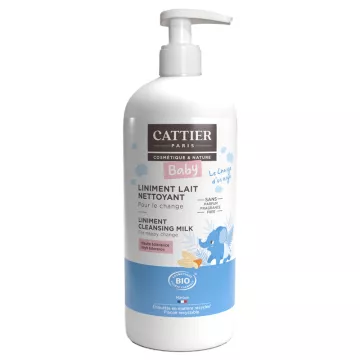
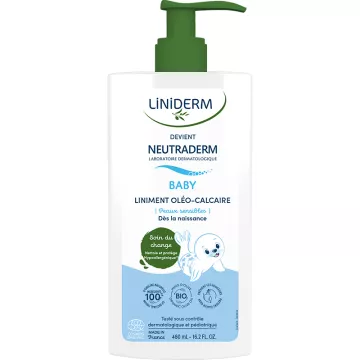
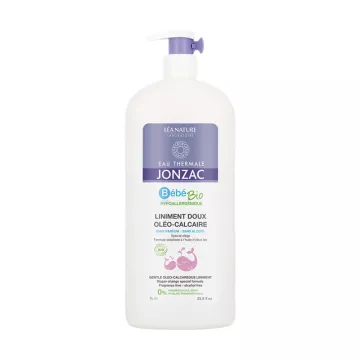
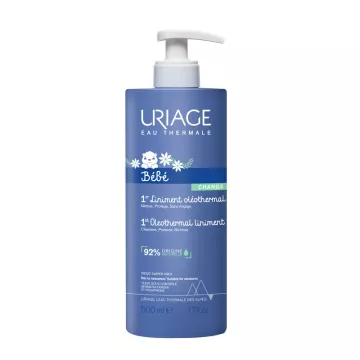
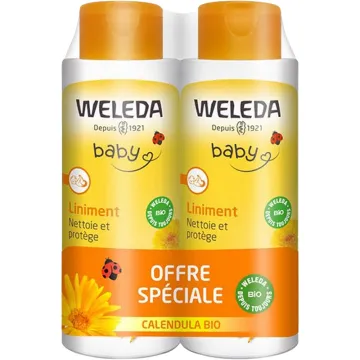
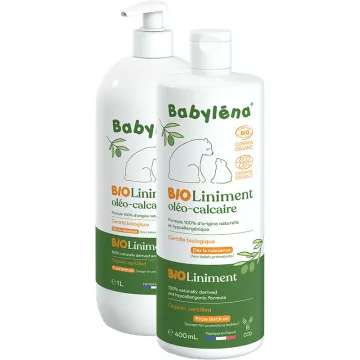
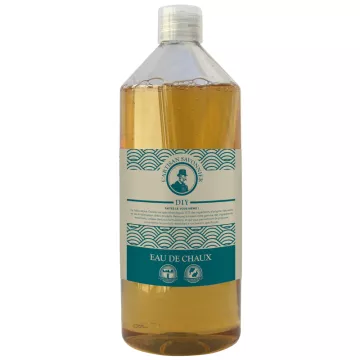
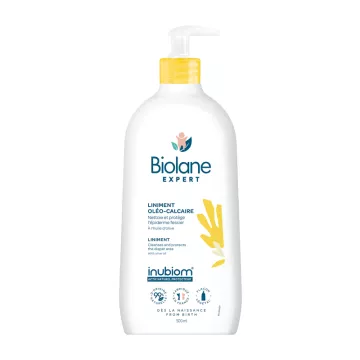
What is an oil-lime liniment, and what is it used for?
Oleo-calcareous liniment is a traditional emulsion composed of equal partslime water (calcium hydroxide) andvegetable oil, typically olive oil. Highly valued for changing infants’ diapers, it combines several properties:
- Gentle cleansing action: removes stool and urine without irritating the skin
- Moisturizing action thanks to plant-based fats
- An alkaline pH that helps neutralize the acidity of urine and stool, a source of irritation
- A protective film that shields the skin from residual moisture
- Minimalist formulation, traditionally free of synthetic preservatives
It fits naturally into your daily baby-changing routine.
How do you use the liniment for baby care?
Application is quick and easy:
- Shake the bottle well before each use to re-homogenize the emulsion (the layers may separate)
- Apply a generous amount to a cotton pad or washable wipe
- Gently clean the diaper area, skin folds, and genital area
- Do not rinse: the oily film left behind continues to protect the skin
- Pat dry if necessary to absorb excess product
- Reapply with each diaper change for optimal protection
In case of heavy bowel movements, a preliminary cleaning with lukewarm water can be added to the routine. For babies prone to dry skin, daily application provides long-lasting comfort for the skin.
Can the liniment be used by adults?
Yes, the liniment can also be used by adults for several purposes:
- Gentle makeup removal, especially for sensitive or reactive skin
- Facial cleansing for skin that is intolerant to soap
- Moisturizing dry skin on the body
- Soothing care for sun-exposed skin (in addition to an appropriate sunscreen)
- Comfort for skin prone to atopic conditions as part of a daily skincare routine
For established skin conditions (eczema, psoriasis), the liniment can be used as part of daily skincare but is not a substitute for treatments prescribed by a dermatologist. Its simple formulation makes it a popular alternative to conventional cleansers.
What are the advantages of liniment compared to other products?
Several benefits explain its enduring success:
- Minimalist formula: 2 main ingredients, clearly listed and easy to understand
- Free of long-chain parabens, sulfates, fragrance, and phenoxyethanol in the classic versions
- Versatility: skincare, cleansing, and protection in a single step
- No rinsing required: convenient for travel
- Economical to use
- Eco-friendly approach: reusable bottles, refills, zero-waste compatible
- Excellent tolerance on the vast majority of skin types
- Long-standingpharmaceutical tradition, a testament to proven effectiveness
It perfectly complements the baby cleanser for a consistent hygiene routine.
How to choose a good liniment?
Several criteria guide your choice:
- A short list of ingredients: lime water, olive oil (or another vegetable oil), and possibly a mild emulsifier
- Organic certification (Cosmebio, Ecocert, Cosmos Organic) to guarantee the quality of the oils
- Fragrance-free, alcohol-free, and free of harsh preservatives
- Free of essential oils for use on children under 3 years of age
- Free of phenoxyethanol in products for infants’ diaper areas (prohibited under EU Regulation 2019/1257)
- May contain soothing extracts: calendula, chamomile; ensure that safety for infants is documented
- Opaque or glasspackaging to protect the oils from light
- Label stating “tested under pediatric and dermatological supervision”
Does liniment have any side effects?
The liniment is generally very well tolerated, even by sensitive skin. A few precautions:
- Rare allergic reactions to added plant extracts (calendula, chamomile)
- Possible hypersensitivity to olive oil in some cases (allergy to the Oleaceae family)
- A tolerance test is recommended on the inner elbow 48 hours before first use
- Monitoring after application: any unusual redness, itching, or rash warrants discontinuation
- Strictly follow storage instructions: a degraded liniment may become irritating
If in doubt or if a reaction persists, ask your pharmacist for advice or consult a pediatrician.
Can you make your own homemade liniment?
You can make it at home using two ingredients:
- 50% lime water (calcium hydroxide, available at pharmacies)
- 50% organicvegetable oil: olive, sweet almond, or coconut (as a vegan alternative)
- Mix in a clean bottle and shake vigorously until emulsified
- Store in a cool place, away from light; recommended shelf life is 2 to 3 months
- Label with the date of preparation
For use on babies under 3 years of age, do not add any essential oils (strictly contraindicated). Vegan versions using coconut or sweet almond oil retain the same cleansing and protective properties. For ready-to-use, guaranteed products, check out our baby liniment section.
Is liniment suitable for a baby’s face?
Yes, liniment can be applied to an infant’s face as long as you follow a few guidelines:
- Choose a simple formula free of allergenic plant extracts and fragrance
- Apply a thin layer to a cotton pad
- Avoid the eye area and mucous membranes
- Test it first on a small area
- Monitor for skin reactions
For cradle cap, however, a specific plant-based oil is more appropriate. Liniment is better suited for cleaning stains on the face and neck (spit-up, food).
Can liniment be used daily?
Yes, daily use is perfectly suitable:
- At every diaper change to prevent diaper rash
- Daily for cleansing the face and bottom
- Compatibility with other skincare products (moisturizers, specialized treatments)
- No problematic buildup with regular use
- Maintains long-termskin balance
For babies with dry or atopic skin, the liniment can be used in combination with an emollient cream applied immediately afterward to lock in moisture.
How should liniment be stored?
To preserve its effectiveness:
- Make surethe airtight container is tightly closed after each use
- Store away from light and heat (ideally 15 to 25 °C)
- Do not store homemade linimentsin a very humidbathroom
- Follow the "Use By" date (PAO ) indicated on commercial products
- Homemade liniments: Use within 2 to 6 months, depending on the ingredients
- Shake before each use to re-homogenize the emulsion
- Check before use: smell, texture, color—if any changes are noticed, replace the product
Does liniment help with diaper rash?
Liniment plays a recognized role in preventing diaper rash:
- Gently cleanse the area with each diaper change
- Partiallyneutralizes the acidity of urine and stool
- Formsa protective film that shields the skin from moisture
- Maintains a skin barrier against irritants
- Compatible with a zinc oxide-based cream in cases of established redness
For existing diaper rash, the liniment can be used alongside a specific zinc oxide-rich cream. If the redness persists for more than 3 to 5 days, oozes, or has white spots (suggesting a fungal infection), a pediatrician’s consultation is necessary to determine the appropriate treatment.