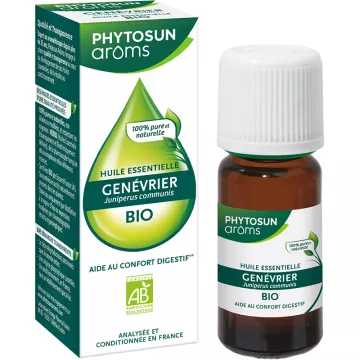
Juniper essential oil (Juniperus communis, berries) is extracted by steam distillation from the berries of the common juniper—an essential oil distinct from that of the twigs, which is more resinous. Its profile, rich in α-pinene (20–40%), sabinene, and terpinene-4-ol, gives it diuretic, antiseptic, and muscle-relaxing properties that complement those of cypress and cedar. Explore our aromatherapy line.
What is juniper essential oil?
Juniper berry essential oil (Juniperus communis, berries, extracted by steam distillation) has a biochemical profile distinct from that of the essential oil derived from the twigs of the same shrub—it is more concentrated in terpinene-4-ol, which is primarily responsible for its diuretic and urinary antiseptic properties. Its complete composition: α-pinene (20–40%), sabinene (10–20%), myrcene, limonene, terpinene-4-ol (5–15%). This last compound is also the main active ingredient in tea tree essential oil—which explains the similarities in antiseptic properties between the two essential oils. It should be distinguished from the essential oil of Juniperus virginiana (Virginia cedar) or Juniperus oxycedrus (cade)—closely related species but with different uses.
Juniper and urinary comfort?
Terpinen-4-ol is the key molecule responsible for juniper’s urinary effects.
- Documented diuretic effect: increased urine output through its action on glomerular filtration — supports normal urinary tract health (traditional use, HMPC-EMA)
- Urinary antiseptic: terpinene-4-ol is excreted in an active form via the urine after hepatic metabolism—acts on urinary flora
- In aromatherapy, used topically on the abdomen or lower back, diluted to 3–5% in a vegetable oil
- See our urinary comfort and urinary tract product line
- Confirmed renal insufficiency: contraindicated — do not use in cases of active kidney disease
Juniper and joint and muscle comfort?
The monoterpenes in juniper essential oil rapidly penetrate tissues—properties valued in joint and muscle massage.
- Apply diluted to 3–5% during massage to areas of joint pain and muscle tension
- Local warming and circulatory effects due to the monoterpenes (α-pinene, sabinene)
- Massage blend: juniper + cypress + camphor rosemary in arnica vegetable oil — protocol for joint and muscle comfort
- Post-workout: recovery massage combined with wintergreen and spike lavender
Juniper and digestive comfort?
Juniper essential oil supports digestion by acting on gastrointestinal motility and gastric secretion.
- Mild digestive carminative and antispasmodic: relief from post-meal bloating and flatulence
- Mild cholagogue: stimulates bile secretion—facilitates the digestion of dietary fats
- Topical application to the abdomen: 2 drops diluted in a vegetable oil, massaged in a clockwise circular motion
- See our digestive comfort line
- In herbal medicine (berries in capsules or mother tincture): see our juniper berry page
Juniper and natural drainage?
Juniper is one of the best-documented diuretic plants—its use should be carefully supervised.
- Diuretic and liver-draining effects recognized by traditional medicine and partially documented—supports normal physiological elimination functions
- Often combined with dandelion (Taraxacum officinale) and black radish in treatments to support liver and kidney health
- See our line of drainage-supporting dietary supplements
- Treatment duration: 2 to 3 weeks maximum—followed by a break—do not use continuously
Precautions and contraindications?
Juniper essential oil requires the same precautions as the dried herb.
- Pregnant women: absolute contraindication—documented oxytocic effect (uterine contractions)
- Kidney failure and active kidney inflammation: contraindicated—do not use
- Use limited to 3–4 weeks—prolonged use may irritate the renal mucosa
- Always dilute to 2–5% for topical use—never use undiluted
- Allergy to Cupressaceae (cypress, cedar, thuja): possible contraindication due to cross-reactivity