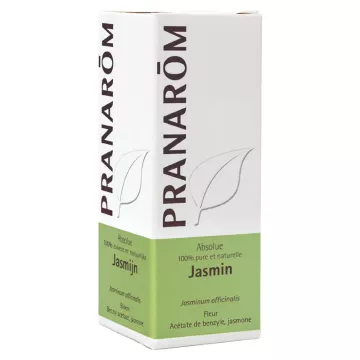
Jasmine (Jasminum grandiflorum, J. officinale, J. sambac) is one of the most prized flowers in the global perfume industry—and one of the few that cannot be steam-distilled without losing most of its aromatic profile. Its absolute contains a unique blend of benzyl acetate, indole, and jasmone, which are responsible for its signature warm, creamy, and slightly animalic floral note. Discover our range of anti-aging and aromatherapy skincare products.
Jasmine: Essential Oil or Absolute—What’s the Difference?
Confusion is very common—and it directly affects price, quality, and uses.
- Jasmine does not withstand steam distillation —its most valuable molecules (indole, jasmone, benzyl acetate) degrade or evaporate too quickly when heated
- Jasmine absolute: extracted using organic solvents (hexane followed by ethanol)—a traditional process in Grasse and India—may contain traces of solvents; check for certifications
- Jasmine CO₂ extract: a newer and purer process (low-temperature supercritical CO₂) — a profile closer to that of fresh flowers, with no traces of solvents
- Products marketed as “jasmine essential oil” are either absolutes or aromatic reconstitutions—always check for “absolute” or “CO₂ extract” on the label
- Approximate price: 1 kg of Jasminum grandiflorum absolute (Grasse) can exceed 3,000 €/kg—any “jasmine essential oil” sold at a very low price is necessarily an aromatic reconstruction
Jasmine and skincare?
Jasmine absolute is a premium cosmetic ingredient—not just a fragrance.
- Benzyl acetate has documented antioxidant properties—protection against oxidative stress in the skin
- Indole, present in very low doses (traces in the absolute), contributes to keratoregulatory and regenerative properties for sensitive skin
- Anti-aging skincare: 0.1–0.5% jasmine absolute in muscat rose or jojoba oil—a regenerating night serum that evens out skin tone
- Cosmetic blend: jasmine + neroli — a white floral duo for radiance-boosting and anti-aging skincare for mature skin
- See our anti-aging serum lines
Jasmine and emotional aromatherapy?
The scent of jasmine acts directly on the limbic system—its effect on emotional well-being is one of the best-documented among white flowers.
- Mild sedative effect: linalool and benzyl acetate modulate GABA-A receptors—promoting relaxation without significant sedation
- Diffusion: 3–5 drops of absolute or CO₂ extract diluted in a vegetable oil, then a few drops in an ultrasonic diffuser—a warm, lingering scent
- Application to the wrists: 1 diluted drop, direct inhalation—supports emotional comfort during times of tension
- Sleep support: jasmine + true lavender — a classic combination for nighttime relaxation
- Scent Combinations: jasmine + ylang-ylang — an enveloping floral synergy for deep relaxation
Which jasmine species are used in perfumery and cosmetics?
Three main species, three distinct characteristics.
- J. grandiflorum (Grasse jasmine, India, Egypt): the most precious absolute—a complex floral note, benzyl acetate + indole + jasmone—the benchmark in fine perfumery
- J. sambac (Arabian jasmine, Southeast Asia): a more intense, sweet, and exotic note—contains methyl jasmonate—used in jasmine tea (China) and in oriental perfumery
- J. officinale (common jasmine, Europe): more accessible, with a greener and fresher note—lower indole concentration—commonly used in cosmetics
- Each species has its own chromatographic profile — check the species on the label based on the intended use
Precautions and quality considerations?
- Pregnant and breastfeeding women: not recommended—aromatic esters and jasmone may affect hormonal balance
- Solvent-extracted absolute: verify the absence of residual solvent traces—prefer CO₂ extractions for frequent topical use
- Allergy to the Oleaceae family (jasmine, olive, ash, lilac): risk of cross-reactivity—skin test recommended
- Benzyl acetate and indole: listed in EC Regulation 1223/2009 — potential allergens at high concentrations — dilute to 0.1–1% for topical use
- Low-cost aromatic reconstitutions: do not possess the properties of natural absolutes—check the label for “natural” or “absolute”