What is butcher's broom?
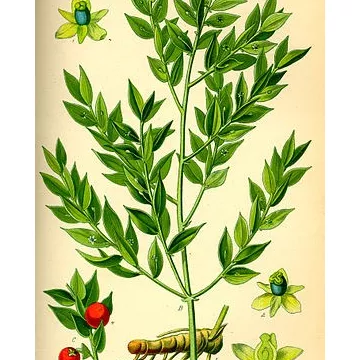
Butcher’s broom, also known as spiny butcher’s broom (Ruscus aculeatus), is an evergreen subshrub in the Asparagaceae family, found in the undergrowth of the Mediterranean region and Western Europe. Its spiny “leaves” and small red berries make it easily recognizable. Its root and rhizome contain specific steroidal saponins — ruscogenins and neoruscogenins—along with flavonoids. The EMA recognizes its use in the symptomatic treatment of chronic venous insufficiency and hemorrhoidal flare-ups.
What benefits do ruscogenins offer?
Ruscogenins exhibit a unique pharmacological profile among plants in the circulatory cluster:
- Direct venoconstrictive effect on the venous wall;
- Reduction in capillary permeability and plasma leakage;
- Relief from heavy legs and lower limb edema;
- Support for varicose veins and chronic venous insufficiency;
- Primary indication for hemorrhoids, for both internal and topical treatment.
Why is it a natural vasoconstrictor?
Ruscogenins exert a direct venous vasoconstrictive effect, a rare characteristic in the plant kingdom. Whereasescin from horse chestnut primarily acts on capillary permeability, the saponins in butcher’s broom actively constrict the venous wall by stimulating postsynaptic alpha-adrenergic receptors. This mechanism explains its rapid perceived effectiveness in relieving feelings of heaviness and its key role in addressing sluggish venous circulation.
Does it really relieve hemorrhoids and heavy legs?
Yes—and this is one of its best-documented uses in the scientific literature. For hemorrhoids, particularly during an initial 10- to 15-day treatment course, butcher’s broom extract (often combined with hesperidin methylchalcone and vitamin C) demonstrates an objective reduction in bleeding, itching, and perianal inflammation. For heavy legs, its effects become apparent after just 2 to 3 weeks of regular use, with documented improvements in circulation and the evening sensation of heaviness.
Does it support weight loss and help reduce rosacea?
Its vasoconstrictive properties make it an ally against cellulite with a vascular component (aqueous, infiltrated cellulite), and it is often incorporated into weight-loss programs targeting water retention. For facial skin, its extracts are used in skincare products designed for skin prone to rosacea and fragile microcirculation, applied topically to specific areas.
How should it be used as an internal treatment or as a gel?
The dosage forms depend on the intended use:
- Capsules of dry extract standardized to ruscogenins: 7 to 15 mg/day of ruscogenins depending on the source, as a 4- to 6-week course of treatment;
- Combination formulations (Ruscus + hesperidin + vitamin C) for hemorrhoidal flare-ups: an initial loading dose for 4 to 7 days, followed by a maintenance dose;
- Root decoction: 1 teaspoon per 250 ml of water, simmer gently for 10 minutes, up to 2 cups per day;
- Mother tincture: 25 to 30 drops in a glass of water, 2 to 3 times a day;
- Gel or cream applied topically to the legs with upward massage. For hemorrhoids: use only forms specifically indicated for this purpose.
What precautions should be taken with butcher’s broom?
- Contraindicated in cases ofuncontrolled hypertension (vasoconstrictive effect);
- Use with caution when taking antihypertensive medications , anticoagulants, or alpha-blockers;
- Not recommended for pregnant or breastfeeding women or children under 12 years of age;
- Raynaud’s phenomenon, peripheral ischemia: seek medical advice before use;
- Possible side effects: mild digestive upset, headaches at the start of treatment;
- For topical use, test on a small area if you have sensitive skin;
- Any severe, persistent, hemorrhagic, or febrile hemorrhoidal episode requires medical consultation.
Which herbs can be combined with butcher’s broom?
Venotonic synergies enhance results:
- Red vine to enhance the effect on capillary fragility;
- Sweet clover and ash to combine venous support with lymphatic drainage;
- Hesperidin methylchalcone (HMC) and bioflavonoids for an intensive hemorrhoid treatment;
- Witch hazel for rosacea-prone skin and fragile facial microcirculation;
- Cypress in gemmotherapy for particularly sluggish venous return.