Why is clary sage so different from common sage in aromatherapy?
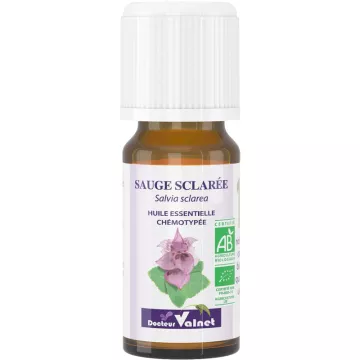
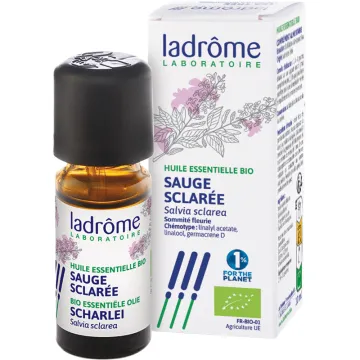
Clary sage (Salvia sclarea) is often referred to as “sweet sage”—and this comparison warrants further explanation. Its profile is dominated by linalool (15–25%), sclareol (diterpenol), and linalyl acetate—and contains no thujone. This absence of a neurotoxic ketone allows for its use in diffusion and massage, which common sage cannot be used for without close supervision.
Sclareol is the most distinctive molecule—its structure, similar to that of steroids, gives it a documented interaction with estrogen receptors. This is what makes clary sage the go-to sage for female hormonal disorders in aromatherapy, whereas common sage is more commonly used in medicinal pharmacopoeia. For common sage, see our page on common sage.
What are the uses of clary sage for women’s well-being?
This is its area of expertise—and the use for which it is irreplaceable among essential oils.
- Menstrual cramps: 3% in calophyllum oil, massaged in circular motions on the lower abdomen—sclareol relieves uterine spasms and supports local hormonal balance
- Hot flashes and night sweats during menopause: diffuse 6–8 drops before bedtime, or apply 1 drop diluted on the wrists—provides gradual hormonal support, with a cooling effect from linalool
- PMS and premenstrual irritability: a blend of true lavender and clary sage (1:1) diffused the week before menstruation—both plants share linalool as their dominant component but complement each other
- Pregnancy (precaution): Due to its phytoestrogenic effects, clary sage is not recommended during pregnancy—use only postpartum after consulting a healthcare provider
Clary sage and emotional balance?
Its very distinctive scent profile—musky, slightly milky, herbaceous—affects the limbic system in a way that is unique among sage varieties.
- Diffusion for stress and anxiety: 5–8 drops, 20 min—clary sage is often described as “the essential oil that helps you let go”—supports emotional well-being, particularly useful during transitions (menopause, postpartum)
- Emotional blend: clary sage + ylang-ylang —two key ingredients for women’s hormonal and emotional well-being when diffused
- Sleep support: clary sage + valerian — clary sage’s relaxing properties complement valerian’s sedative effects in herbal tea
- On the wrists: 1 drop diluted to 5% — a lingering, comforting note that supports daily relaxation
Clary sage and oily skin care?
Its linalool and sclareol make it an effective sebum-regulating ingredient for combination to oily skin.
- Serum for oily skin: 0.5% in jojoba oil — clary sage regulates sebum without drying out the skin, with a pleasant herbaceous note
- Combination for combination skin: clary sage + geranium —two complementary sebum-regulating active ingredients
- Oily scalp: 3 drops (2%) in a mild shampoo—balances sebum production and provides a natural fragrance
What precautions should be taken with clary sage?
- Pregnant and breastfeeding women: not recommended—sclareol has phytoestrogenic effects
- Hormone-dependent conditions (breast cancer, endometrial cancer, endometriosis): medical advice required—same precautions as for fennel and anise
- Current hormone therapy: possible interactions—inform your doctor
- Children under 12 years of age: not recommended
- Dilute to 1–3% for topical use—sclareol is better tolerated than common fennel but should always be used in diluted form
- Alcohol: The estrogen-like compounds in sclareia enhance the effects of alcohol—do not combine