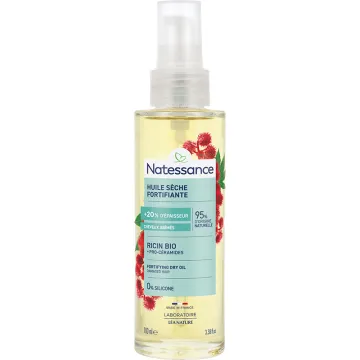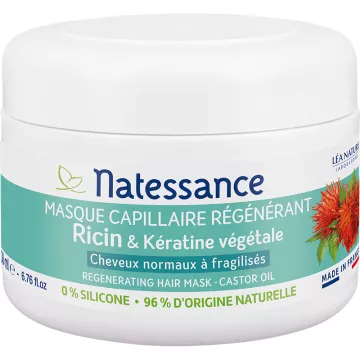
The castor plant (Ricinus communis), native to Africa and India, yields a vegetable oil renowned for its nourishing, moisturizing, and emollient properties. Extracted through cold-pressing,castor oil is rich in fatty acids, vitamin E, and especially ricinoleic acid—its signature component that gives it its characteristic thick, viscous texture. Used since ancient times, it is now a staple in natural cosmetic care for hair, eyelashes, nails, and skin. Its high fat content makes it an ally in nourishing and coating the hair shaft and the epidermis. It easily integrates into a hair or skin care routine. Note that it also has a very different historical internal use (as a laxative), which falls under strict guidelines detailed below.
Castor oil is primarily valued for its cosmetic uses:
Its rich texture locks in moisture and creates a protective barrier. It is a highly nourishing oil; use only a small amount due to its thickness.
This is its most widespread claim, but it’s important to qualify it honestly. Castor oil nourishes and coats the hair shaft as well as eyelash and eyebrow hairs, making them more supple, shinier, more resistant to breakage, andappear fuller. By reducing breakage, it helps preserve length. However, there is no solid scientific evidence to show that it actually accelerates growth or increases hair density: growth rate and density are primarily genetic. The observed “longer lashes” effect is mainly due to the coating action, which reduces breakage and creates a denser appearance—a real cosmetic benefit, but one that should not be confused with actual regrowth. For nourished lashes and coated hair, castor oil remains very useful. However, significant hair loss requires a dermatologist’s evaluation, which no oil can replace.
There are several application methods depending on your goal. As a hair oil treatment: Apply to the scalp and hair lengths, leave on for 1 to 2 hours (or overnight) before shampooing—often mixed with a lighter oil (jojoba, coconut) since castor oil is thick. As an eyelash and eyebrow serum: Apply a thin layer in the evening using a clean brush, avoiding contact with the eyes. For a skin massage: to nourish dry skin and soften chapped and rough areas. On nails and cuticles: apply daily to nourish and protect. As a warm poultice: traditionally used to promote muscle and joint comfort. In all cases, for external use, first perform a skin test and use only a small amount, as the texture is very rich. These cosmetic uses are safe and well-tolerated by most skin types, unlike internal use, which requires strict supervision.
For dry skin care, castor oil is very effective at nourishing, softening, and restoring comfort to rough areas, chapped skin, and cracks, thanks to its high fat content, which creates a protective film. When it comes to dark spots, scars, and stretch marks, however, one should exercise caution: castor oil softens the skin and improves its comfort, but there is no solid evidence that it “erases” pigmented spots or established scars. At best, it can improve the skin’s suppleness and appearance. Similarly, it is often credited with benefits against acne and blemishes: in reality, its thick texture can be comedogenic for certain skin types, and acne is a condition that requires dermatological advice, not treatment with an oil. Caution is therefore advised for those with oily or acne-prone skin. Castor oil remains, above all, an excellent nourishing oil for dry skin.
Castor oil has a long history of internal use as a powerful laxative: when ingested, it has a pronounced purgative effect by stimulating bowel movements. This use must be approached with the utmost caution and falls under a quasi-medicinal category. Its effect is very potent and can cause abdominal cramps, dehydration, and imbalances. It is not a harmless remedy for everyday digestive comfort: for occasional constipation, much gentler solutions are available. If used as a laxative, it should be taken only occasionally, at the lowest possible dose, and under the supervision of a healthcare professional. It is strongly discouraged for pregnant women (due to the risk of stimulating uterine contractions) and breastfeeding women, as well as in cases of digestive disorders (such as intestinal obstruction or unexplained abdominal pain). Persistent constipation also requires medical evaluation. In summary, oral castor oil is not a common digestive supplement but a powerful purgative that must be used with caution.
There are a few precautions to follow when using castor oil:
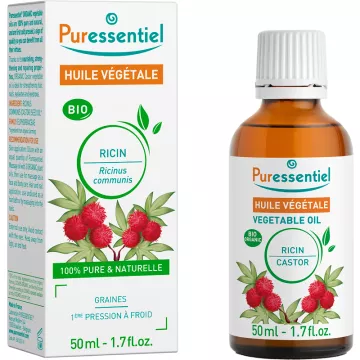
For quality, choose 100% pure, virgin, cold-pressed, and certified organic castor oil—free of solvents and pesticides—packaged in an amber glass bottle (which protects the active ingredients from light) and free of additives and fragrances. High-quality oil ensures better tolerance and optimal results for hair, nails, and skin. Available at pharmacies, organic stores, and specialty shops in the form of pure oil, hair serums, or nourishing balms.