Basil CT estragole vs. CT linalool: Two essential oils that shouldn't be confused?
This is the first question to ask yourself before buying basil essential oil—the chemotype makes all the difference.
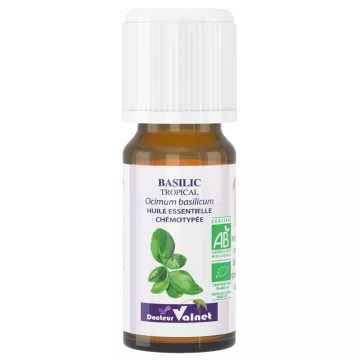
- Exotic basil CT estragole (Ocimum basilicum var. estragol): estragole (methyl chavicol) 70–85% — powerful antispasmodic profile, similar to tarragon — same EFSA/ANSES regulatory precautions regarding potential genotoxicity at high doses and with prolonged use
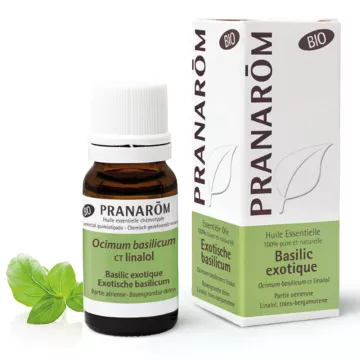
- Linalool-type basil (Ocimum basilicum var. linalol, Comoros): linalool 50–70% + eugenol — mild and balancing profile — similar to true lavender in its effects — well tolerated, with no estragole concerns
- Holy Basil / Tulsi (Ocimum tenuiflorum): predominantly eugenol + methyl eugenol — adaptogenic and respiratory profile — derived from Ayurvedic medicine — distinct profile from the previous two
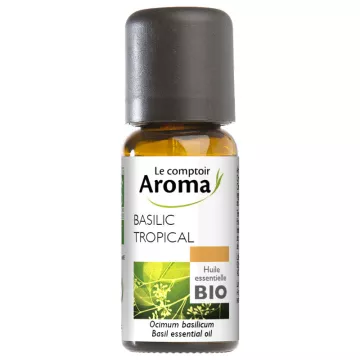
- On the label: check for “CT estragol” or “CT linalool”—“basil essential oil” without further specification is often the CT estragol variety—the best-selling one in France
- For prolonged daily use: opt for CT linalool—use CT estragole only for short courses of 2–3 weeks at most, similar totarragon
Estragole CT basil and digestive spasms?
Its signature indication—but only as a short-term treatment.
- Estragole is one of the most powerful digestive antispasmodics in aromatherapy—it has an almost immediate effect on intestinal cramps and colon spasms
- Abdominal massage: 2–3% in jojoba oil—apply in a clockwise circular motion—relief from cramps within 10–15 minutes
- Combination for nervous spasms: estragole-containing sweet basil + marjoram (1:1)—sweet basil releases the spasm, marjoram blocks the nerve signal
- Duration: 2–3 weeks maximum, mandatory break — same precautions as for tarragon (estragole) — do not use daily for an extended period
Linalool-type basil: a gentle alternative—for what uses?
Its dominant linalool content makes it a versatile, balancing essential oil—without the duration restrictions of estragole CT.
- Nervous system relaxation and sleep support: diffuse 6–8 drops for 20 minutes — floral and herbaceous note, milder than estragole CT, olfactorily accessible
- Concentration support: linalool in moderate doses supports cognitive alertness without overstimulation—a few drops on the wrists during the day
- Milddigestive comfort: herbal tea made from dried leaves—less potent than estragole CT but well-tolerated for daily use
- Balancing blend: linalool CT basil + true lavender — a combination for those experiencing nervous tension and mild insomnia
Holy basil (Tulsi): a distinct use?
Tulsi is a different plant—often confused with common basil in dietary supplements.
- Ayurvedic medicine: Tulsi is considered an adaptogenic herb—supporting the nervous and respiratory systems—used as an infusion or dry extract
- Its essential oil (eugenol-dominant) is less common in France — has a “mild clove” aroma profile
- Tulsi dietary supplements: available in pharmacies—to be distinguished from “basil” capsules, which may contain common basil with estragole as the main compound
- Check Ocimum tenuiflorum for tulsi vs. O. basilicum for common basil
Precautions?
- CT estragole: same regulations as tarragon—treatment duration 2–3 weeks max, adults only, never used continuously—potentially genotoxic at high doses over prolonged periods according to EFSA/ANSES
- CT linalool: well tolerated, more flexible use—pregnant women: essential oil not recommended; herbal tea only under medical supervision
- Children under 12 years of age: estragole is contraindicated — use linalool with caution; diffusion only
- Allergy to Lamiaceae (mint, lavender, rosemary): possible cross-reactivity—perform a skin test before extended use
- Anticoagulants: eugenol (found in linalool and tulsi essential oils) may potentiate the effect—consult a doctor