NOTICE
ANSM - Updated on : 11/03/2025
Product name
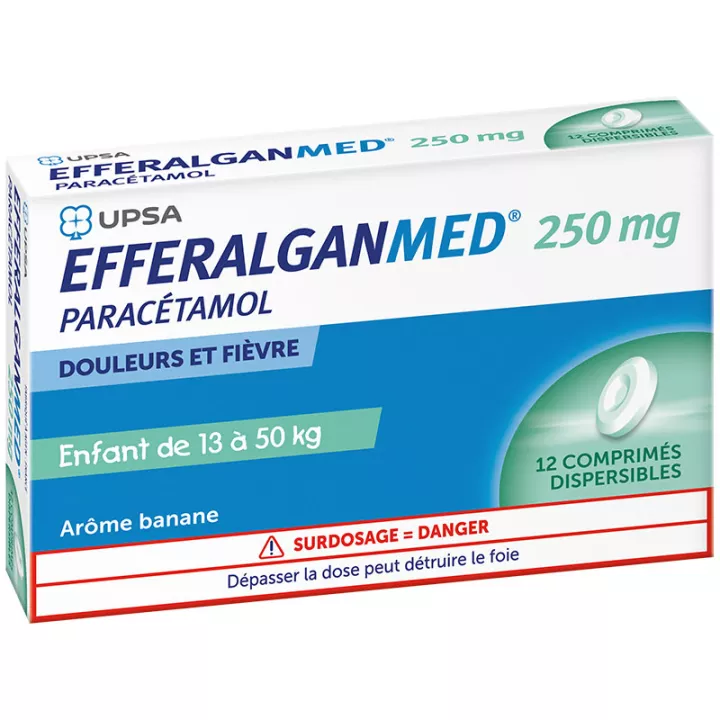
EFFERALGANMED 250 mg, dispersible tablet
Paracetamol
Box
Please read this leaflet carefully before taking this medicine, as it contains important information for you.
You must always take this medicine exactly as instructed in this leaflet or by your doctor or pharmacist.
- Keep this leaflet as you may need to read it again.
- Ask your pharmacist for advice and information.
- If you experience any side effects, talk to your doctor or pharmacist. This also applies to any side effects not mentioned in this leaflet. See section 4.
You should contact your doctor if you do not feel any improvement or if you feel less well after 3 days.
What does this leaflet contain?
1. What is EFFERALGANMED 250 mg, dispersible tablet and what is it used for?
2. What do I need to know before taking EFFERALGANMED 250 mg, dispersible tablet?
3. How should EFFERALGANMED 250 mg, dispersible tablet be taken?
4. What are the possible side effects?
5. How should EFFERALGANMED 250 mg, dispersible tablet be stored?
6. Package contents and other information.
1. WHAT IS EFFERALGANMED 250 mg, dispersible tablet AND WHAT IS IT USED FOR?
Pharmacotherapeutic class: Other analgesics and antipyretics - ATC code: N02BE01
This medicine is an analgesic and antipyretic. It contains paracetamol.
It is indicated for the symptomatic treatment of mild to moderate pain and/or fever, such as headaches, flu, toothache, aches and pains or painful menstruation.
This medicine is reserved for CHILDREN weighing 13 to 50 kg (approx. 2 to 15 years). See section 3 "How to take EFFERALGANMED 250 mg, dispersible tablet? "
2. WHAT DO I HAVE TO KNOW BEFORE TAKING EFFERALGANMED 250 mg, dispersible tablet?
Never take EFFERALGANMED 250 mg dispersible tablet
- If you are allergic to the active substance or to any of the other ingredients of this medicine, as listed in section 6.
- In case of severe liver disease,
- In case of phenylketonuria (hereditary disease detected at birth), due to the presence of aspartam.
Warnings and precautions
Talk to your doctor or pharmacist before taking EFFERALGANMED 250 mg, dispersible tablet :
- if you weigh less than 50 kg (for an adult),
- if you have liver disease,
- in case of chronic alcoholism,
- chronic malnutrition,
- in case of dehydration,
- kidney disease
- if you are taking any other medication affecting liver function.
During treatment with EFFERALGANMED 250 mg, dispersible tablet, inform your doctor immediately: if you have any serious illnesses, including severe kidney failure or sepsis (when bacteria and their toxins circulate in the blood, causing organ damage), or if you are malnourished, chronically alcoholic or also taking flucloxacillin (an antibiotic). A serious condition called metabolic acidosis (an abnormality of the blood and fluids) has been reported in patients who regularly take paracetamol for a prolonged period or who take paracetamol in combination with flucloxacillin. Symptoms of metabolic acidosis may include: severe breathing difficulties with rapid, deep breathing, drowsiness, nausea and vomiting.
You may need to reduce the amount of paracetamol you are taking or avoid using this product altogether.
In the event of acute viral hepatitis, stop your treatment and consult your doctor.
This medicine contains paracetamol. To avoid the risk of overdose, you must not take other products containing paracetamol at the same time as this medicine.
Children
The total dose of paracetamol should not exceed 80 mg/kg/day in children under 37 kg and 3 g/day in older children over 38 kg (see "If you have taken more EFFERALGANMED 250 mg, dispersible tablet than you should have").
Dispersible tablets are not recommended for children under 6 years of age, as they may cause a false-route.
In children treated with paracetamol 60 mg/kg/day, the association of another antipyretic is justified only if it is effective.
This medicine contains banana flavouring and may be appealing to children. Keep out of sight and reach of children.
Other medicines and EFFERALGANMED 250 mg, dispersible tablet
Tell your doctor or pharmacist if you are taking, have recently taken or may take any other medicines.
Always tell your doctor or pharmacist if you are taking any of the following medicines before starting treatment with EFFERALGANMED 250 mg, dispersible tablet:
- probenecid (used to treat gout) ;
- salicylamide (used to treat fever);
- enzyme-inducing drugs, including carbamazepine, phenobarbital, phenytoin, primidone (used to treat epilepsy), rifampicin (antibacterial), St. John's wort (medicinal herb used to treat mild to moderate depression), etc. ;
- metoclopramide and domperidone (used to treat and prevent nausea and vomiting) ;
- cholestyramine (used to treat high concentrations of lipids (fats) in the blood) ;
- anticoagulants, notably warfarin (used to prevent blood clotting).
- flucloxacillin (antibiotic), due to a serious risk of blood and fluid abnormalities (known as metabolic acidosis), which must be treated as an emergency (see section 2).
Pregnancy and breast-feeding
If you are pregnant or breast-feeding, think you may be pregnant or are planning to become pregnant, ask your doctor or pharmacist for advice before taking this medicine.
If necessary, EFFERALGANMED 250 mg, dispersible tablet may be used during pregnancy. You should use the lowest possible dose to relieve pain and/or fever, and take it for the shortest possible time.
Contact your doctor if the pain and/or fever do not subside or if you need to take the medication more frequently.
EFFERALGANMED 250 mg, dispersible tablet contains laspartam
This medicine contains 30 mg daspartam per dose.
Laspartam contains a source of phenylalanine. May be dangerous for people with phenylketonuria (PKU), a rare genetic disorder characterized by accumulation of phenylalanine that cannot be eliminated properly.
Biological tests
If you have to undergo biological tests to check your blood glucose or uric acid levels, inform your doctor of your treatment with EFFERALGANMED 250 mg, dispersible tablet.
3. HOW DO I TAKE EFFERALGANMED 250 mg, dispersible tablet?
This medicine is reserved for CHILDREN weighing between 13 and 50 kg (approximately 2 and 15 years of age).
For children under 6 years of age, the tablets should be dissolved in a spoonful of water or milk (not fruit juice, as there is a risk of bitterness), before being given to the child.
In children over 6, the tablets can be sucked, as they melt very quickly in the mouth on contact with saliva.
Method of administration
Opening instructions :
This medicine is available in single-dose, perforated, secure blister packs with detachable lids:
Remove a single dose by tearing along the perforated line of the blister pack and removing the top of the blister pack to remove the tablet.
Dosage
In children, it is imperative to respect the dosage defined on the basis of body weight, and consequently to use an adapted presentation. Approximate ages according to weight are given for information only.
The recommended daily dose of paracetamol is approximately 60 mg/kg per day, divided into 4 or 6 daily doses, i.e. approximately 15 mg/kg every 6 hours or 10 mg/kg every 4 hours.
- For children weighing 13 to 20 kg (approx. 2 to 7 years), the recommended dose is 1 tablet per dose, repeated if necessary after 6 hours, up to a maximum of 4 tablets per day.
- For children weighing 21 to 25 kg (approx. 6 to 10 years), the recommended dose is 1 tablet per dose, repeated if necessary after 4 hours, up to a maximum of 6 tablets per day.
- For children weighing 26 to 40 kg (approx. 8 to 13 years), the recommended dose is 2 tablets per dose, repeated if necessary after 6 hours, up to a maximum of 8 tablets per day.
- For children weighing 41 to 50 kg (approx. 12 to 15 years), the recommended dose is 2 tablets per dose, to be repeated if necessary after 4 hours, not to exceed 12 tablets per day.
Special populations:
In patients with impaired hepatic or renal function, or Gilbert's syndrome, the doctor will adjust the dose.
In patients with severe renal impairment, the interval between two doses should be at least 8 hours.
Talk to your doctor or pharmacist before taking EFFERALGANMED 250 mg in the following situations:
- Weight less than 50 kg in adults
- Chronic alcoholism
- dehydration
- Chronic malnutrition.
If you feel that the effect of EFFERALGANMED 250 mg is too strong or too weak, talk to your doctor or pharmacist.
Take EFFERALGANMED at the correct dosage to avoid pain or a recurrence of fever.
Inchildren, doses should be taken at regular intervals, including at night, preferably every 6 hours, or at least every 4 hours.
You should consult a doctor if your symptoms worsen or do not improve after 3 days.
If you have taken more EFFERALGANMED 250 mg, dispersible tablet than you should have:
Stop treatment and consult a doctor immediately.
Symptoms of overdose generally appear within the first 24 hours and are characterized by nausea, vomiting, loss of appetite, paleness and abdominal pain.
Consult a doctor immediately in the event of overdosage, even if the patient feels well, because of the risk of serious and irreversible late liver damage.
If you forget to take EFFERALGANMED 250 mg, dispersible tablet :
Do not take a double dose to make up for the one you forgot to take.
If you have any further questions about the use of this medicine, please ask your doctor or pharmacist.
4. WHAT ARE THE POSSIBLE SIDE EFFECTS?
Like all medicines, this drug is likely to have undesirable effects, although not everyone is subject to them.
The following side effects may occur:
Rare adverse reactions (may affect up to 1 in 1000 people):
Increased liver enzymes (transaminases).
Very rare adverse reactions (may affect up to 1 in 10,000 people):
Allergic reactions: rash or skin eruption with itchy swelling balls, swelling of the face or tongue, shortness of breath or breathing difficulties which may be caused by a severe allergic reaction. If you experience a severe allergic reaction, discontinue EFFERALGANMED 250 mg and seek medical advice immediately.
Skin reactions: very rare cases of severe skin reactions have been reported.
Undesirable effects of undetermined frequency (cannot be estimated from available data)
Decrease or increase in liver enzymes (liver damage).
Blood disorders: reduced platelet count leading to nose or gum bleeds, and reduced white blood cell count leading to increased susceptibility to infection.
A serious condition that can cause the blood to become more acidic (known as metabolic acidosis), in patients with serious illnesses taking paracetamol (see section 2).
Reporting side effects
If you experience any side effects, please tell your doctor or pharmacist. This also applies to any side effect not mentioned in this leaflet. You can also report adverse reactions directly via the national reporting system: Agence nationale de sécurité du médicament et des produits de santé (ANSM) and the network of Centres Régionaux de Pharmacovigilance - Website: www.signalement.social-sante.gouv.fr
By reporting adverse reactions, you contribute to providing more information on drug safety.
5. HOW TO CONSERVE EFFERALGANMED 250 mg, dispersible tablet?
Keep out of sight and reach of children.
Do not use this medicine after the expiration date stated on the blister and box.
The expiry date refers to the last day of the month.
No special storage precautions.
Do not use if you notice any visible signs of deterioration.
Do not dispose of any medicine down the drain or in the household waste. Ask your pharmacist to dispose of any medicines you no longer use. These measures will help protect the environment.
6. CONTENTS AND OTHER INFORMATION
What EFFERALGANMED 250 mg dispersible tablet contains
- Active substance: paracetamol
Each tablet contains 250 mg paracetamol (in the form of coated paracetamol crystals).
- The other components are :
Butyl methacrylate basic copolymer, 30% polyacrylate dispersion, colloidal hydrophobic silica, mannitol (granulated, powder), crospovidone, aspartam (E951), banana flavor, magnesium stearate.
What is EFFERALGANMED 250 mg, dispersible tablet and what does it contain?
EFFERALGANMED 250 mg is a white, round, biconvex dispersible tablet with a central concave depression and a characteristic banana odor.
Packaging: boxes of 12 or 24 tablets in single-dose, perforated, secure blisters with detachable lids.
Not all presentations may be marketed.
Marketing authorization holder
ETHYPHARM
194 Bureaux de La Colline, Bâtiment D
92213 Saint Cloud cedex
France
Marketing authorization holder
UPSA SAS
3 rue joseph monier
92500 rueil malmaison
France
Manufacturer
ETHYPHARM
Z.I. de Saint-Arnoult
28170 CHATEAUNEUF-EN-THYMERAIS
france
ETHYPHARM
CHEMIN DE LA POUDRIERE
76120 GRAND QUEVILLY
france
DELPHARM NOVARA SrL
VIA CROSA, 86
28065 CERANO (NO)
ITALY
Product names in member states of the European Economic Area
This medicinal product is authorized in the member states of the European Economic Area under the following names: In accordance with current regulations.
[To be completed subsequently by the holder].
The last date on which this leaflet was revised was :
[To be completed at a later date by the registrant]
Other
Detailed information on this drug is available on the ANSM (France) website.
Health education advice :
WHAT TO DO IN CASE OF FEVER :
Normal body temperature varies from one individual to another, ranging from 36°5C to 37°5C. A rise in temperature above 38°C may be considered a fever.
This medicine is intended for adults and children weighing from 13 to 50 kg (approx. 2 to 15 years).
If the symptoms of fever are too troublesome, you can take this paracetamol-containing medicine at the recommended dosage.
To avoid the risk of dehydration, remember to drink frequently.
With this medication, fever should fall rapidly. Nevertheless :
- if other unusual signs appear
- if fever persists for more than 3 days or worsens,
- if headaches become severe, or if vomiting occurs.
CONSULT YOUR DOCTOR IMMEDIATELY.
WHAT TO DO IN CASE OF PAIN :
The intensity of pain perception and the ability to resist it vary from one person to another.
- If there is no improvement after 5 days of treatment,
- If the pain is violent, unexpected and comes on suddenly (particularly a strong pain in the chest) and/or recurs regularly,
- If it is accompanied by other signs such as general malaise, fever, unusual swelling of the painful area or reduced strength in a limb,
- If it wakes you up at night,
CONSULT YOUR DOCTOR IMMEDIATELY.