When should you use these flea and tick pipettes?
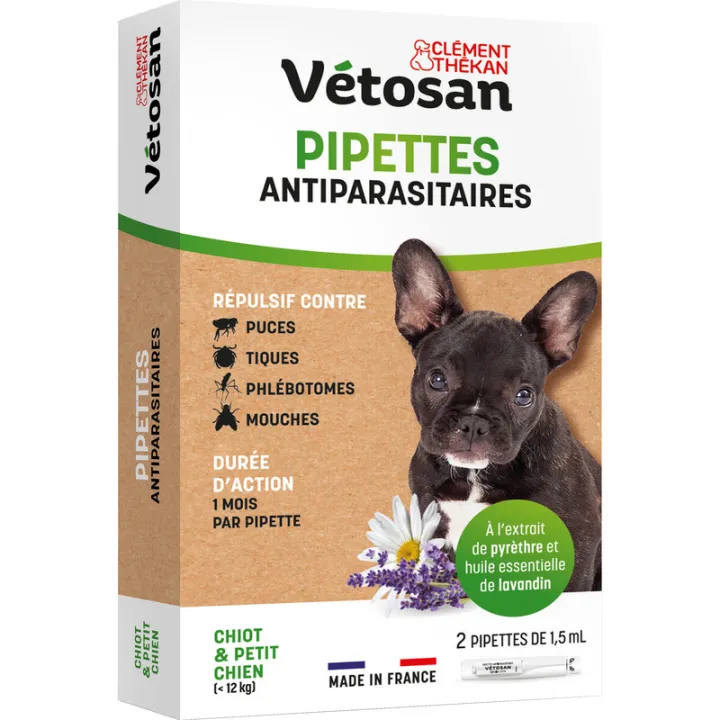
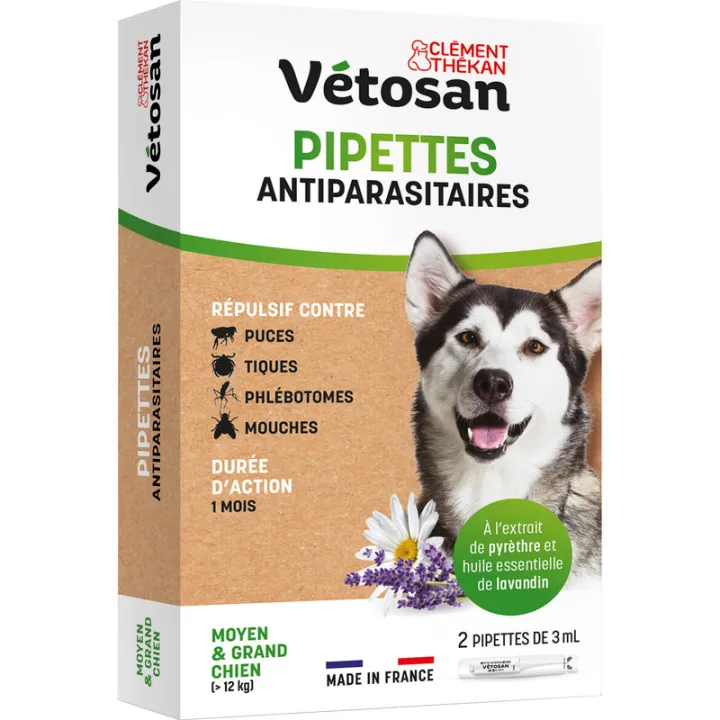
Vetosan Antiparasitic Pipette for Dogs is a repellent pipette designed to be applied directly to the dog’s skin. Its oily solution combines two active ingredients: lavandin essential oil (Lavandula hybrida), at 15.35 g/kg, and pyrethrum flower extract (Chrysanthemum cinerariaefolium), at 4.17 g/kg. It is available in two pipette sizes, depending on the dog’s weight.
These pipettes repel fleas, ticks, sand flies, and flies. A single application covers all four targets at once, with no need for a daily routine or a second product to add for flies.
The product takes effect immediately after application and remains effective for approximately 4 weeks against fleas, ticks, and flies. Against sand flies, this duration is reduced to about one week.
These pipettes are suitable for dogs that go out daily into tall grass, along the edges of woods, or near bodies of water from spring through fall—where ticks lurk close to the ground. They also fit easily into a travel kit for vacations or weekend trips to the countryside. To round out this protection based on your pet’s lifestyle, explore our full range of tick prevention solutions for dogs and cats.
We recommend using them in combination with the Biocanina 2-Hook Tick Remover. The hook removes any ticks that have managed to latch on with a twisting motion, without squeezing the tick’s abdomen or leaving its mouthparts in the skin—and the sooner you remove the tick, the better.
How do you apply these pipettes to your dog?
Instructions for Use
Apply
- 1 pipette of 1.5 mL per month for puppies 4 months and older and small dogs weighing less than 12 kg,
- 1 3-mL pipette per month for medium-sized dogs weighing 12 to 25 kg,
- 2 3-mL pipettes per month for large dogs weighing more than 25 kg.
Cut off the tip of the pipette, part the fur at the base of the neck, and apply the dose directly to the skin at 2 or 3 spots between the shoulder blades.
Share your feedback on the usage instructions and dosage for Vetosan Antiparasitic Pipettes for Dogs with our partner, Verified Reviews, after your purchase.
Precautions
- For veterinary use only. For topical application; external use only. Do not swallow.
- For dogs only. Do not apply to cats or other pets: a specific pipette is available for cats, in an appropriate volume.
- Do not use on puppies under 4 months of age.
- Not recommended for pregnant or nursing females.
- Follow the dosage instructions based on the dog’s weight and do not exceed the recommended dose.
- In case of reinfestation, repeat the application, allowing at least 7 days between doses.
- Do not apply the product to irritated or broken skin, open wounds, or to sick or convalescing animals.
- If your dog has a history of seizures, consult your veterinarian before the first application.
- Do not use these pipettes in combination with another topical antiparasitic treatment, collar, spray, or second pipette without consulting your veterinarian.
- Apply the dose to the base of the neck, in a spot where the dog cannot lick it. Prevent other animals in the household from licking each other’s treated areas until the solution is dry.
- Keep any cats in the household away from the treated dog until the application site is dry.
- The product’s effectiveness may be reduced if the animal gets wet.
- To prevent reinfestation, treat all animals in the household with a product appropriate for their species.
- Monitor the application site over the following days. If redness, itching, hair loss, excessive drooling, or unusual behavior occurs, wash the area with soapy water and consult a veterinarian.
- A repellent reduces the risk of bites but does not eliminate it entirely. Inspect your dog’s coat after every outing in wooded, grassy, or damp areas, and remove any attached ticks immediately.
- If your dog spends time in the south of France or around the Mediterranean basin, ask your veterinarian what additional protection to use in combination with these pipettes.
- Avoid contact with the product and wash your hands after application. Do not let a child pet the dog in the treated area until it is dry.
- Contains linalool, linalyl acetate, and Chrysanthemum cinerariaefolium. May cause an allergic reaction.
- Warning. Very toxic to aquatic organisms, causing long-term effects. Avoid release into the environment. Do not dispose of residues in sewers or waterways.
- Dispose of empty packaging and unused product in accordance with local waste disposal regulations, such as at a recycling center. Do not recycle packaging that still contains product.
- If medical attention is needed, have the container or label available. If swallowed, contact the nearest poison control center (UFI: K2WA-4JUU-U00F-REG2).
- Store the pipettes at a temperature not exceeding 25 °C, out of the sight and reach of children.
What are the ingredients in this lavender and pyrethrum repellent?
Ingredients
Active ingredients: Lavandula hybrida (CAS 91722-69-9) 15.35 g/kg, Chrysanthemum cinerariaefolium, extract of open and mature flowers of Tanacetum cinerariifolium obtained using supercritical CO₂ (CAS 89997-63-7) 4.17 g/kg. Biocidal product TP19 (repellent), oily solution.
Packaging
Box of 2 pipettes, available in two sizes.
- Puppies and small dogs: 2 pipettes of 1.5 mL, providing 2 months of use.
- Medium and large dogs: 2 pipettes of 3 mL, providing 2 months of use for dogs weighing 12 to 25 kg and 1 month for dogs weighing over 25 kg.
Our expert advice on Vetosan pipettes for dogs
Before the first application, the first thing we check at the counter is the list of products already used on the dog: among the precautions, the one regarding the accumulation of antiparasitic treatments is the most critical, because adding a collar or a spray does not double the effect. Another common misconception is to apply the treatment more frequently when you spot a parasite. The application schedule is based on the product’s duration of action, not on what you see in the coat, and a tick you spot is best removed rather than treated with another dose.
As for the schedule, start before the first spring outings rather than after the first tick appears, and note the date of each application so you don’t fall behind schedule. At the end of the season, don’t stop at the first sign of cold weather: ticks remain active as long as the days are mild, often until November.
FAQ
Does the Vetosan Antiparasitic Pipette for Dogs kill fleas and ticks?
No, that’s not its purpose. It’s a repellent: lavandin and pyrethrum keep fleas, ticks, sand flies, and flies away, without claiming to eliminate them. A dog that already has fleas requires a parasite treatment that eliminates them—one chosen in consultation with a veterinarian—before switching to a repellent-based protection.
What is the difference between the Vetosan Antiparasitic Pipette for Dogs and a fipronil pipette?
A fipronil pipette is a veterinary medication approved to eliminate fleas and ticks present on the animal. The Vetosan pipette is a repellent biocide designed to keep these parasites at bay. The two are not intended for the same situation, and the choice between them depends on the dog’s exposure to parasites and the region where it lives.
I notice a greasy residue and a lavender scent on the back of my dog’s neck after using the Vetosan Antiparasitic Pipette for Dogs—is this normal?
Yes. The product is an oily solution containing lavandin essential oil; a greasy-looking patch of fur and a scent similar to lavender at the application site are a direct result of this. The area does not need to be washed to make them go away.
My dog weighs about 12 kg: which size of Vetosan Dog Flea and Tick Treatment should I choose?
The cutoff between the two sizes is 12 kg. A dog that exceeds this weight—or a puppy that will exceed it during the season—should use the 3 mL pipette. Weighing your dog recently, either at the vet’s office or at home, will help ensure you don’t underdose your pet.