NOTICE
ANSM - Updated on : 30/05/2024
Product name
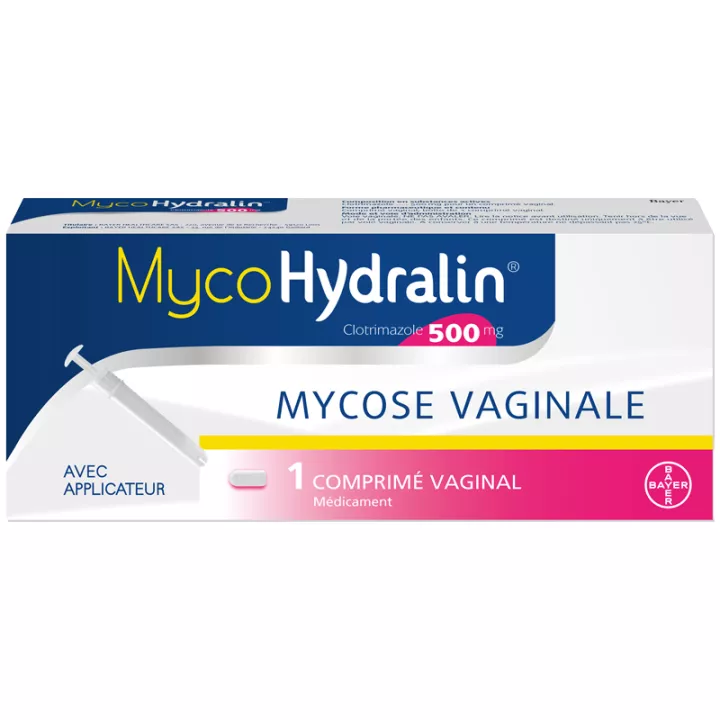
MYCOHYDRALIN 500 mg, vaginal tablet
Clotrimazole
Box
Please read this leaflet carefully before using this medicine, as it contains important information for you.
You must always use this medicine in strict accordance with the information provided in this leaflet or by your doctor or pharmacist.
- Keep this leaflet. You may need to read it again.
- Ask your pharmacist for advice and information.
- If you experience any side effects, talk to your doctor or pharmacist. This also applies to any side effects not mentioned in this leaflet. See section 4.
- You should contact your doctor if you do not feel any improvement or if you feel less well after 7 days.
What does this leaflet contain?
1. What is MYCOHYDRALIN 500 mg, vaginal tablet and what is it used for?
2. What do I need to know before using MYCOHYDRALIN 500 mg, vaginal tablet?
3. How do I use MYCOHYDRALIN 500 mg, vaginal tablet?
4. What are the possible side effects?
5. How should MYCOHYDRALIN 500 mg vaginal tablet be stored?
6. Package contents and other information.
1. WHAT IS MYCOHYDRALIN 500 mg, vaginal tablet AND WHAT IS IT USED FOR?
Pharmacotherapeutic class - ATC code: imidazole derivatives - G01AF02
LOCAL ANTIFUNGAL (G: Genitourinary system and sex hormones).
Indicated for the treatment of sensitive vaginal yeast mycoses (conditions caused by microscopic fungi).
In the case of associated vulvar lesions, it is recommended to complete vaginal treatment by applying a 1% clotrimazole cream to the lesions.
This medicine is for adults only.
You should contact your doctor if you do not feel any improvement or if you feel worse after 7 days.
2. WHAT DO I HAVE TO KNOW BEFORE USING MYCOHYDRALIN 500 mg, vaginal tablet?
Never use MYCOHYDRALIN 500 mg, vaginal tablet :
- if you are allergic to the active substance or to any of the other components of this medicine listed in section 6.
This medicine MUST NOT BE USED with a male condom or latex diaphragm.
Warnings and precautions
Talk to your doctor or pharmacist before using MYCOHYDRALIN 500 mg, vaginal tablet.
DO NOT SWALLOW; THE TABLET MUST BE PLACED DEEP INSIDE THE VAGINA.
If you experience any of the following symptoms before or during the use of MYCOHYDRALIN 500 mg, vaginal tablet, please consult your doctor:
- fever, nausea, vomiting
- Lower abdominal pain
- Back or shoulder pain
- Vaginal secretions with unpleasant odours
- Vaginal bleeding
In cases of candidiasis, we advise against the use of acidic pH soaps (pH favoring Candida multiplication).
Vaginal douching should be avoided.
The use of internal tampons, spermicides, condoms or diaphragms should be avoided during treatment with MYCOHYDRALIN 500 mg, vaginal tablet (risk of condom or diaphragm rupture).
It is recommended to avoid sexual intercourse in case of vulvovaginal mycosis in order to reduce the risk of infection of the partner.
Your doctor may also treat your sexual partner to prevent recontamination.
Treatment may cause local burning and increased itching. These symptoms usually subside spontaneously with continued treatment. If symptoms persist beyond 24 to 48 hours, consult your doctor.
If used during pregnancy, vaginal tablets should be inserted without the applicator (see Pregnancy and breast-feeding section).
Children
Not applicable.
Other medicinal products and MYCOHYDRALIN 500 mg, vaginal tablet
Do not use with spermicidal products (risk of inactivation), or with latex condoms or diaphragms (risk of condom or diaphragm rupture).
Clotrimazole may interfere with the metabolism of Tacrolimus and Sirolimus. To prevent any risk of Tacrolimus or Sirolimus overdose, inform your doctor or pharmacist before using Mycohydralin.
Tell your doctor or pharmacist if you are using, have recently used or may use any other medicines.
MYCOHYDRALIN 500 mg, vaginal tablet with food, drink and alcohol
Not applicable.
Pregnancy and breast-feeding
If you are pregnant or breastfeeding, think you may be pregnant or are planning to become pregnant, ask your doctor or pharmacist for advice before taking this medicine.
MYCOHYDRALIN 500 mg, vaginal tablet may be used during pregnancy if prescribed by your doctor.
If used during pregnancy, vaginal tablets should be inserted without the applicator.
MYCOHYDRALIN 500 mg, vaginal tablet may be used during breast-feeding.
Ask your doctor or pharmacist for advice before taking any medication.
Driving and use of machinery
Not applicable.
3. HOW DO I USE MYCOHYDRALIN 500 mg, vaginal tablet?
This medicine is intended for adults only.
Always use this medicine exactly as instructed in this leaflet or as directed by your doctor or pharmacist. Check with your doctor or pharmacist if in doubt.
Dosage
Vaginal route, DO NOT swallow.
Single administration of one tablet in the evening, to be placed at the bottom of the vagina.
If symptoms persist beyond 3 days, a second vaginal tablet may be administered.
If symptoms persist beyond 7 days, consult your doctor.
Always use this medication exactly as directed by your doctor or pharmacist. Check with your doctor or pharmacist if in doubt.
Method of administration
Use without applicator:
After thoroughly washing your hands, insert the tablet deep into the vagina, preferably in the evening at bedtime and while lying down. The easiest way to do this is to lie on your back with your knees bent and apart.
Use with applicator:
Use the applicator to insert the tablet as high as possible into the vagina, preferably in the evening at bedtime.
The easiest way to do this is to lie on your back with your knees bent and apart.
|
1-Take the applicator out of its packaging. Remove the plunger and red lock from the applicator.
|
|
|
2- Place the vaginal tablet, rounded edge down, into the open end of the applicator. Push the locking plunger into the applicator until you feel a click.
3- Once you've felt the click, remove the plunger lock, then gently insert the applicator into the vagina up to the patterned grip area.
|
|
|
4- Hold the applicator body at the patterned grip area and gently push the plunger all the way in until it stops to insert the vaginal tablet.
5- After use, disassemble all parts of the applicator for cleaning and wash thoroughly in warm soapy water (not boiling), rinse for 30 seconds and dry each part thoroughly. Store in a clean, safe place.
After final use, dispose of the applicator in a safe place out of the reach of children.
|
|
If you have used more MYCOHYDRALIN 500 mg, vaginal tablet than you should have
No cases of overdose have been reported to date.
If you forget to use MYCOHYDRALIN 500 mg, vaginal tablet
Not applicable.
If you stop using MYCOHYDRALIN 500 mg, vaginal tablet
Not applicable.
If you have any further questions about the use of this medicine, please ask your doctor or pharmacist.
4. WHAT ARE THE POSSIBLE SIDE EFFECTS?
Like all medicines, this drug may cause undesirable effects, but they do not occur systematically in everyone.
The following adverse reactions have been reported following the marketing of MYCOHYDRALIN; their frequency cannot be defined on the basis of available data:
- allergic reactions: anaphylactic shock, angioedema,
- skin reactions: itching, redness, rash,
- at the application site: irritation, swelling or redness, pain
- decrease in blood pressure, loss of consciousness,
- sensation of shortness of breath,
- vaginal discharge, vaginal bleeding
- Vulva and vagina: pain, discomfort, itching, redness, burning sensation,
- abdominal pain, nausea
Reporting side effects
If you experience any side effects, please tell your doctor or pharmacist. This also applies to any side effects not mentioned in this leaflet. You can also report adverse reactions directly via the national reporting system: Agence nationale de sécurité du médicament et des produits de santé (ANSM) and the network of Centres Régionaux de Pharmacovigilance - Website: www.signalement-sante.gouv.fr
By reporting adverse reactions, you contribute to providing more information on drug safety.
5. HOW TO CONSERVE MYCOHYDRALIN 500 mg, vaginal tablet?
Keep out of sight and reach of children.
Do not use this medicine after the expiration date indicated on the box after EXP. The expiration date refers to the last day of this month.
Store at a temperature not exceeding 25°C.
Do not dispose of any medicine in the drain or with the household waste. Ask your pharmacist to dispose of any medicines you no longer use. These measures will help protect the environment.
6. CONTENTS AND OTHER INFORMATION
What MYCOHYDRALIN 500 mg, vaginal tablet contains
- The active substance is :
Clotrimazole.................................................................................................................. 500 mg
For one vaginal tablet.
- Other ingredients are : Lactose, corn starch, lactic acid, magnesium stearate, colloidal anhydrous silica, crospovidone, hypromellose, microcrystalline cellulose, calcium lactate.
What MYCOHYDRALIN 500 mg vaginal tablet is and what it contains
This medicine is a vaginal tablet. Box of 1 tablet with applicator.
Marketing authorization holder
BAYER HEALTHCARE SAS
1 RUE CLAUDE BERNARD
59000 LILLE
Marketing authorization holder
BAYER HEALTHCARE SAS
33, RUE DE LINDUSTRIE
74240 GAILLARD
FRANCE
Manufacturer
GP GRENZACH PRODUKTIONS GMBH
EMIL-BARELL-STRASSE 7
79639 GRENZACH-WYHLEN
GERMANY
Product names in member states of the European Economic Area
Not applicable.
The last date on which this leaflet was revised was :
[to be completed subsequently by the holder].
Other
Detailed information on this drug is available on the ANSM (France) website.
HEALTH DEDUCATION ADVICE
a/ What is vulvovaginal mycosis?
Vulvovaginal mycoses are frequent infections of the mucous membranes of a woman's private parts (vulva and vagina), most often caused by a fungus called Candida albicans. This fungus is naturally present in the body, but certain factors can cause the fungus to proliferate abnormally, leading to infection. This imbalance in vaginal flora results in vaginal mycosis, which can be associated with vulvar mycosis.
There are many factors that can contribute to the development of vulvovaginal mycosis:
- Taking certain medications: antibiotics, corticoids, etc.
- diabetes
- Hormonal factors: hormonal contraception, menopause, pregnancy
- Unsuitable hygiene
b/ How to recognize vulvovaginal mycosis?
The main symptoms of vaginal mycosis are as follows:
- Itching
- Burning sensation in intimate parts
- White discharge
- Pain during or after intercourse
c/ Advice on vulvovaginal mycosis:
- Intimate cleansing with a basic soap. Avoid acid soaps, whose pH favors the multiplication of Candida albicans.
- The use of internal tampons, spermicides, condoms or diaphragms should be avoided during treatment with MYCOHYDRALIN 500 mg, vaginal tablet (risk of condom or diaphragm rupture).
- Sexual intercourse should be avoided in cases of vulvovaginal mycosis, to reduce the risk of infection to the partner.
d/ Tips to avoid vulvovaginal mycosis:
- Avoid over-detergent soaps, excessive hygiene, douches and intimate sprays.
To avoid recontamination, consider treating the sexual partner.