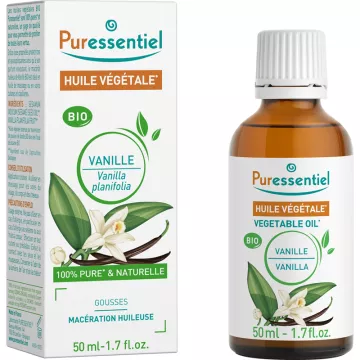
Does vanilla have a true essential oil—and how does it differ from the extract?
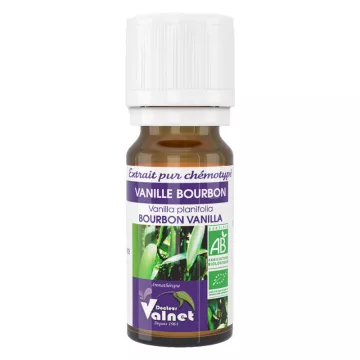
Vanilla (Vanilla planifolia, V. tahitensis, V. pompona) is not steam-distilled—its vanillin and other valuable compounds (coumarins, p-hydroxybenzoate) cannot withstand the heat of distillation without breaking down. What is found in aromatherapy under the name “vanilla essential oil” is always an absolute, an oleoresin, or a CO₂ extract.
- Vanilla absolute: solvent extraction from the pods—the most complete profile, the note closest to real vanilla—used in natural perfumery and emotional aromatherapy
- Vanilla oleoresin: a thick extract obtained through ethanol extraction—high viscosity, dark brown color—deep, warm note
- Vanilla CO₂ extract: a modern process free of residual organic solvents—clean profile, well-suited for cosmetic care
- Vanilla food extract: hydroalcoholic dilution of the pods — used in baking and beverages — different from cosmetic and aromatherapy products
- On a cosmetic label: “Vanilla planifolia fruit extract” or “Vanilla planifolia pod extract”—the terms “absolute” or “CO₂” specify the extraction method
What are the properties of vanilla in emotional aromatherapy?
Vanillin—the main active ingredient in fermented pods—stimulates the limbic system with a warm, sweet, and enveloping note that almost universally triggers a response of calm and comfort.
Vanilla’s effect on emotional well-being is one of the best-documented in neuroaromatherapy. Vanillin modulates endogenous opioid receptors—this mechanism explains its calming effect and its association with feelings of safety and comfort. This is why it is used in medical settings (neonatal units, operating rooms) to reduce anxiety.
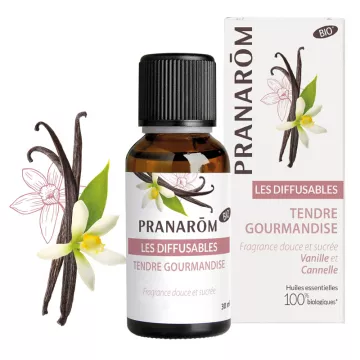
- Diffusion: 2–3 drops of absolute or oleoresin in a diffuser—a very long-lasting and enveloping scent—ideal for relaxing evenings
- Warm scent combinations: vanilla + sandalwood + patchouli —an enveloping oriental trio for moments of emotional recovery
- Vanilla + true lavender —the “absolute sweetness” blend for those experiencing nighttime anxiety or difficulty waking up
- On the wrists: 1 drop of absolute diluted to 5%—long-lasting fragrance, soothing effect through the sense of smell
How is vanilla used in skincare products?
Its antioxidant properties and luxurious scent make it a premium cosmetic ingredient—found in high-end skin and hair care products.
- Vanillin is a documented free-radical scavenger—found in anti-aging serums and complexion-brightening treatments
- Sensitive skin: 0.5–1% CO₂ vanilla extract in a cream base—a soft, soothing scent and a protective antioxidant profile
- Luxury body care: vanilla massage oil—0.5% vanilla absolute in macadamia or sweet almond oil—a lingering scent and silky texture
- Base note in natural perfumery: vanilla anchors and enriches floral and woody accords—just a few drops in a blend are enough
- See our anti-aging skincare products
What are the differences between vanilla varieties in cosmetics?
Not all vanillas are created equal—the aromatic profile and vanillin content vary depending on the species and origin.
- V. planifolia (Madagascar/Bourbon, Mexico): the highest in vanillin (1.5–2.5%)—warm, round, classic note—the benchmark for absolutes in perfumery and cosmetics
- V. tahitensis (Tahiti): richer in heliotropin and coumarin—more floral, anise-like, and fruity notes—rare and precious—used in high-end cosmetic products with an exotic scent
- V. pompona (Central America): less commonly used in cosmetics—has a woodier, less refined scent
What precautions should be taken with vanilla-based products?
- Vanillin is listed as a potential allergen under EC Regulation 1223/2009 — mandatory declaration on cosmetic labels above certain thresholds
- Coumarins (found mainly in V. tahitensis) may be slightly photosensitizing at high concentrations—preferably use on the skin in the evening or with sunscreen
- Allergy to Orchidaceae: rare but possible—perform a skin test before extensive use
- Solvent-extracted absolute: check for the absence of residues—prefer CO₂ extracts for frequent skin care