Which sandalwood should you choose—white, Australian, or red?
The term “sandalwood” encompasses several species and even distinct botanical genera. Checking the label helps avoid disappointment.
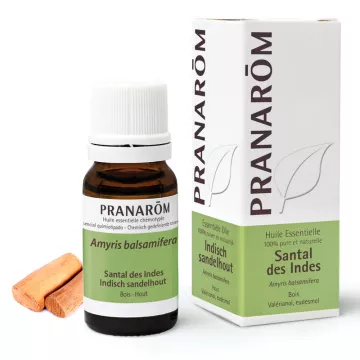
Santalum album (white sandalwood from Mysore, India) is the gold standard in perfumery and aromatherapy. α-santalol and β-santalol account for 85–90% of the essential oil—one of the highest concentrations of sesquiterpene alcohols among all essential oils. It is also the most overexploited species: S. album is classified as “vulnerable” on the IUCN Red List. Choose a certified and traceable essential oil.
- Santalum spicatum (Australian sandalwood): similar profile but lower in santalols (50–65%)—less expensive, less rare, more sustainable option—drier scent, slightly more camphor-like
- Pterocarpus santalinus (red sandalwood): botanically distinct—no essential oil—used primarily as a dye and in Ayurvedic medicine—no olfactory resemblance to white sandalwood
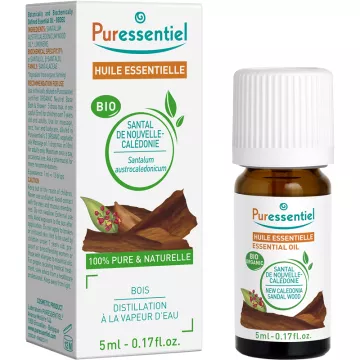
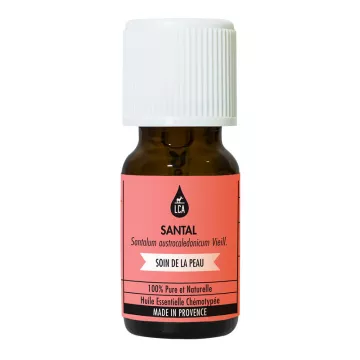
- On the label: check for“Santalum album” to ensure it’s true white sandalwood—low-priced “sandalwood” products are often Australian sandalwood or synthetic blends
What are the properties of white sandalwood essential oil?
Its dominant sesquiterpenol profile gives it an action very different from that of common essential oils—gentle, deep, and long-lasting.
α-Santalol and β-santalol are highly stable and long-lasting sesquiterpene alcohols—which is why sandalwood is the natural fixative par excellence in perfumery: it anchors and prolongs all the other notes in a blend. Biologically, santalols have a documented soothing effect on the autonomic nervous system, an astringent effect on mucous membranes (traditional ENT use), and benefits for dry and sensitive skin.
- The most persistent base note among natural essential oils—sandalwood essential oil applied in the morning can still be detected in the evening
- Emotional grounding: sandalols modulate the limbic system—providing a centering and calming effect without sedation
- Supports sleep and deep relaxation: 3–5 drops in a diffuser for 20 minutes—combine with true lavender or frankincense
How to use sandalwood in skincare?
Its sesquiterpenol profile makes it one of the gentlest cosmetic active ingredients—ideal for sensitive and mature skin.
- Sensitive and reactiveskin: 0.5–1% in jojoba or muscat rose oil—santalols soothe redness and support the integrity of the skin barrier
- Anti-aging serum: 0.5% white sandalwood + 0.5% ylang-ylang in a muscat rose base—the silkiest woody-floral combination for mature skin
- Skincare for Oily Skin and Breakouts: Santalols have a mild astringent effect—1% in jojoba oil as a regulating evening serum
- See our anti-aging facial care products
Why is sandalwood irreplaceable in natural perfumery?
It’s its signature property—and the reason perfumers have sought it out for centuries.
Sandalwood is the most effective natural fixative in the plant kingdom. When added to a blend of essential oils or a fragrance formula, it prolongs the longevity of all other notes—particularly florals (rose, jasmine, ylang-ylang) and citrus notes, which evaporate quickly on their own. This is one of the most valuable properties in artisanal natural perfumery.
- Meditation blend: sandalwood + frankincense + patchouli —the ultimate grounding woody-resinous trio
- Luxury base note: sandalwood + ylang-ylang + rose absolute—the creamy floral-woody accord of oriental fragrances
- Sandalwood incense: a more complex fragrance than the essential oil—when burned, the wood reveals complementary milky and smoky notes
What precautions should be taken with sandalwood?
- Pregnant and breastfeeding women: not recommended as an essential oil
- Children under 6: diffusion for short periods only; do not apply to the skin
- Allergy to aromatic woods: skin test — cross-reactivity with patchouli is possible
- Dilute to 1–3% for topical use
- Ethical sourcing required: S. album is a protected species — choose only certified essential oils with traceability to the source forest