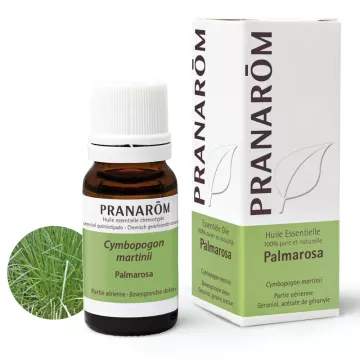
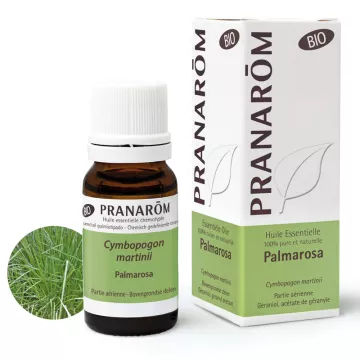
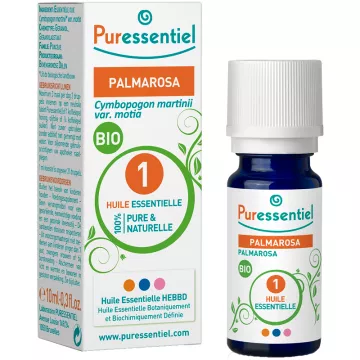
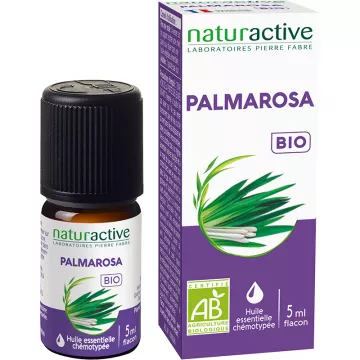
Palmarosa (Cymbopogon martinii var. motia) is a tropical Indian grass whose essential oil contains 75 to 90% geraniol—a concentration far higher than that of rose geranium (15–25%). It’s the aromatherapy shortcut to reaping the benefits of geraniol—for skin, fungal infections, and sebum—without paying the price of Bourbon geranium. Its scent is sweet, floral, and slightly rosy, with a hint of herbaceousness. Explore our aromatherapy line.
Palmarosa vs. Geranium: Which One Should You Choose?
Same key active ingredient (geraniol), similar uses, very different prices—here’s how to choose.
- Palmarosa: 75–90% geraniol—concentrated, economical—excellent for oily skin, fungal infections, as a natural deodorant, and for seasonal diffusion
- Rose Geranium: 15–25% geraniol + citronellol + esters — more complex profile — best for emotional balance, delicate combination skin, and anti-aging serums
- For uses where geraniol is sufficient (fungal infections, sebum control, deodorization): palmarosa offers unbeatable value for money
- For emotional well-being and refined anti-aging skincare: rose geranium remains superior
- Check the variety on the label: Cymbopogon martinii var. motia (palmarosa, floral) vs. var. sofia (gingergrass, camphor-like) — two different oils
Palmarosa for oily and acne-prone skin?
Its high geraniol content makes it one of the most effective sebum-regulating active ingredients in aromatherapy.
- Acne-prone and combinationskin: 1% in jojoba oil at night—regulates sebum production and gently cleanses pores
- Natural deodorant: 2–3% in aloe vera gel or a light oil—geraniol neutralizes odor-causing bacteria without blocking perspiration
- Mature skin that is beginning to lose firmness: 0.5% in a night cream or musk rose oil—regenerating effect on tired skin
- Oily or dandruff-prone scalp: 3 drops in shampoo—sebum-regulating and purifying effect, with a subtle and pleasant scent
Palmarosa against fungal infections?
This is where palmarosa outperforms geranium—high doses of geraniol have been shown to be effective against several fungal species.
- Athlete’s foot and nailfungus: 5–10% in a vegetable oil (coconut, calophyllum)—apply morning and evening to the affected areas; treatment course of 4 to 6 weeks
- High-concentration geraniol inhibits Candida albicans and several dermatophytes —documented in vitro; clinical data are limited, but traditional use is well established
- Purifying foot bath: 5 drops in lukewarm water with sea salt—15 minutes, 3 times a week
- Seek medical advice in cases of severe or recurrent fungal infections—palmarosa remains a complementary support, not a substitute treatment
- See our range of products for fungal infections
Palmarosa for Aromatherapy and Well-Being?
Its sweet floral scent makes it a pleasant essential oil to diffuse—and its geraniol has a calming effect when inhaled, as documented in studies.
- Diffuse 8–10 drops for 20 minutes—a light, floral-rose-herbal note that’s well-tolerated even in the workplace
- Supports relaxation and sleep: palmarosa + ylang-ylang —a soothing floral duo
- Body massage treatment: 2% in jojoba or sweet almond oil—relaxing effect and a pleasant, long-lasting scent
- Winter synergy: palmarosa + ravintsara + noble laurel — supports the body’s natural defenses when diffused
Precautions?
- Pregnant women (1st trimester) and infants under 3 months: not recommended — geraniol may affect hormonal balance
- Hormone-dependent cancers: seek medical advice — same note as for rose geranium (geraniol has potential estrogen-like activity)
- Dilute to 1–3% for topical use — geraniol: potential allergen (EC Regulation 1223/2009) at high concentrations
- Perform a patch test before widespread use if you have sensitive skin—palmarosa is well tolerated but not suitable for everyone