The first few hours of a foal’s life are critical to its survival. The “1-2-3” rule applies:
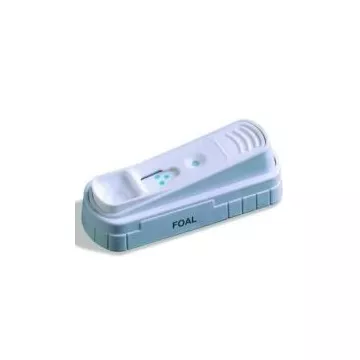
IgG testing kits (Snap Foal test) can be used to verify that passive immunity has been transferred—a level < 400 mg/dl indicates a deficiency requiring emergency intervention. Human infants and foals share this same vulnerability during the first few hours, when the quality of maternal colostrum is critical.
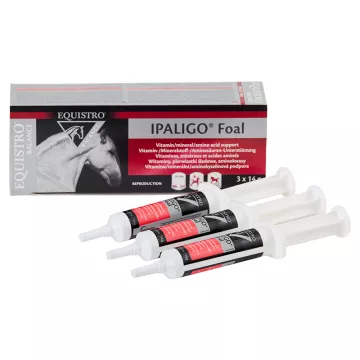
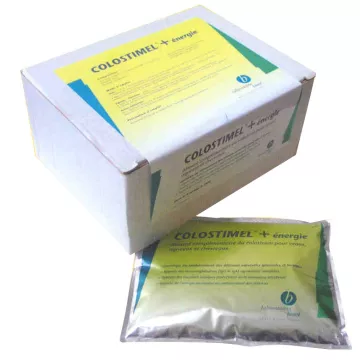
When the mare does not produce enough colostrum or the IgG test reveals insufficient transfer, several solutions are available. Syringes of synthetic immunoglobulins (administered orally within the first 12 hours, before the intestinal barrier closes) provide concentrated equine IgG. Substitute colostrum (powder to be reconstituted, derived from mares or cattle) meets minimum needs in an emergency. For orphaned or inadequately nursed foals, equine milk replacers (milk powder in 2.2 kg containers, with a composition similar to mare’s milk) enable artificial rearing. The young animal’s diet must follow a progression suited to its immature digestive system, as with any newborn.
A foal’s intestinal flora is virtually nonexistent at birth and develops gradually. Probiotic injections (Lactobacillus, Bifidobacterium, Saccharomyces boulardii) administered within 24 hours of birth and repeated for 5 to 7 days accelerate the establishment of a balanced flora, reducing the risk of neonatal diarrhea (common at 7–10 days, associated with the activation of digestive enzymes). Colic in foals (meconium plugs, intussusception, gas colic) can be fatal if not treated promptly—they require immediate emergency veterinary care. Royal jelly (10-HDA + B vitamins) can support the immune system development of very young foals.
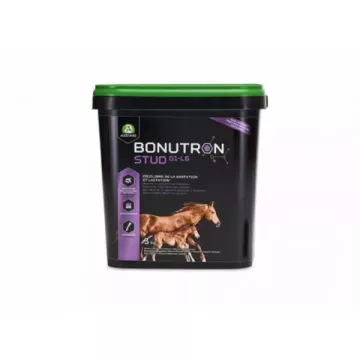
The quality of the foal at birth depends largely on the mare’s nutrition during the last trimester of gestation (80% of fetal growth occurs during this period). Requirements for energy, protein, calcium, phosphorus, vitamins A, D, and E, and trace minerals increase significantly. Vitamin A (retinol) is critical for fetal lung and eye maturation. Manganese is essential for the strength of the foal’s cartilage and bones—a deficiency during gestation is associated with dyschondroplasia and angular limb deformities at birth. The nursing mare pellets provide all of these nutrients in a convenient format.
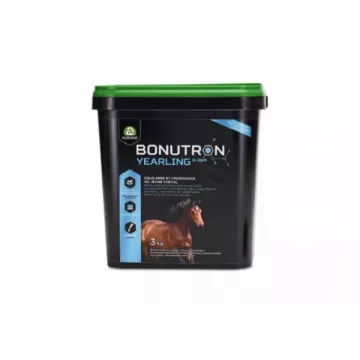
Weaning (5 to 6 months) and the yearling period (6 to 36 months) are key stages. The base ration must be supplemented with appropriate growth pellets that meet the requirements for protein (lysine, methionine), minerals (calcium, phosphorus, magnesium, zinc, copper), and vitamins (A, D, E, B complex). Excess energy should be avoided—a yearling that is too fat develops serious musculoskeletal disorders (OCD, dyschondroplasia). Royal jelly serves as a natural vitality supplement for young horses undergoing rapid growth or recovering from illness. At every stage, breeding animals deserve care that is just as rigorous as that provided to pets.
Several situations require immediate veterinary intervention in a newborn foal: failure to stand within 2 hours, failure to nurse within 4 hours, failure to pass meconium within 6 hours, signs of colic (restlessness, abdominal pain, rolling), hyperthermia or hypothermia, extreme weakness (foal unable to stand). The “limp foal” or prematurity/dysmaturity syndrome is a neonatal emergency requiring intensive care. Preventive veterinary care includes vaccination against equine influenza and tetanus (starting at 5–6 months), deworming (starting at 8 weeks, every 2 months until 1 year of age), and developmental assessments. The quality of a foal’s early development determines its entire future career—early care is a fundamental investment forall the animals in our care.