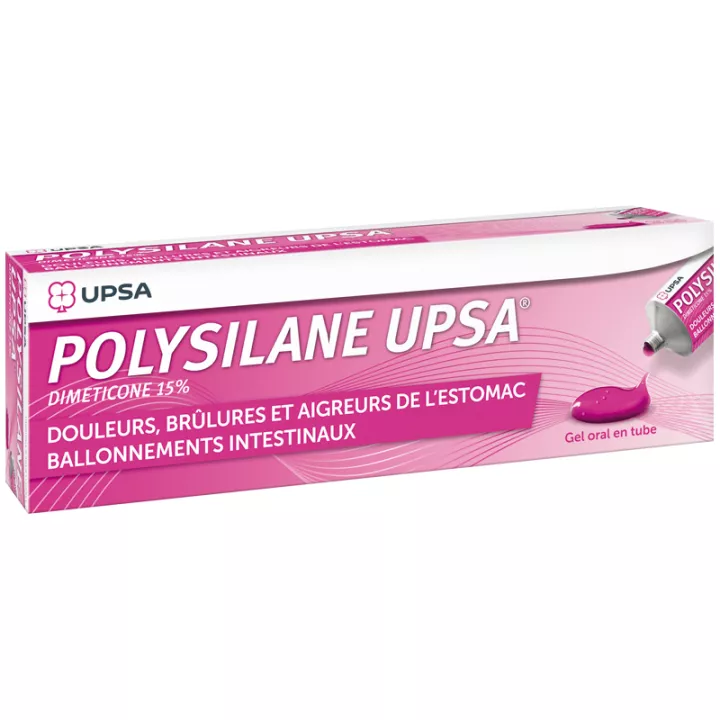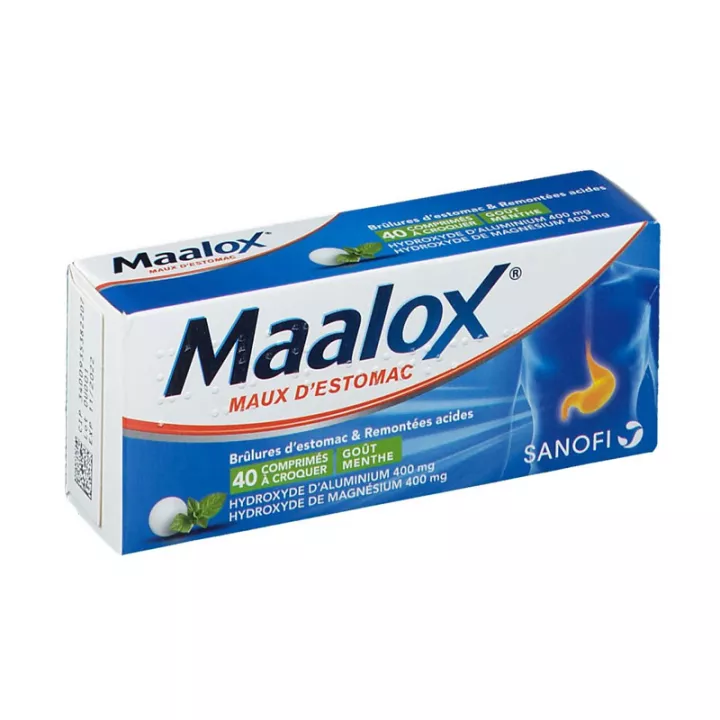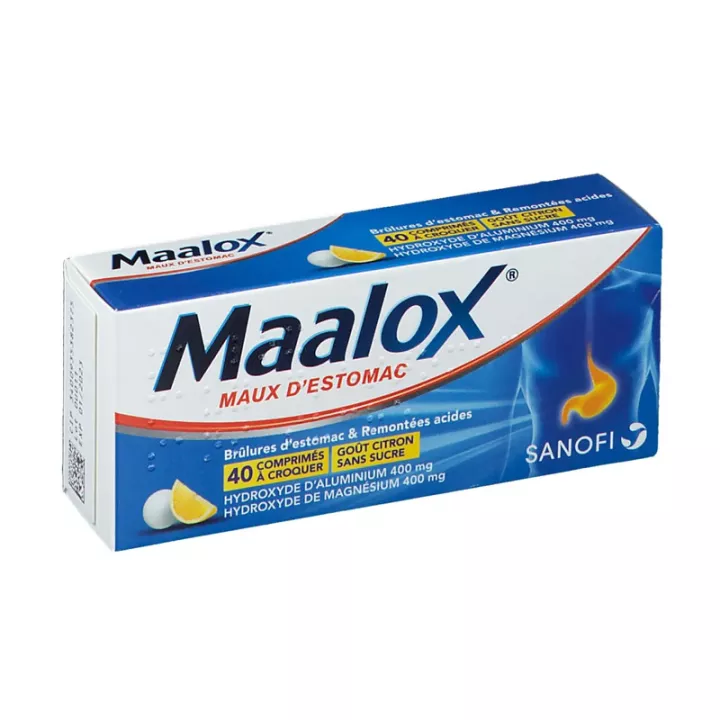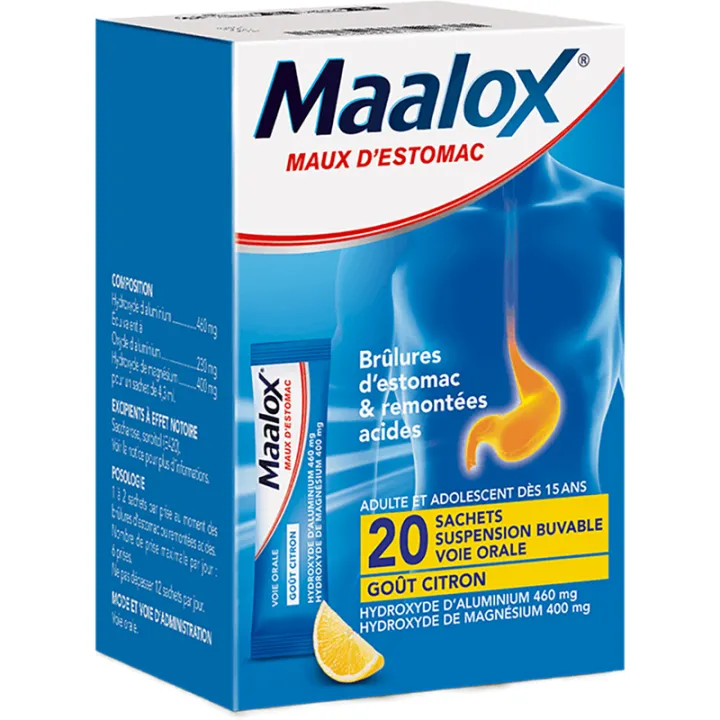
Maalox lemon flavor is a medication containing antacids which act locally to neutralize the acids secreted by the stomach. It is indicated for adults (aged 15 and over) in the treatment of heartburn and acid reflux.

For warnings, precautions and contraindications, please refer to the Maalox sachet package insert.
When healthy lifestyle measures aren't enough, your doctor or pharmacist may recommend several types of medication to treat heartburn and acid reflux. Each type has a different mode of action. Locally-acting antacids reduce or neutralize the acidity of the gastric juice already secreted. Antacids are sometimes combined with alginates, substances which form a viscous gel that floats in the stomach.
For effective, natural relief from acid reflux, we recommend you explore Charcoal for Acid Reflux, available in pharmacies under the Belloc brand. As they act on the symptoms, they should be taken at the time of trouble, or in situations that may encourage it (heavy meals, etc.). Their effect is immediate, but sometimes short-lived.
Maalox Lemon Flavor is a drug containing local antacids which neutralize the acids secreted by the stomach. It is indicated for adults (aged 15 and over) to relieve heartburn and acid reflux . For adults only
Active ingredients :
Excipients:
64% sucrose syrup, liquid (non-crystallizing) sorbitol (E420), xanthan gum, guar gum, sodium chloride, lemon-lime flavoring (lemon essential oil, vitamin E, lemon terpene, grapefruit, distilled lime, orange essential oils, coconut oil, citral).
Notable excipients:
One sachet contains 3.15 g sucrose and 0.14 g sorbitol (E420) (see Warnings and Precautions for use).
1 to 2 sachets per dose at the time of pain. The maximum number of doses per day is 6, with a maximum of 12 sachets per day.
Contraindications of Maalox sachet
Read the leaflet for Maalox Lemon Flavor sachet carefully.
Maalox sachet packaging
Box of 20 oral suspension sachets
Summary of product characteristics (ANSM)
Warning: Maalox lemon flavor sachet is not a product like any other. Read the package insert carefully before ordering. Keep Maalox lemon, red fruit and mint flavour sachets out of the reach of children. If symptoms persist, ask your doctor or pharmacist for advice. Be aware of incompatibilities with your current products.
Pharmacovigilance Report an adverse drug reaction(s)
ANSM - Updated: 12/12/2017
Aluminum hydroxide / magnesium hydroxide
You should always take this medicine exactly as described in this leaflet or by your doctor or pharmacist.
· Keep this leaflet. You might need to read it again.
· Talk to your pharmacist for any advice or information.
· If you get any side effects, talk to your doctor or pharmacist. This also applies to any undesirable effects that are not mentioned in this leaflet. See section 4.
· You should talk to your doctor if you do not feel better or if you feel worse.
What does this booklet contain ?
1. What is MAALOX STOMACH MALE HYDROXIDE ALUMINUM HYDROXIDE / MAGNESIUM HYDROXIDE 460 mg / 400 mg, oral suspension in sachet and in which cases is it used?
2. What you need to know before taking MAALOX STOMACH MALE HYDROXIDE ALUMINUM HYDROXIDE / MAGNESIUM HYDROXIDE 460 mg / 400 mg, oral suspension in sachet?
3. How to take MAALOX STOMACH MALE HYDROXIDE ALUMINUM HYDROXIDE / MAGNESIUM HYDROXIDE 460 mg / 400 mg, oral suspension in sachet?
4. What are the possible side effects?
5. How to store MAALOX STOMACH MALE HYDROXIDE ALUMINUM / MAGNESIUM HYDROXIDE 460 mg / 400 mg, oral suspension in sachet?
6. Contents of the package and other information.
Pharmacotherapeutic group: Anti-acid, ATC code: A02AD01
(A: digestive system and metabolism).
MAALOX MAUX D'ESTOMAC contains aluminum hydroxide and magnesium hydroxide. This medicine belongs to the antacid family. They act by neutralizing the acidity of the stomach.
This medicine is used to relieve heartburn and acid reflux.
It is reserved for adults and teenagers from the age of 15.
If you have been told by your doctor that you have an intolerance to some sugars, contact your doctor before taking this medicine.
· if you are allergic to aluminum hydroxide or magnesium hydroxide or to any of the other ingredients of this medicine, listed in section 6.
· if you have severe kidney disease (severe kidney failure).
If in doubt, it is essential to seek the advice of your doctor or pharmacist.
Warnings and precautions
Talk to your doctor or pharmacist before taking MAALOX STOMACH MALE HYDROXIDE ALUMINUM / MAGNESIUM HYDROXIDE 460 mg / 400 mg, oral suspension in sachet :
· if your troubles are associated with weight loss,
· if you have difficulty swallowing or persistent abdominal discomfort,
· if you have digestive disorders for the first time or if these disorders have recently changed,
· if you have kidney disease (kidney failure) or if you are on dialysis, you should consult a doctor because MAALOX MAUX D'ESTOMAC contains aluminum and magnesium. The accumulation of aluminum and magnesium can lead to a serious neurological disease (encephalopathy).
This medication may cause or worsen constipation in at-risk patients such as the renally impaired and the elderly.
Prolonged use of this drug should be avoided in patients with renal impairment.
Medical advice is recommended for prolonged use or if you have a risk of lack of phosphorus (eg low phosphorus diet).
This medicine contains sucrose and sorbitol. It is not recommended for use in patients with fructose intolerance, glucose-galactose malabsorption or sucrase / isomaltase deficiency.
This medicine contains 3.15 g of sucrose per sachet which should be taken into account in the daily ration in case of low sugar diet or diabetes.
children
Not applicable.
Other medicines and MAALOX STOMACH MALE HYDROXIDE ALUMINUM / MAGNESIUM HYDROXIDE 460 mg / 400 mg, oral suspension in sachet
MAALOX MAUX D'ESTOMAC interacts with other drugs taken orally. Do not take MAALOX MAUX D'ESTOMAC and another medicine at the same time, and take at least 2 hours between taking them.
Some medications may be influenced by magnesium hydroxide or affect the effectiveness of magnesium hydroxide. Tell your doctor or pharmacist if you are already taking:
· Salicylates.
This medicine contains antacids (aluminum hydroxide and magnesium hydroxide). Other medicines contain it. Do not combine them, so as not to exceed the recommended maximum doses ( see instructions for use and dosage ). |
Tell your doctor or pharmacist if you are taking, have recently taken or might take any other medicines.
MAALOX STOMACH MALE ALUMINUM HYDROXIDE / MAGNESIUM HYDROXIDE 460 mg / 400 mg, oral suspension in sachet with food and drink
Not applicable.
This medicine will only be used during pregnancy on the advice of your doctor.
The use of this medicine is possible during breastfeeding.
Ask your doctor or pharmacist for advice before taking any medicine.
Driving and using machines
Not applicable.
MAALOX STOMACH MALE HYDROXIDE ALUMINUM / MAGNESIUM HYDROXIDE 460 mg / 400 mg, oral suspension in sachet contains sucrose and sorbitol (E420).
This medicine is reserved for adults and adolescents from 15 years old.
Dosage
The usual dose is 1 to 2 sachets per dose at the time of heartburn or acid reflux.
You must not exceed 6 shots per day (6 to 12 bags).
Administration mode
Thoroughly mix the bag before opening.
Absorb the suspension as it is without diluting it.
Duration of the treatment
The duration of use is limited to 10 days. |
If symptoms worsen or persist after 10 days of treatment, do not increase the dose but consult your doctor or pharmacist.
If you take more than MAALOX STOMACH MALE HYDROXIDE ALUMINUM HYDROXIDE / MAGNESIUM HYDROXIDE 460 mg / 400 mg, oral suspension in sachet that you should have
Consult your doctor or your pharmacist.
Oral overdosage of magnesium does not, in general, lead to toxic reactions in normal kidney function. Magnesium intoxication can, however, develop in kidney failure.
If you forget to take MAALOX STOMACH MALE HYDROXIDE ALUMINUM HYDROXIDE / MAGNESIUM HYDROXIDE 460 mg / 400 mg, oral suspension in sachet
Not applicable.
If you stop taking MAALOX STOMACH MALE HYDROXIDE ALUMINUM HYDROXIDE / MAGNESIUM HYDROXIDE 460 mg / 400 mg, oral suspension in sachet
Not applicable.
4. WHAT ARE THE POSSIBLE SIDE EFFECTS?
Like all medicines, this medicine can cause side effects, although not everybody gets them.
Adverse effects can occur at the frequencies defined below:
Very rare (may affect up to 1 in 10,000 people)
· hypermagnesemia. This has been observed after prolonged administration to patients with renal insufficiency
Not known frequency (frequency can not be estimated from available data)
· diarrhea or constipation,
· abdominal pain,
· decrease in the amount of phosphorus in the blood if you use this medicine for a long time or at high doses,
· increase in the amount of aluminum in the blood,
· allergic reaction :
o pimples and / or redness on the skin,
o urticaria,
o abrupt swelling of the face and neck may cause difficulty breathing (Quincke's edema),
o sudden discomfort with significant drop in blood pressure (anaphylactic shock).
Declaration of side effects
If you get any side effects, talk to your doctor or pharmacist. This also applies to any undesirable effects that are not mentioned in this leaflet. You can also report side effects directly via the national reporting system: National Agency for the Safety of Medicines and Health Products (ANSM) and the network of Regional Pharmacovigilance Centers - Website: www.ansm.sante.fr
By reporting side effects, you can help provide more information on the safety of the medicine.
Keep this medicine out of the sight and reach of children.
Do not use this medicine after the expiry date which is stated on the carton after EXP. The expiry date refers to the last day of this month.
This medicine does not require any special storage precautions.
Do not dispose of any medication in the sewage system or garbage. Ask your pharmacist to eliminate medications you no longer use. These measures will help protect the environment.
6. CONTENTS OF PACKAGING AND OTHER INFORMATION
· Active substances are:
Aluminum hydroxide .............................................. .................................................. ... 460 mg
Equivalent to aluminum oxide ............................................ .......................................... 230 mg
Magnesium hydroxide ............................................... ............................................... 400 mg
For a sachet of oral suspension.
· The other ingredients are: 64% sucrose syrup, liquid sorbitol (non-crystallizable) (E420), xanthan gum, guar gum, sodium chloride, lemon-green lemon flavor *.
* Composition of the lemon-lime aroma: lemon essential oil, vitamin E, lemon-terpene essential oil, grapefruit essential oil, distilled lime essential oil, orange essential oil, coconut oil, citral.
See section 2.
This medication is in the form of an oral suspension in sachets.
Box of 10, 20, 30 or 50 sachets.
Not all presentations may be marketed.
Marketing Authorization Holder
82 AVENUE RASPAIL
94250 GENTILLY
Operator of the marketing authorization
SANOFI-AVENTIS FRANCE
82 AVENUE RASPAIL
94250 GENTILLY
SANOFI SPA
VIALE EUROPA, 11
21040 ORIGGIO (VA)
ITALY
or
A. NATTERMANN & CIE GMBH
NATTERMANN ALLEE 1
50829 COLOGNE
GERMANY
Names of the medicine in the member states of the European Economic Area
Not applicable.
The last date this leaflet was revised is:
{MM / YYYY}.
Detailed information on this medicine is available on the ANSM website (France).
COUNCIL OF HEALTH EDUCATION:
This medicine is intended to relieve your stomach upset.
Heartburn, acid reflux can be due to changes in diet (acidic or spicy food, alcoholic beverages ...) or taking certain drugs (aspirin, anti-inflammatory ...). Do not hesitate to talk to your doctor or pharmacist.
In order to limit the appearance of symptoms, respect as much as possible, the following hygiene rules:
· avoid heavy meals and high fat,
· avoid certain foods such as chocolate, spices, peppers, citrus juices, soft drinks,
· vary your diet,
· normalize your weight and exercise,
· avoid the practice of a major effort just after the meal,
· avoid smoking and limit alcohol consumption.
YOUR PHARMACIST, YOUR DOCTOR, KNOW THE MEDICINES.
DO NOT HESITATE TO REQUEST PRECISIONS
NEVER LEAVE A MEDICINAL DRINK FOR CHILDREN.
Ce médicament contient des antiacides d'action locale. Ils agissent en neutralisant les acides sécrétés par l'estomac.
Il est utilisé dans le traitement des brûlures d'estomac et des remontées acides.
Les prix mentionnés ne tiennent pas compte des « honoraires de dispensation » du pharmacien.
La dernière mise à jour des informations contenues dans cette fiche médicament ne concerne que les présentations toujours commercialisées.
| p cp menthe | p cp sans sucre | |
| Aluminium hydroxyde | 400 mg | 400 mg |
| Magnésium hydroxyde | 400 mg | 400 mg |
| Saccharose | + | |
| Sorbitol | + | + |
| Maltitol | + |
| p sachet | p c à s | |
| Aluminium hydroxyde | 460 mg | 525 mg |
| Magnésium hydroxyde | 400 mg | 600 mg |
| Saccharose | 3,15 g | |
| Sorbitol | + | + |
Ce médicament ne doit pas être utilisé en cas d'insuffisance rénale grave.
Il est préférable de consulter un médecin dans les situations suivantes :
troubles de la digestion apparaissant pour la première fois, ou si les troubles ont changé récemment ;troubles associés à une perte de poids ;difficulté à avaler ou gêne abdominale persistante.N'utilisez pas ce médicament de façon prolongée sans l'avis de votre médecin : des examens peuvent être nécessaires si les symptômes persistent.
Compte tenu de la teneur en aluminium de ce médicament, des précautions sont recommandées chez les insuffisants rénaux traités par dialyse.
Les personnes souffrant de douleurs d'estomac doivent éviter d'utiliser des médicaments contenant de l'aspirine ou des AINS qui fragilisent la muqueuse de l'estomac. Le paracétamol est en revanche sans danger pour traiter les douleurs ou la fièvre.
Les sachets de suspension buvable contiennent du sucre (saccharose) en quantité notable.
Ce médicament peut diminuer l'absorption de nombreux médicaments. Un délai d'au moins 2 heures (voire 4 heures avec les antibiotiques de la famille des quinolones) doit être respecté entre la prise de ce médicament et celle des autres traitements. Demandez conseil à votre médecin ou à votre pharmacien.
Les substances contenues dans ce médicament sont peu absorbées. Néanmoins, ne l'utilisez pas de façon prolongée pendant la grossesse ou l'allaitement sans l'avis de votre médecin ou de votre pharmacien.
Ce médicament doit être pris au moment des douleurs d'estomac ou des remontées acides.
Les comprimés sont à sucer ou à croquer.
La suspension buvable doit être avalée telle quelle, sans être diluée. Le sachet doit être malaxé avant ouverture.
Une alimentation équilibrée, une mastication lente, la suppression des aliments difficiles à digérer et des boissons alcoolisées permettent souvent d'atténuer les symptômes dus aux remontées acides ou à une inflammation de l'estomac.
Si vous êtes fumeur, la poursuite du tabagisme est un frein important au traitement ; la nicotine augmente l'acidité gastrique et réduit l'efficacité du muscle qui ferme la jonction entre l'œsophage et l'estomac.
Ce médicament peut être en accès libre (ou accès direct) dans certaines pharmacies ; dans ce cas, faites valider votre choix par votre pharmacien.
Constipation ou diarrhée : les sels d'aluminium favorisent la constipation alors que le magnésium peut avoir un effet laxatif. Suivant les personnes, l'un ou l'autre de ces effets peut prédominer.
Douleurs abdominales.
Réaction allergique (démangeaisons, rougeur cutanée, urticaire, choc).
Médicament qui neutralise l'acidité des sécrétions gastriques ou qui bloque les glandes responsables de la sécrétion d'acide.
Malaise brutal et grave avec chute de la pression artérielle. Les principales causes de choc sont les allergies (choc allergique ou anaphylactique), les troubles cardiovasculaires graves (choc cardiovasculaire) et les septicémies (choc septique).
Procédé d'épuration du sang en cas d'insuffisance rénale grave, assurée essentiellement par l'emploi d'un rein artificiel.
Incapacité des reins à éliminer les déchets ou les substances médicamenteuses. Une insuffisance rénale avancée ne se traduit pas forcément par une diminution de la quantité d'urine éliminée. Seuls une prise de sang et le dosage de la créatinine peuvent révéler cette maladie.
Réaction due à l'hypersensibilité de l'organisme à un médicament. Les réactions allergiques peuvent prendre des aspects très variés : urticaire, œdème de Quincke, eczéma, éruption de boutons rappelant la rougeole, etc. Le choc anaphylactique est une réaction allergique généralisée qui provoque un malaise par chute brutale de la tension artérielle.
Consultez l'article : Peut-on être allergique aux médicaments ?.
Le saccharose est la substance qui compose le sucre de cuisine et le sucre industriel que l'on retrouve dans les biscuits, les gâteaux, les sucreries et les boissons sucrées (une bouteille d'un litre et demi de soda contient l'équivalent de trente morceaux de sucre). Certaines personnes sont intolérantes au fructose issu de la digestion du saccharose et souffrent alors de ballonnements et de diarrhée. Certains médicaments contiennent du saccharose comme excipient (composant sans activité thérapeutique).
Consultez l'article : Tous les glucides sont-ils équivalents ?.
Le sorbitol est un sucre que l'on trouve dans certains fruits (les pruneaux par exemple). Parce qu'il est moins calorique que le sucre industriel (saccharose), il est utilisé comme édulcorant (sous le sigle E420) mais également comme stabilisateur, par exemple dans certains médicaments. Lors de la digestion, le sorbitol est transformé en fructose (sucre des fruits). Certaines personnes ont du mal à digérer le fructose et, de ce fait, présentent des troubles intestinaux (diarrhées) lorsqu'elles ingèrent un produit contenant du sorbitol.
Terme général désignant différentes substances dont la plus répandue est le saccharose. D'autres sucres peuvent être contenus dans les médicaments : glucose, fructose, lactose, etc. Le glucose est le sucre utilisé par l'organisme ; il est le seul à circuler en quantité notable dans le sang.
Les édulcorants (faux sucre) sont autorisés chez les diabétiques ou les personnes suivant un régime, et sont très peu caloriques.
Consultez l'article : Tous les glucides sont-ils équivalents ?.
Éruption de boutons sur la peau, dont l'origine est le plus souvent allergique. Les boutons ressemblent à des piqûres d'orties et leur couleur varie du rose pâle au rouge. L'urticaire peut apparaître ou disparaître en quelques minutes, et provoque d'intenses démangeaisons ; elle peut être localisée ou généralisée à la totalité de la surface cutanée.