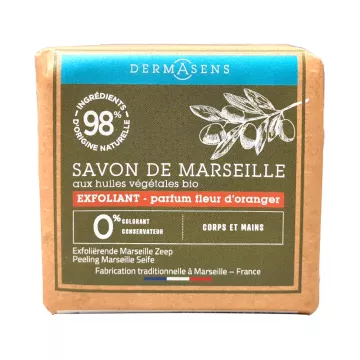
What is real Marseille soap, and how can you tell it apart?
Marseille soap is one of the most imitated plant-based soaps in the world—and one of the least legally protected. There is no official PGI (Protected Geographical Indication) for Marseille soap, which allows any brand to use this name without any guarantee of authenticity. For those with sensitive skin looking for a soap they can trust, here’s how to spot the real thing.
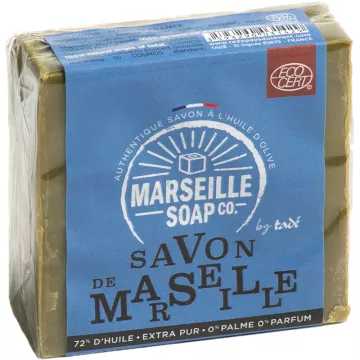
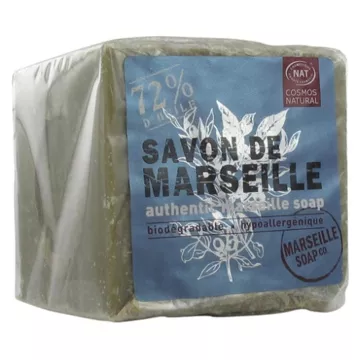
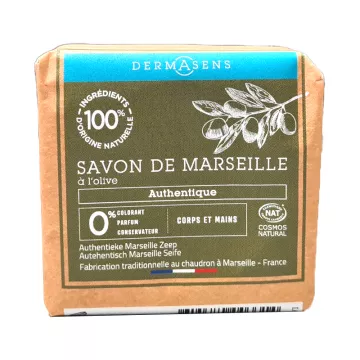
- "72% oil" stamp: Authentic bars from the Marseille region bear this marking—it indicates that the soap contains 72% saponified vegetable oils, with the remainder being water and salt—a lower percentage indicates a less concentrated product
- Color: green (made with olive oil) or white/beige (coconut or palm oil)—both are authentic if the composition is pure
- Minimal INCI: “sodium olivate” (or “sodium cocoate”) + “aqua” + “sodium chloride”—no fragrance, no dyes, and no preservatives in pure Marseille soap
- Made in Marseille: the historic soap factories (Marius Fabre, La Licorne, Rampal Latour) still produce soap using the traditional hot-cauldron method
What are the uses of Marseille soap for the skin?
Marseille soap is the Swiss Army knife of natural hygiene products —but its alkaline profile (pH 9–10) makes it less suitable than syndets for very sensitive skin.
For dry skin, the green bar made with superfatted olive oil is preferable to the white bar, which is richer in coconut oil—olive oil provides more softness and nourishment. For mild acne-prone skin, white Marseille soap (coconut oil) offers deep cleansing without the harsh ingredients found in traditional purifying gels.
- Body: a versatile, long-lasting, and economical daily cleanser—a 300-gram bar lasts 2–3 months for one person
- Face: Suitable for normal skin that tolerates alkaline pH well— sensitive and reactive skin types will prefer a superfatted soap or a syndet
- Shaving: Lathering Marseille soap in your hands creates a lubricating emulsion for a smooth shave—a well-established traditional use
Marseille soap for hair: how to use it without leaving residue?
Using Marseille soap as shampoo is entirely possible, provided you manage its alkaline pH on the scalp. Unlike a shampoo formulated with a pH of 4.5–5.5, Marseille soap leaves hair dull and tangled if the residual alkalinity isn’t neutralized.
- Systematic acidic rinse: 1 tbsp of apple cider vinegar in 500 mL of lukewarm water after lathering—neutralizes the pH and closes the hair cuticles
- Ideal for oily hair: white (coconut) Marseille soap is more purifying than most natural shampoos—visible results after 2–3 weeks of use
- Not recommended for colored or severely damaged hair: the alkaline pH opens the cuticle and accelerates color fading
Marseille soap vs. Aleppo soap vs. artisanal plant-based soap: which one should you choose?
All three are part of the broad family of plant-based soaps —but their characteristics are quite distinct.
- Marseille soap: olive oil or coconut oil alone—the most versatile, for body, laundry, and household use—moderate cleansing action—standard alkaline pH
- Aleppo soap: olive oil + laurel — effective for problem skin and oily scalps — not suitable for laundry
- Cold-processed, superfatted artisanal soap: various oils + 5–10% superfatting agents—the most moisturizing and gentlest for dry skin—see our page on superfatted soap
- For organic certification of soap: see our organic soap page — Marseille soap can be certified organic if its oils are sourced from organic farming