Green anise, star anise, and caraway: three plants that look alike but aren’t interchangeable?
In pharmacy and herbal medicine, the term “anise” actually refers to three distinct plants—each with its own essential oil, precautions, and specific uses.
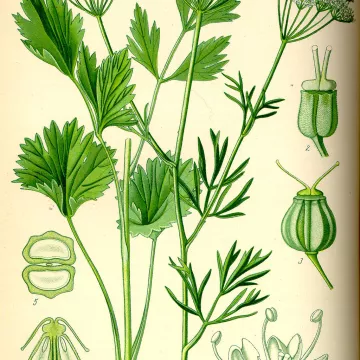
Green anise (Pimpinella anisum) is the classic medicinal plant in the European Pharmacopoeia. Its seeds, rich in trans-anethole, are recognized by the EMA/HMPC for digestive comfort and respiratory support. It is the plant used to make the anise tea found in French herbal shops.
Star anise (Illicium verum) is not botanically an “anise”—it is an Asian plant from a different family. Its essential oil (also dominated by trans-anethole) is more potent than that of green anise and shares the same precautions. In herbal medicine, the two complement each other but should not be interchanged lightly.
- Caraway (Carum carvi, “meadow cumin”): often confused with anise due to its slightly anise-like note—active ingredient carvone, different profile and precautions
- Fennel (Foeniculum vulgare): same main active ingredient (trans-anethole) as green anise—same hormone-dependent precautions—often more effective for bloating
What are the recognized digestive uses of green anise in herbal medicine?
This is the primary indication for green anise in Europe—documented since ancient times and confirmed by the EMA.
The trans-anethole in green anise relaxes the smooth muscles of the digestive tract and promotes the expulsion of gas—it is one of the most potent carminatives in the pharmacopoeia. The EMA recognizes its traditional use for mild digestive disorders: bloating, gas, and mild cramps after meals.
- Herbal tea: 1 c.c. of lightly crushed seeds in 250 mL of water at 90°C, steeped covered for 10 minutes—1 cup after heavy meals—mild and pleasant anise flavor
- Classic carminative combination: anise + fennel + caraway — the standard digestive trio in European herbal medicine
- Green anise essential oil: 1–2 drops (2% dilution) in vegetable oil, applied with circular abdominal massage—rapid relief from spasms—short course of treatment, not for daily use
- Anise lozenges and candies: superficial digestive comfort and fresh breath after meals—the most accessible use
How does anise support respiratory comfort?
Less well-known than its digestive uses, but long documented in traditional herbal medicine.
- Trans-anethole has a mild expectorant effect—mucus becomes thinner and easier to clear
- Herbal tea for a dry, irritating cough: green anise + cilantro — the gentlest herbal tea for the upper respiratory tract
- Essential oil for light diffusion: 4–5 drops, warm anise note, gentle respiratory note—less potent than eucalyptus but very well tolerated
What are the important precautions for anise?
Trans-anethole has an estrogen-like effect—a genuine precaution, not just a theoretical one.
- Pregnant women: not recommended in essential oil or concentrated extracts—occasional mild herbal tea is generally well-tolerated but should be limited
- Breastfeeding: Anise traditionally stimulates lactation—but scientific evidence is limited, and caution is advised with essential oil
- Hormone-dependent conditions (breast cancer, endometrial cancer, endometriosis): Avoid concentrated forms—seek medical advice
- Allergy to Apiaceae (fennel, celery, carrot, cumin): risk of cross-reactivity—test before extended use
- Essential oil: Not recommended for children under 12 years of age—very mild herbal tea only under pediatric supervision
- Duration of essential oil treatment: 2–3 weeks maximum — anethole accumulates with prolonged use