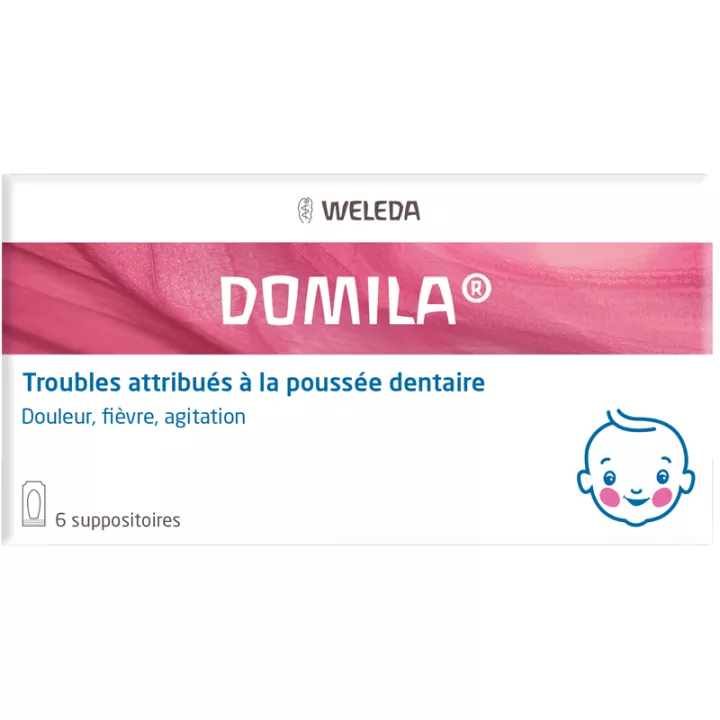
Weleda DOMILA (C 354) Homeopathic Suppositories is a homeopathic medicine indicated for teething disorders that may be accompanied by fever or restlessness (pain, fever, restlessness, etc.) in infants and children 3 months of age and older.

Order DOMILA homeopathic suppositories according to your homeopath’s prescription.
DOMILAⓇ is a homeopathic medicine in suppository form. Its unique formulation includes Argentum metallicum 19DH, Belladonna 3DH, Chamomilla vulgaris (root decoction) 2DH, Echinacea angustifolia Mother Tincture, and Gelsemium sempervirens (decoction) 4DH. This combination has been specifically formulated to provide effective relief during teething episodes, which are characterized by pain, fever, and restlessness in young children.
Weleda DOMILA homeopathic suppositories (C 354) provide natural and effective relief during difficult teething periods for infants and children. Designed specifically to soothe symptoms associated with teething, such as pain, fever, and restlessness, these suppositories are a gentle solution that avoids the need for stronger medications. By prioritizing natural ingredients, Weleda DOMILA ensures a gentle and appropriate approach for little ones, starting at 3 months of age.
Teething is an important stage in your child’s development, but it can be challenging for both little ones and parents. Weleda DOMILA suppositories (C 354) are here to support you during this time, offering comfort and relief to your child. Their homeopathic formula is specially designed to address teething discomfort that may be accompanied by fever or restlessness, thereby making this crucial growth phase easier.
Your child’s safety is paramount. That’s why Weleda DOMILA (C 354) undergoes rigorous quality controls, ensuring optimal effectiveness and tolerability. The Weleda brand, recognized for its expertise in natural and homeopathic products, guarantees a safe formulation tailored to the delicate needs of infants and children. Choose a trusted treatment designed to support your child’s well-being during teething.
DOMILA®, a suppository, is a homeopathic medication traditionally used for symptoms associated with teething (pain, fever, restlessness, etc.) in infants and children 3 months of age and older.
A homeopathic physician selects the appropriate remedy, dilution, and dosage based on the patient’s health condition and characteristic symptoms.
Weleda C354 homeopathic suppositories can be used for a variety of symptoms; therefore, it is not possible to specify the indications and dosage for a specific preparation.
Usage and Benefits of DOMILAⓇ
For Infants as Young as 3 Months
One of the notable benefits of DOMILAⓇ is that it can be used starting at the very young age of 3 months. This marks a significant advance in the field of pediatric care, where effective and safe treatment options for infants are often limited.
Usual Dosage
Children under 12 years of age: 1 suppository per day. Rectal administration.
Administration and Dosage
DOMILAⓇ comes in the form of rectal suppositories, a method of administration suitable for very young children. Each box contains 6 1-gram suppositories, with CIP code 34009 302 753 6 8.
Regulatory Status and Availability
Over-the-Counter Medication
This medication does not require a prescription, which greatly facilitates access for parents seeking quick relief for their children.
Additional Information
For complete information, please consult the Summary of Product Characteristics, available on the public drug database website.
Usual Dosages for Complex Preparations C 354
These dosages are provided for guidance only and may vary depending on the nature of the medication and the clinical context.
At what age can Weleda DOMILA (C 354) be used?
Weleda DOMILA is indicated for infants and children 3 months of age and older.
How do Weleda DOMILA (C 354) suppositories help during teething?
They provide natural relief from symptoms associated with teething, such as pain, fever, and restlessness, thanks to their homeopathic formula specially designed for young children.
Does Weleda DOMILA (C 354) contain ingredients of natural origin?
Yes, these homeopathic suppositories are formulated with ingredients of natural origin, in accordance with Weleda’s strict quality and safety standards.
ARGENTUM METALLICUM D19 2%
BELLADONNA D3 2%
CHAMOMILLA VULGARIS, RADIX D2 2%
ECHINACEA ANGUSTIFOLIA TM 27%
GELSEMIUM SEMPERVIRENS D4 2%
EXCIPIENT Q.S.P. 100%
(CHILDREN) 1G
Packaging of DOMILA C 354 Children’s Suppositories
Box of 6 Weleda DOMILA C 354 homeopathic suppositories, 1 g each
Changes in Distribution—Replacement of the Compounded Preparation
DOMILAⓇ replaces the equivalent compounded preparation, which was available in a box of 12 suppositories. It is important to note that two boxes of DOMILAⓇ are needed to replace one box of the previous compounded preparation.
If there is no improvement within 24 hours, consult your homeopathic physician.
The launch of DOMILAⓇ represents a significant advance in the homeopathic treatment of teething-related discomfort in infants. Its unique formulation, availability without a prescription, and suitability for the needs of very young children make it a preferred choice for many parents. As a medication that is not covered by insurance and not approved for use by public health programs, DOMILAⓇ underscores the importance of parental autonomy in managing their children’s health, while offering a safe and effective alternative to traditional treatments.
What to Do If There Is No Improvement Within 24 Hours
Certain conditions cannot be treated with homeopathy through self-medication with DOMILA Weleda alone. Their severity requires medical advice, which can be provided by a homeopathic physician. This physician will determine whether your condition can be treated with homeopathy alone or whether your treatment needs to be supplemented with allopathic medicine.
Pharmacovigilance Report an adverse drug reaction(s)
NOTICE
ANSM - Updated on : 05/07/2023
Name of medicinal product
DOMILA, suppository
Sidebar
Please read this leaflet carefully before using this medicine, as it contains important information for you.
You must always use this medicine in strict accordance with the information provided in this leaflet or by your doctor or pharmacist.
- Keep this leaflet. You may need to read it again.
- Ask your pharmacist for advice and information.
- If you experience any side effects, talk to your doctor or pharmacist. This also applies to any side effects not mentioned in this leaflet. See section 4.
- You should contact your doctor if you do not feel any improvement or if you feel less well after 3 days.
What does this leaflet contain?
1. What is DOMILA suppository and what is it used for?
2. What do I need to know before using DOMILA, suppository?
3. How do I use DOMILA suppository?
4. What are the possible side effects?
5. How should DOMILA suppositories be stored?
6. Package contents and other information.
1. WHAT IS DOMILA, suppository AND WHAT IS IT USED FOR?
DOMILA suppository is a homeopathic medicine traditionally used to treat teething troubles (pain, fever, restlessness) in infants and children aged 3 months and over.
2. WHAT DO I HAVE TO KNOW BEFORE USING DOMILA, suppository?
Never use DOMILA, suppository:
- If your child is allergic to any of the active ingredients or to any of the other ingredients listed in section 6.
- If your child is less than 3 months old.
- If your child has a recent history of lesions of the anus or rectum, due to the route of administration.
Warnings and precautions
Talk to your doctor or pharmacist before using DOMILA suppository.
- A single bout of teething rarely causes a temperature above 38°C. In the event of fever (temperature above 38°C), it is advisable to consult a doctor:
o if the fever persists for more than 2 days in a child aged between 3 months and 2 years,
o if fever persists for more than 3 days in children over 2 years of age.
- This medicine is intended to relieve fever and pain, and is not intended to significantly lower body temperature, nor to treat the condition that may be causing the fever. If the fever persists for more than 2 or 3 days, depending on your child's age (see section 3 "HOW TO USE DOMILA, suppository"), or if there is no improvement or any other sign, consult a doctor.
-
- In case of diarrhea, the suppository form is not suitable.
Children and adolescents
This medicine is intended for infants and children aged 3 months and over.
Other medicinal products and DOMILA, suppository
Tell your doctor or pharmacist if your child is taking or has recently taken any other medicines.
DOMILA, suppository with food and drink
Not applicable.
Pregnancy, breast-feeding and fertility
Not applicable.
Driving and use of machinery
Not applicable.
DOMILA suppository contains solid hemisynthetic glycerides, powdered cellulose and lactose monohydrate (dilution vehicle).
3. HOW TO USE DOMILA, suppository?
DOMILA, suppository is indicated for infants and children aged 3 months and over.
The recommended dose is 1 to 2 suppositories per day.
The duration of treatment should not exceed 3 days without medical advice.
This medicine is to be administered rectally.
|
Detach suppository |
Open by pulling apart the two edges |
Insert the suppository through the flat end (to avoid rejection) |
If you have used more DOMILA suppository than you should have
Consult your doctor or pharmacist immediately.
If you forget to use DOMILA, suppository
Do not use a double dose to make up for the one you have forgotten.
If you stop using DOMILA, suppository
Not applicable.
If you have any further questions about the use of this medicine, please ask your doctor or pharmacist.
4. WHAT ARE THE POSSIBLE SIDE EFFECTS?
Like all medicines, this product may cause undesirable effects, but they do not occur systematically in everyone.
Reporting side effects
If you experience any side effects, please tell your doctor or pharmacist. This also applies to any side effects not mentioned in this leaflet. You can also report adverse reactions directly via the national reporting system: Agence nationale de sécurité du médicament et des produits de santé (ANSM) and the network of Regional Pharmacovigilance Centers.
By reporting adverse reactions, you are helping to provide more information on drug safety.
5. HOW TO USE DOMILA, suppository?
Keep out of sight and reach of children.
Store at a temperature not exceeding 30°C.
Do not use this medicine after the expiration date indicated on the packaging and the blister. The expiration date refers to the last day of that month.
Do not dispose of any medicine down the drain or in the household waste. Ask your pharmacist to identify any medicines you no longer use. These measures will help protect the environment.
6. CONTENTS AND OTHER INFORMATION
What DOMILA suppository contains
- The active ingredients are :
Argentum metallicum 19DH......................................................................................... 20 mg
Belladonna 3DH......................................................................................................... 20 mg
Chamomilla vulgaris, radix, decocted 2DH..................................................................... 20 mg
Echinacea angustifolia TM........................................................................................ 270 mg
Gelsemium sempervirens, decocted 4DH...................................................................... 20 mg
For a 1 g suppository.
- Other ingredients: solid hemi-synthetic glycerides, powdered cellulose, lactose monohydrate (dilution vehicle).
What DOMILA suppository is and what it contains
This medicine comes in suppository form.
Box of 6 suppositories.
Marketing authorization holder
LABORATOIRE WELEDA SA
9 RUE EUGENE JUNG
68330 HUNINGUE
Marketing authorization holder
LABORATOIRE WELEDA SA
9 RUE EUGENE JUNG
68330 HUNINGUE
Manufacturer
LABORATOIRE WELEDA SA
9 RUE EUGENE JUNG
68330 HUNINGUE
Drug names in member states of the European Economic Area
Not applicable.
The last date on which this leaflet was revised was :
[to be completed subsequently by the holder]
{MM/YYYY}
Other
Detailed information on this drug is available on the ANSM (France) website.
Ce médicament contient un complexe (association) de remèdes homéopathiques.
Il est traditionnellement utilisé pour soulager les troubles attribués aux premières poussées dentaires (douleur, fièvre, agitation...).
Les prix mentionnés ne tiennent pas compte des « honoraires de dispensation » du pharmacien.
| p suppos | |
| Argentum metallicum 19 DH | 20 mg |
| Belladonna 3 DH | 20 mg |
| Chamomilla vulgaris radix décocté 2 DH | 20 mg |
| Echinacea angustifolia TM | 270 mg |
| Gelsemium sempervirens décocté 4 DH | 20 mg |
antécédent récent de lésions anales ou rectales,
Certains symptômes sont fréquemment attribués à une poussée dentaire : rougeurs des fesses ou des joues, selles molles, fièvre. Cependant, si la fièvre est élevée ou si la douleur est importante, une autre affection est possible, notamment une otite ou une angine : n'hésitez pas à consulter votre médecin.
Consultez votre médecin si les symptômes persistent plus de 3 jours.
Les premières dents sortent habituellement aux environs du 6e mois ; cependant, les poussées peuvent être plus précoces ou plus tardives (entre le 3e et le 15e mois) sans que cela soit anormal.
Lors des poussées dentaires, certains enfants peuvent refuser les aliments solides ; ce phénomène est passager et ne doit pas vous inquiéter. D'autres enfants sont soulagés par le fait de mordre : une tétine ou un bâton de guimauve peuvent les apaiser.
Infection douloureuse du pharynx (gorge) et des amygdales provoquant de la fièvre. La majorité des angines est due à des virus. Dans 20 % des cas chez les enfants (10 % des cas chez les adultes), l'angine est due à une bactérie, un streptocoque du groupe A. Les angines à streptocoques du groupe A justifient un traitement antibiotique pour prévenir de possibles complications : infection généralisée (septicémie), rhumatisme articulaire aigu, problèmes cardiaques, etc.
Consultez l'article : Angine et mal de gorge de l’adulte ou Angine et mal de gorge de l’enfant
Affection guérie ou toujours en évolution. L'antécédent peut être personnel ou familial. Les antécédents constituent l'histoire de la santé d'une personne.
Nom donné à une association de plusieurs remèdes homéopathiques. En général, les dilutions employées sont basses : de 3 DH (décimale hahnemannienne) à 6 CH (centésimale hahnemannienne).
Abréviation de décimale hahnemannienne. Elle correspond à la dilution au dixième d'une substance homéopathique (soit 1 volume de substance pour 9 volumes d'eau). 6 DH signifie que la substance (teinture mère) a subi 6 dilutions successives au dixième.
Mode de traitement fondé sur deux principes : l'usage de substances douées d'effets semblables aux symptômes de la maladie qu'elles sont destinées à combattre, et la dilution infinitésimale de ces substances.
Consultez les articles : Les médicaments d'homéopathie
Enfant de un à 30 mois. Un enfant de moins de un mois est un nouveau-né.
Inflammation ou infection de l'oreille. L'otite externe ne concerne que le conduit auditif. L'otite moyenne aiguë et l'otite séreuse chronique touchent la partie de l'oreille située derrière le tympan (oreille moyenne).
Consultez les articles : Otite et douleur d’oreille de l'adulte et Otite aiguë chez l’enfant.
Trouble ressenti par une personne atteinte d'une maladie. Un même symptôme peut traduire des maladies différentes et une même maladie ne donne pas forcément les mêmes symptômes chez tous les malades.