0
Menu
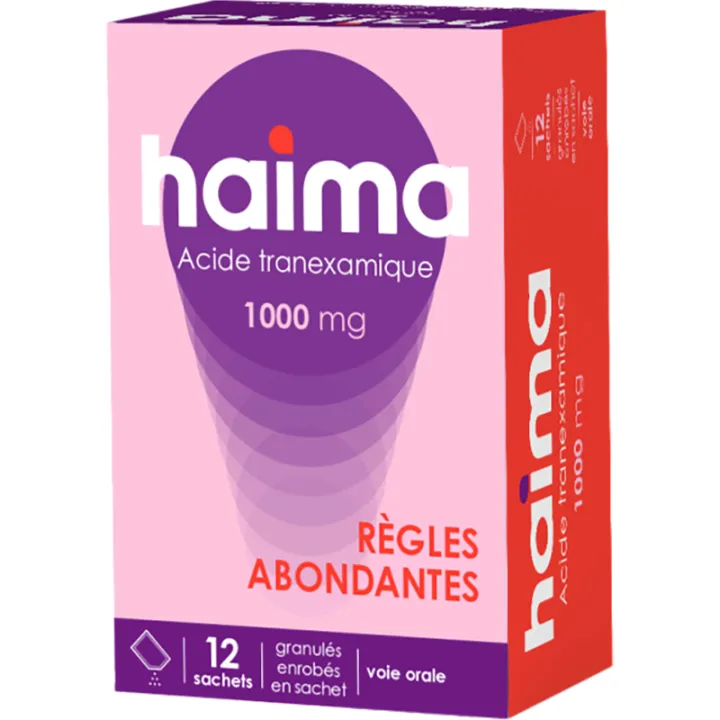
Haima 1000 mg - Heavy periods - 12 sachets
Over-the-counter medication

Haima 1000 mg - Heavy periods - 12 sachets

Haima 1000 mg 12 sachets help reduce the intensity and duration of heavy periods. Thanks to tranexamic acid, it acts directly on the bleeding mechanism to improve menstrual comfort and limit discharge in women with regular cycles.

€12.07 EXCL. VAT €13.29 INCL. VAT
Replenishment in progress Pre-order Secure payment
Reference : 3400930281567
You must be logged in to add this product to a list. Customer login
See delivery conditions

In the same category

Zytolia Polycystic ovary syndrome 60 sticks Zytolia Polycystic ovary syndrome 60 sticks
€16.95
Shipped within 24h
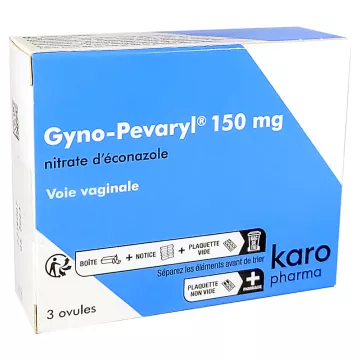
GYNO Pevaryl 150 MG 3 OVA GYNO Pevaryl 150 MG 3 OVA
€5.99
Add to cart
Shipped within 24h
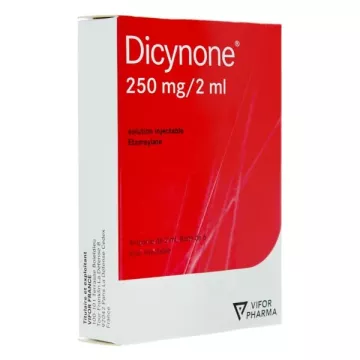
Dicynone 250mg 6 vials Dicynone 250mg 6 vials
€14.99
Add to cart
Shipped within 24h

When should I use Haima for heavy periods?

When periods become particularly heavy, they can quickly have an impact on everyday life. You may feel unusually tired, have to change your protection very frequently, or be worried about leaks. In this context, Haima can be used to help control these episodes, provided your cycles remain regular, between 21 and 35 days, with little variation.

Haima acts as a menstrual flow regulator. During menstruation, the body naturally forms clots to limit blood loss. Sometimes, these clots dissolve too quickly. Haima intervenes at this precise point, slowing down this mechanism, thereby reducing the abundance of bleeding and limiting its duration.

To better understand, imagine a water leak that we try to contain with small dams. If these dams disappear too quickly, the water flows further. The tranexamic acid in Haima acts as a reinforcement that stabilizes these natural dams, helping to promote menstrual comfort and better control the flow.

This treatment is intended for women and teenagers over the age of 15 with regular cycles. Before using it, it's important to check that your situation corresponds to this type of heavy menstrual flow. For example, if you have to use double protection or change your protection very frequently, this may be a warning sign.

In practice, this type of treatment can help you feel more serene during your period. By reducing the intensity of bleeding, Haima helps to improve quality of life without disrupting the natural functioning of the cycle.

In addition, if you experience associated pain, you may consider taking Spasfon Douleurs Spasmodiques 80 mg, which acts on uterine contractions. This combination acts on both the flow and the pain, for a more comprehensive approach.

How to use this medicine

Always take this medicine in accordance with the instructions in the package leaflet or those of your healthcare professional.

The recommended dose for adults and teenagers aged 15 and over is 1 sachet, to be taken 3 times a day, for a maximum of 4 days. In the case of very heavy flow, the dose can be adjusted up to a maximum of 4 sachets a day, with an interval of 6 to 8 hours between each dose.

Coated granules are taken orally with a glass of water. Treatment should be started as soon as menstruation begins.

If no improvement is observed after the first day, treatment should be stopped and medical advice sought.

Give your opinion on the advice for use and dosage of Haima with our partner Avis Vérifiés after your purchase.

Precautions

  • Do not use if you are being treated for a blood clot (phlebitis, embolism, stroke).
  • Do not use in case of renal insufficiency
  • Do not use if you have a history of convulsions.
  • Do not combine with combined hormonal contraceptives
  • Do not use if allergic to tranexamic acid
  • Seek medical advice if your cycles are irregular
  • Consult a doctor if you have a personal or family history of thrombosis
  • Report any presence of blood in urine
  • Keep out of reach of children
  • Respect expiration date
  • Do not dispose of medication in wastewater or household waste.

What does this medicine for heavy periods contain?

Acide Tranexamique 1000 mg, Sphères De Sucre (Saccharose, Amidon De Maïs), Povidone K30 (E1201), Sucralose (E955), Silice Colloïdale Anhydre (E551), Dispersion De Polyacrylate À 30 Pour Cent, Talc (E553B)

Presentation :

Box of 12 sachets. Available at the best price from our online pharmacy.

Our expert advice on Haima for heavy periods

To optimize the effectiveness of your treatment, start taking Haima at the first signs of menstruation, without waiting for the flow to become too heavy. You should also monitor the evolution of your cycles over several months. If you notice any unusual changes (irregularity, intense pain, bleeding outside your period), a medical check-up is essential to adapt your treatment.

FAQ

How do I know if my periods are too heavy?
If you have to change your pads very frequently, or use a double pad to avoid leakage, this may indicate heavy periods.

Can I use this medication if my cycles are irregular?
No, this treatment is reserved for regular cycles. In the event of irregularity, medical advice should be sought.

How long can I take this treatment?
The maximum duration is 4 days per cycle, during menstruation only.

Pharmacovigilance Report an adverse drug reaction(s)

Download PDF leaflet

NOTICE

ANSM - Updated on : 15/09/2025

Product name

HAIMA 1000 mg, coated granules in sachet

Tranexamic acid

Capsule

Please read this leaflet carefully before taking this medicine, as it contains important information for you.

Always take this medicine exactly as it is prescribed by your doctor, pharmacist or pharmacist.

- Keep this leaflet. You may need to read it again.

- Ask your pharmacist for any advice or information you may need.

- If you experience any side effects, talk to your doctor or pharmacist. This also applies to any side effects not mentioned in this leaflet. See section 4.

- If the expected effect (reduction in bleeding) has not occurred after the first day, stop treatment and talk to your doctor.

What does this leaflet contain?

1. What is HAIMA 1000 mg, coated granules in sachet and what is it used for?

2. What do I need to know before taking HAIMA 1000 mg, coated granules in a sachet?

3. How do I take HAIMA 1000 mg, coated granules in a sachet?

4. What are the possible side effects?

5. How to store HAIMA 1000 mg, coated granules in sachet?

6. Package contents and other information.

1. WHAT IS HAIMA 1000 mg, coated granules in sachet AND WHAT IS IT USED FOR?

Pharmacotherapeutic class: Antifibrinolytics - ATC code: B02AA02.

HAIMA is used to reduce heavy menstrual periods and should only be used if you have regular cycles lasting 21 to 35 days, with individual variability of 3 days or less, and you are over 15 years of age.

It contains tranexamic acid, which inhibits the action of the enzyme that dissolves blood clots. This reduces the volume and duration of blood loss.

2. WHAT DO I HAVE TO KNOW BEFORE TAKING HAIMA 1000 mg, coated granules in sachet?

Please note that you should only use HAIMA if you have regular cycles and heavy periods. To find out if this is the case, answer yes to the following two questions:

1. Are your cycles regular, i.e. do they last between 21 and 35 days (with individual variability less than or equal to 3 days)?

2. To avoid leakage, do you need to use double sanitary protection (e.g. two sanitary towels or one sanitary towel plus one tampon) or replace your sanitary protection very frequently?

Never take HAIMA 1000 mg, coated granules in sachet

- if you are taking treatment for blood clots, e.g. in the legs, lungs or brain.

- if you have kidney failure.

- if you have a history of convulsions (epilepsy or seizures).

- if you are taking a combined hormonal contraceptive (pill, vaginal ring or patch).

- if you are allergic to tranexamic acid or any of the other ingredients of this product (listed in section 6).

Warnings and precautions

Talk to your doctor before taking HAIMA if any of the following apply to you:

- You have irregular cycles.

- You or your parents and/or siblings have already had a blood clot.

- You have had blood in your urine between periods.

- You have severe kidney failure.

If you have heavy periods while using a combined hormonal contraceptive ("pill", vaginal ring or patch), you should consult your healthcare professional before taking tranexamic acid.

Certain diseases of the luteus, such as myoma or polyps, may explain the appearance of heavy periods.

If treated, menstrual flow may decrease. If in doubt, consult your gynecologist.

Regular gynecological check-ups are recommended.

Children and adolescents

No clinical data are available on the use of HAIMA in menorrhagic children under 15 years of age.

Other medicinal products and HAIMA 1000 mg, coated granules in sachet

Tell your doctor or pharmacist if you are taking, have recently taken or may take any other medicines.

If HAIMA is taken at the same time as anticoagulants, this could potentially affect the way HAIMA or these anticoagulants work.

HAIMA 1000 mg, coated granules in sachet with food and drink

Not applicable.

Pregnancy and breast-feeding

HAIMA is indicated in cases of repeated heavy menstrual bleeding and is not intended for use during pregnancy. An adverse effect in breast-feeding infants seems unlikely at therapeutic doses. Ask your doctor or pharmacist for advice if you are breast-feeding.

Driving vehicles and operating machinery

Undesirable effects that may affect your ability to drive and use machines have been reported. If you experience dizziness or vision problems, do not drive or operate machinery until the symptoms have disappeared.

HAIMA 1000 mg, coated granules in sachet contains sucrose.

If your doctor has informed you that you are intolerant to certain sugars, contact him/her before taking this medicine.

3. HOW DO I TAKE HAIMA 1000 mg, coated granules in sachet?

Always take HAIMA exactly as instructed in this leaflet or as directed by your doctor or pharmacist. Check with your doctor or pharmacist if in doubt.

The coated granules can be swallowed with a glass of water.

Treatment should be started when you start your period. The recommended dose for adults and teenagers aged 15 and over is 1 sachet 3 times a day for as long as necessary, up to a maximum of 4 days. The dose may be increased if the flow is very heavy. Do not take more than 4 sachets a day (1 sachet every 6 to 8 hours). Your doctor may prescribe a different dose.

If the expected effect (reduction in bleeding) has not occurred after the first day, stop treatment and talk to your doctor.

If you have taken more HAIMA 1000 mg, coated granules in sachet, than you should have

If you have taken more HAIMA than you should have, or if a child has accidentally swallowed it, contact your doctor or hospital immediately for medical advice and appropriate action. Signs of overdose may include dizziness, headache, nausea, diarrhea, low blood pressure, myopathy (damage to the muscular system) and convulsions. An overdose may increase the risk of thrombosis (blood clot formation) if you have a predisposition.

If you forget to take HAIMA 1000 mg, coated granules in sachet

Do not take a double dose to make up for the one you forgot to take;

If you stop taking HAIMA 1000 mg, coated granules in sachet

Not applicable.

4. WHAT ARE THE POSSIBLE SIDE EFFECTS?

Like all medicines, HAIMA may cause undesirable effects, but these do not always occur in everyone.

Common (affecting up to 1 in 10 people): nausea, vomiting, diarrhea, stomach ache, headache, dizziness. These side effects are often mild and transient.

Uncommon (affecting up to 1 in 100 people): allergic skin reactions.

Undetermined frequency (frequency cannot be estimated on the basis of available data): rare cases of blood clots, changes in color vision and other visual problems, convulsions.

If the effect of HAIMA is not sufficient or if you cannot tolerate HAIMA, there are other methods of treating heavy periods. Contact your gynecologist for information on these methods.

Reporting side effects

If you experience any side effects, please tell your doctor or pharmacist. This also applies to any side effects not mentioned in this leaflet. You can also report adverse reactions directly via the national reporting system: Agence nationale de sécurité du médicament et des produits de santé (ANSM) and the network of Centres Régionaux de Pharmacovigilance - Website: https://signalement.social-sante.gouv.fr/

By reporting adverse reactions, you contribute to providing more information on drug safety.

5. HOW TO CONSERVE HAIMA 1000 mg, coated granules in sachet?

Keep out of sight and reach of children.

Do not use this medicine after the expiration date indicated on the packaging after EXP. The expiration date refers to the last day of that month.

No special storage precautions are required.

Do not dispose of any medicine down the drain or in the household waste. Ask your pharmacist to dispose of any medicines you no longer use. This will help protect the environment.

6. CONTENTS AND OTHER INFORMATION

What HAIMA 1000 mg coated granules in sachet contains

- The active substance is :

Tranexamic acid...................................................................................................... 1000 mg

For one sachet.

- The other components are :

Sugar spheres (sucrose, corn starch), povidone K30 (E1201), sucralose (E955), colloidal anhydrous silica (E551), 30 percent polyacrylate dispersion, talc (E553B).

What HAIMA 1000 mg coated granules in sachet is and what it contains

1,750 mg coated granules in sachet (PEBD/Aluminium/PEBD/paper).

White to off-white coated granules.

Box of 12 sachets.

Marketing authorization holder

CEMAG CARE

55 RUE DE TURBIGO

75003 PARIS

Marketing authorization holder

CEMAG CARE

55 RUE DE TURBIGO

75003 PARIS

Manufacturer

INPHARMASCI

Z.I N°2 PROUVY-ROUVIGINIES

1 RUE NUNGESSER

59121 PROUVY

Product names in member states of the European Economic Area

This product is authorized in the member states of the European Economic Area under the following names: In accordance with current regulations.

[To be completed subsequently by the holder].

The last date on which this leaflet was revised was :

[to be completed later by the holder]

{month YYYY}.

Other

Detailed information on this drug is available on the ANSM (France) website.

The latest version of the patient leaflet for this product is available by scanning this QR code and on request from your pharmacist.

Une image contenant motif, pixel, mots croisés, point  Le contenu généré par lIA peut être incorrect.

VIDAL DE LA FAMILLE

HAIMA

Fiche révisée le 11 Février 2025
Famille du médicament : Antifibrinolytique

Indications

Ce médicament limite la durée et l'intensité des saignements en ralentissant la destruction naturelle des caillots qui se forment lors d'une hémorragie.

Il est utilisé pour diminuer les règles anormalement abondantes (ménorragies).

Présentations

HAIMA 1000 mg : granulés (blanc) ; boîte de 12 sachets
Ordonnance facultative - Non Remboursé - Prix libre

Les prix mentionnés ne tiennent pas compte des « honoraires de dispensation » du pharmacien.

Composition

  p sachet
Acide tranexamique 1000 mg
Saccharose 450 mg

Contre-indications

Ce médicament ne doit pas être utilisé dans les cas suivants :
  • accident thromboembolique,
  • insuffisance rénale grave,
  • antécédent de convulsions.

Attention

Ce médicament est destiné aux femmes souffrant de règles abondantes mais dont les cycles sont réguliers. En effet, un saignement important et inhabituel peut traduire l'existence d'une maladie génitale nécessitant un diagnostic médical rapide.

De plus, un avis médical est nécessaire en cas d'usage prolongé, d'utilisation d'un contraceptif (pilule, anneau vaginal, patch) contenant un estrogène et un progestatif, d'antécédent personnel ou familial d'accident thromboemboembolique ou de coagulation intravasculaire disséminée.

Attention : conducteurConducteur : ce médicament peut être responsable de vertiges.

Fertilité, grossesse et allaitement

Grossesse :

Ce médicament n'a pas d'indication pendant la grossesse.

Allaitement :

Ce médicament passe dans le lait maternel : néanmoins, l'allaitement est possible pendant le traitement si besoin.

Mode d'emploi et posologie

Les granulés doivent être avalés avec un verre d'eau.

Posologie usuelle :

  • Adulte et adolescente de plus de 15 ans : 1 sachet, 3 fois par jour au moment des règles. La durée du traitement ne doit pas dépasser 4 jours.

Une adaptation de la posologie est nécessaire en cas d'insuffisance rénale.

Effets indésirables possibles

Fréquents (1 à 10 %  des patientes) : vertiges, malaise, nausées, vomissements, diarrhée, douleurs abdominales.

Peu fréquents (0,1 à 1 %  des patientes) : réaction allergique cutanée.

Fréquence indéterminée : convulsions, changement de vision des couleurs, évènement thromboembolique.

LEXIQUE

accident thromboembolique

Accident qui résulte de l'obstruction (embolie) d'un vaisseau sanguin par un caillot (thrombus).

Le vaisseau peut être une artère : il s'agit alors d'une embolie artérielle, qui provoque une ischémie (privation de sang oxygène) dans la région que cette artère irriguait. Une ischémie grave aboutit à la mort des tissus privés d'oxygène : l'infarctus. Heureusement, dans de nombreux cas, une artère voisine permet d'éviter l'infarctus en apportant du sang oxygéné dans la région victime de l'ischémie.

Le cœur est irrigué par les artères coronaires qui ont la propriété d'être peu reliées entre elles, ce qui explique la gravité d'un accident thromboembolique coronarien : une partie du muscle cardiaque, le myocarde, est détruite (infarctus du myocarde).

L'obstruction d'une veine est moins grave, car les veines assurent le retour du sang chargé de gaz carbonique vers le cœur. L'obstruction d'une veine est généralement appelée thrombophlébite. La gravité d'une thrombophlébite, ou phlébite, tient à la possibilité pour un caillot de se détacher de la veine et d'être emporté par le sang veineux jusqu'au coeur. Après avoir traversé l'oreillette droite et le ventricule droit, ce caillot va pénétrer dans une artère pulmonaire et obstruer un vaisseau sanguin, provoquant une embolie pulmonaire et un infarctus pulmonaire.

antécédent

Affection guérie ou toujours en évolution. L'antécédent peut être personnel ou familial. Les antécédents constituent l'histoire de la santé d'une personne.

coagulation intravasculaire disséminée

Contrairement à ce qu'indique son nom, c'est une hémorragie qui succède à la formation de caillots multiples dans l'ensemble des vaisseaux de l'organisme, survenant notamment lors d'une opération, d'une infection ou de certaines maladies du sang.

convulsions

Contractions involontaires limitées à quelques muscles ou généralisées à tout le corps. Elles sont dues à une souffrance ou à une stimulation excessive du cerveau : fièvre, intoxication, manque d'oxygène, lésion du cerveau. Les convulsions peuvent être dues à une crise d'épilepsie ou à une fièvre élevée chez le jeune enfant.

diagnostic

Action d'identifier une maladie avec précision.

diarrhée

Le sens médical strict de diarrhée est « émission de selles trop fréquentes et trop abondantes ». En fait, le sens commun assimile la diarrhée à la notion de selles liquides et fréquentes. Normalement, les selles sont pâteuses, mais l'émission de selles liquides ou à peine formées, sans douleur ou trouble particulier associé, n'est pas pathologique. On peut parler de diarrhée lorsque les émissions de selles liquides se répètent dans la journée, et que les besoins sont impérieux ou douloureux.

Beaucoup de médicaments peuvent accélérer le transit intestinal et rendre les selles plus liquides, sans que cet effet indésirable soit réellement préoccupant.

Les antibiotiques peuvent altérer la flore digestive, indispensable à la digestion, et provoquer des diarrhées plus ou moins gênantes mais bénignes. L'effet apparaît immédiatement ou après quelques jours de traitement. Une forme de diarrhée grave et exceptionnelle, la colite pseudomembraneuse, peut être observée après un traitement antibiotique ; cette affection se traduit par l'émission de glaires et de fausses membranes (ressemblant à des lambeaux de peau) associées à des douleurs abdominales ; une constipation peut remplacer la diarrhée initiale. La colite pseudomembraneuse peut survenir plusieurs jours après l'arrêt du traitement antibiotique et nécessite un avis médical urgent.

Consultez l'article : Diarrhée et gastro-entérite de l’adulte ou Diarrhée et gastro-entérite de l’enfant

estrogène

Famille d'hormones stimulant les organes sexuels féminins (utérus et glandes mammaires essentiellement). On écrit aussi œstrogène.

fréquence indéterminée

La fréquence d'un effet indésirable est décrite dans les documents officiels de la manière suivante :

  • Très fréquent : constaté chez plus d'un patient sur 10
  • Fréquent : survient chez moins d'un patient sur 10 mais plus d'un patient sur 100
  • Peu fréquent : survient chez moins d'un patient sur 100 mais plus d'un patient sur 1000
  • Rare : survient chez moins d'un patient sur 1000 mais plus d'un patient sur 10000
  • Très rare : survient chez moins d'un patient sur 10000
  • Fréquence indéterminée : effet indésirable trop rare pour que l'on puisse en préciser la fréquence, ou concernant un médicament très ancien pour lequel on ne dispose pas d'études permettant de quantifier sa fréquence de survenue.
hémorragie

Perte de sang à partir d'une artère ou d'une veine. Une hémorragie peut être externe, mais également interne et passer inaperçue.

insuffisance rénale

Incapacité des reins à éliminer les déchets ou les substances médicamenteuses. Une insuffisance rénale avancée ne se traduit pas forcément par une diminution de la quantité d'urine éliminée. Seuls une prise de sang et le dosage de la créatinine peuvent révéler cette maladie.

posologie

Quantité et répartition de la dose d'un médicament en fonction de l'âge, du poids et de l'état général du malade.

progestatif

Substance dont l'action est proche de celle de la progestérone.

réaction allergique

Réaction due à l'hypersensibilité de l'organisme à un médicament. Les réactions allergiques peuvent prendre des aspects très variés : urticaire, œdème de Quincke, eczéma, éruption de boutons rappelant la rougeole, etc. Le choc anaphylactique est une réaction allergique généralisée qui provoque un malaise par chute brutale de la tension artérielle.

Consultez l'article : Peut-on être allergique aux médicaments ?

saccharose

Le saccharose est la substance qui compose le sucre de cuisine et le sucre industriel que l'on retrouve dans les biscuits, les gâteaux, les sucreries et les boissons sucrées (une bouteille d'un litre et demi de soda contient l'équivalent de trente morceaux de sucre). Certaines personnes sont intolérantes au fructose issu de la digestion du saccharose et souffrent alors de ballonnements et de diarrhée. Certains médicaments contiennent du saccharose comme excipient (composant sans activité thérapeutique).

Consultez l'article : Tous les glucides sont-ils équivalents ?

vertige

Symptôme qui peut désigner une impression de perte d'équilibre (sens commun) ou, plus strictement, une sensation de rotation sur soi-même ou de l'environnement (sens médical).

Consultez l'article : Vertiges.

Advice from our naturopaths

The role of naturopathic medicine in PMS The role of naturopathic medicine in PMS

PMS is a collection of somatic, emotional and behavioral symptoms.  These symptoms appear before your period and go away with it. This symptom set affects approximately 75% of women of childbearing age. The specificity of this syndrome is in fact its cyclicity, and its intensity severe enough to significantly alter personal, social and professional functioning. What is PMS PMS is a recurring luteal phase…

Read the article on the blog
Diet and a healthy lifestyle to relieve painful periods Diet and a healthy lifestyle to relieve painful periods

During their menstrual cycles, many women suffer from painful periods of varying intensity. But having your period shouldn't be synonymous with suffering. Diet and lifestyle play an essential role: they can either exacerbate the discomfort or, on the contrary, naturally relieve period pain. In this article, we'll explore how certain foods and lifestyle habits can help you get through this…

Read the article on the blog
Painful periods: what natural remedies can relieve menstrual pain? Painful periods: what natural remedies can relieve menstrual pain?

Menstrual pain, also known as dysmenorrhoea, affects between 50% and 90% of women of childbearing age, according to the American Academy of Family Physicians. This pain can range from annoying to incapacitating, and is sometimes poorly relieved by conventional drug treatments. Fortunately, there are research-backed natural solutions to alleviate these symptoms. This article explores proven remedies, such as certain medicinal…

Read the article on the blog
Natural Health Advice