NOTICE
ANSM - Updated on : 16/01/2026
Product name
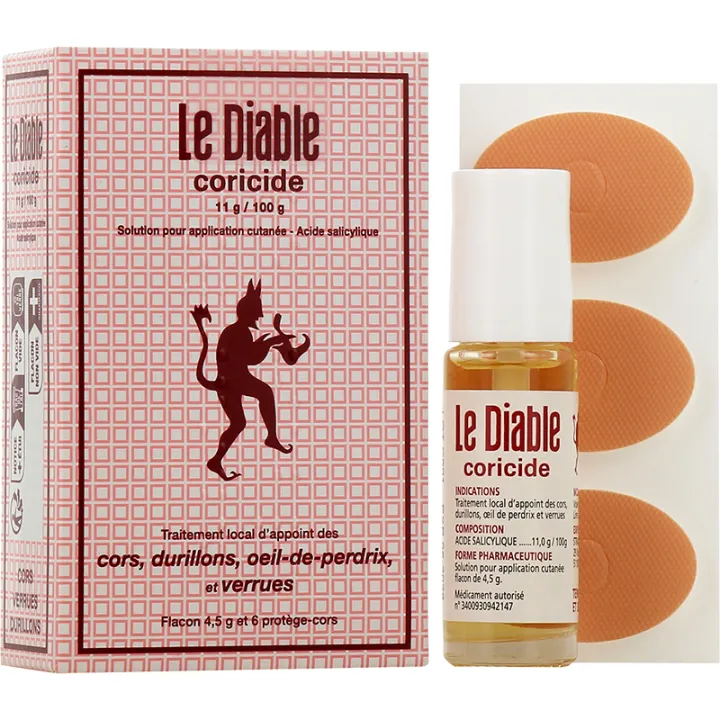
CORICIDE LE DIABLE 11 g/100 g, solution for cutaneous application
Salicylic acid
Sidebar
Please read this leaflet carefully before using this medicine, as it contains important information for you.
You must always use this medicine in strict accordance with the information provided in this leaflet or by your doctor or pharmacist.
- Keep this leaflet. You may need to read it again.
- Ask your pharmacist for any advice or information you may need.
- If you experience any side effects, talk to your doctor or pharmacist. This also applies to any side effects not mentioned in this leaflet. See section 4.
- You should contact your doctor if you do not feel any improvement or if you feel less well.
What does this leaflet contain?
1. What is CORICIDE LE DIABLE 11 g/100 g, solution for cutaneous application and what is it used for?
2. What do I need to know before using CORICIDE LE DIABLE 11 g/100 g, solution for cutaneous application?
3. How do I use CORICIDE LE DIABLE 11 g/100 g, solution for cutaneous application?
4. What are the possible side effects?
5. How to store CORICIDE LE DIABLE 11 g/100 g, solution for cutaneous application?
6. Package contents and other information.
1. WHAT IS CORICIDE LE DIABLE 11 g/100 g, solution for cutaneous application AND WHAT IS IT USED FOR?
Pharmacotherapeutic class: - VERRUCIDES AND CORICIDES ATC code: D11AF.
This drug is a solution for cutaneous application.
It is indicated for the adjunctive local treatment of corns, calluses, athlete's foot and warts.
2. WHAT DO I HAVE TO KNOW BEFORE USING CORICIDE LE DIABLE 11 g/100 g, solution for cutaneous application?
Never use CORICIDE LE DIABLE 11 g/100 g, solution for cutaneous application in the following cases:
- Allergy to salicylic acid or to any of the product components listed in section 6.
- Infected corns
Warnings and precautions
Be careful with CORICIDE LE DIABLE 11 g/100 g, solution for cutaneous application:
Special warnings
If you suffer from arteritis, diabetes or neuropathy, consult your doctor before using this product.
Due to the risk of systemic transmission, this product should not be applied to large surfaces.
Due to the presence of 96% ethanol (320 mg per mL), this product may cause skin irritation.
Precautions for use
Consult your doctor if treatment fails or recurs. It may be useful to investigate the cause and treat it accordingly (orthopedic measures to correct support, modification of footwear).
Do not use on mucous membranes.
Do not apply to healthy skin.
Contains castor oil. May cause skin reactions.
Other medicinal products and CORICIDE LE DIABLE 11 g/100 g, solution for cutaneous application
Tell your doctor or pharmacist if you are taking or have recently taken any other medicines, including medicines obtained without a prescription.
CORICIDE LE DIABLE 11 g/100 g, solution for cutaneous application with food and drink
Not applicable.
Pregnancy and breast-feeding
If you are pregnant or breast-feeding, think you may be pregnant or are planning to become pregnant, ask your doctor or pharmacist for advice before taking this medicine.
CORICIDE LE DIABLE 11 g/100 g, solution for cutaneous application should not be used during pregnancy, except for the single, short-term treatment of a wart, horn or small partridge-eye.
Oral forms (e.g. tablets) of this product class are likely to cause adverse effects in the unborn child. It is not known whether the same risks apply to CORICIDE LE DIABLE 11 g/100 g, solution for cutaneous application when used on warts, corns or partridge eyes.
This medicine should be used with caution during pregnancy and breast-feeding.
Driving and use of machinery
Not applicable.
CORICIDE LE DIABLE 11 g/100 g, solution for cutaneous application contains : Acetic acid, castor oil, turpentine oil, 96% ethanol, rosin, collodion.
3. HOW TO USE CORICIDE LE DIABLE 11 g/100 g, solution for cutaneous application?
Dosage
Apply to the area to be treated 1 or 2 times a day, taking care not to overlap healthy skin: protect healthy skin with a horn guard.
Close bottle tightly after use.
Leave to dry. After a week's treatment, remove mortified tissue with a warm footbath.
Method and route of administration
Cutaneous route
Duration of treatment
For corns, calluses and partridge's itch: 5 to 6 days
For warts: 2 weeks
If you have used more CORICIDE LE DIABLE 11 g/100 g, solution for cutaneous application than you should have
Not applicable.
If you forget to use CORICIDE LE DIABLE 11 g/100 g, solution for cutaneous application
Not applicable.
If you stop using CORICIDE LE DIABLE 11 g/100 g, solution for cutaneous application
Not applicable.
4. WHAT ARE THE POSSIBLE SIDE EFFECTS?
As with all medicines, this product may cause undesirable effects, but these do not always occur in everyone.
Skin irritation when applied to healthy skin.
Local irritation and burning may occur.
Reporting side effects
If you experience any side effects, please tell your doctor or pharmacist. This also applies to any side effects not mentioned in this leaflet. You can also report adverse reactions directly via the national reporting system: Agence nationale de sécurité du médicament et des produits de santé (ANSM) and the network of Centres Régionaux de Pharmacovigilance - Website: https://signalement.social-sante.gouv.fr
By reporting adverse reactions, you are helping to provide more information on drug safety.
5. HOW TO CONSERVE CORICIDE LE DIABLE 11 g/100 g, solution for cutaneous application?
Keep out of sight and reach of children.
Do not use CORICIDE LE DIABLE 11 g/100 g, solution for cutaneous application after the expiration date on the outer packaging or on the bottle.
Close bottle tightly after use.
Flammable product, keep away from sources of heat.
Do not dispose of in the sewage or household waste. Ask your pharmacist to dispose of any medicines you no longer use. These measures will help protect the environment.
6. CONTENTS AND OTHER INFORMATION
What CORICIDE LE DIABLE 11 g/100 g, solution for cutaneous application, contains
- The active substance is :
Salicylic acid............................................................................................................. 11.0 g
- Excipients: acetic acid, castor oil, turpentine oil, 96% ethanol, rosin, collodion.
What CORICIDE LE DIABLE 11 g/100 g, solution for cutaneous application is and what it contains
This medicine comes in the form of a solution for cutaneous application with an applicator seal, a 4.5 g bottle and 6 horn protectors.
Only the administration device supplied should be used for this medication.
Marketing authorization holder
PHARMEN (PHARmacie - MEdiation - Evolution - Négocia-tion)
8 BIS RUE GABRIEL VOISIN
51100 REIMS
Marketing authorization holder
EURODEP PHARMA
10 RUE ANTOINE DE SAINT EXUPERY
ZAC DU PARC DE COMPANS
77290 MITRY MORY
Manufacturer
CREAPHARM INDUSTRY
29 RUE LEON FAUCHER
51100 REIMS
Product names in member states of the European Economic Area
Not applicable.
The last date on which this leaflet was revised was :
[to be completed subsequently by the holder]
< {MM/YYYY}>< {month/YYYY}.>
Other
Detailed information on this drug is available on the ANSM (France) website.