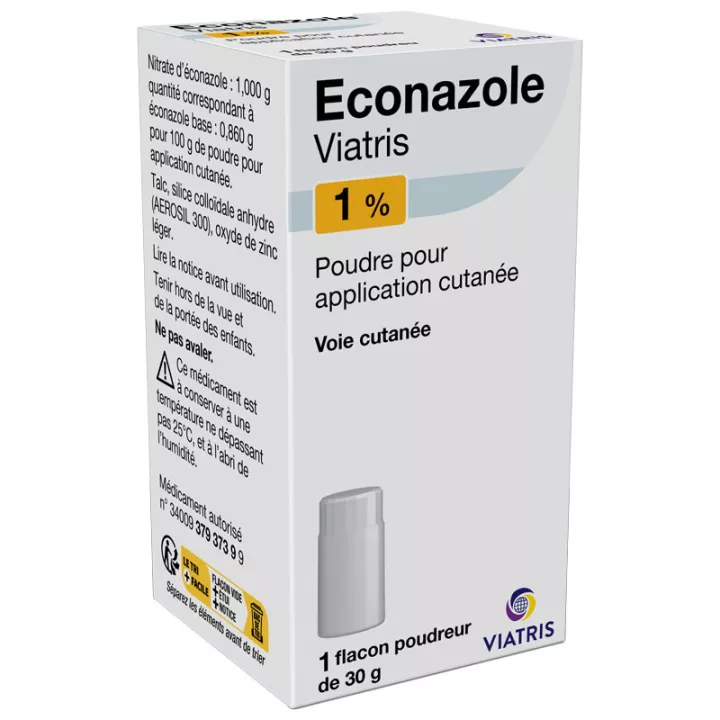
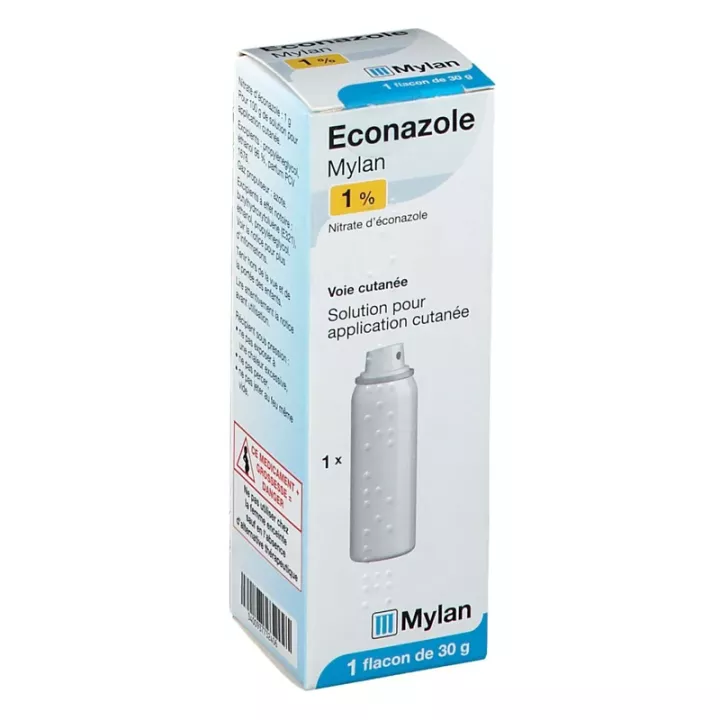
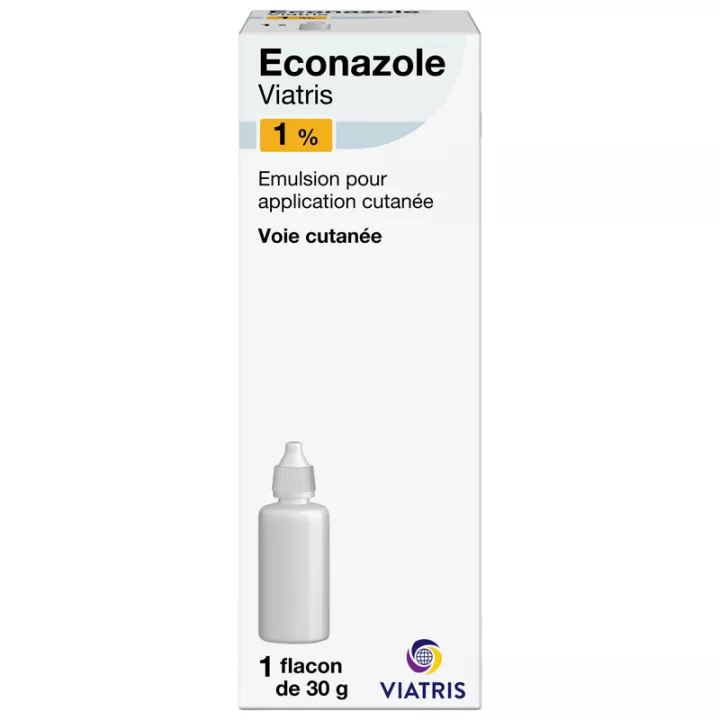
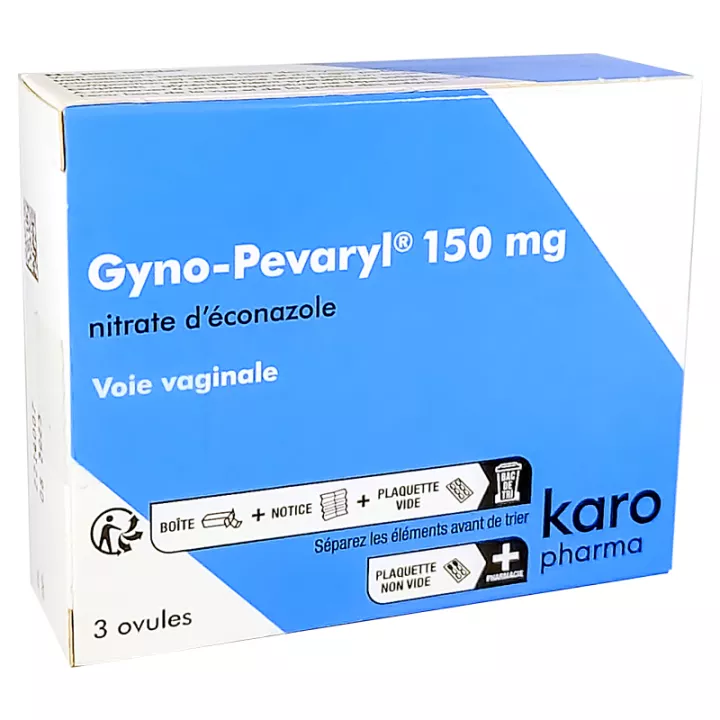
Treat fungal skin infections effectively with Viatris Econazole 1% cream, available in pharmacies. A practical, affordable solution for healthy, soothed skin.

Econazole 1% Viatris cream is a topical antifungal medication specially designed to treat fungal infections of the skin. Thanks to its powerful formula, it is effective against various types of mycosis, including candidiasis and dermatophytes. This cream is your ally in restoring healthy skin free from harmful fungi.
Econazole 1% Viatris acts effectively against fungal infections by eliminating the fungi responsible for unpleasant symptoms such as itching, redness and skin irritation. Its active ingredient, econazole nitrate, quickly penetrates the skin to target and destroy fungi at their source.
Candidiasis: This cream is specially formulated to treat candidiasis, including non-macerated fold mycoses such as interdigital, submammary and genital intertrigo. It is also effective against nail mycoses (onyxis and perionyxis), although in these cases, systemic antifungal treatment may be necessary as a complement.
Dermatophytes: In addition to candidiasis, Econazole 1% Viatris is also indicated for the treatment of dermatophytes of glabrous skin, non-macerated genital and crural intertrigos, and ringworm. In cases of ringworm, systemic antifungal treatment may be recommended as a complement.
This cream offers an effective and practical solution for relieving the symptoms of fungal skin infections, allowing you to quickly regain comfort and well-being.
In short, Econazole 1% Viatris is much more than just an antifungal cream. It's your ally in fighting fungal infections and restoring healthy, soothed skin. Thanks to its effective formula and multiple benefits, it's the ideal solution for treating candidiasis and dermatophytes. Don't let fungus spoil your daily routine, opt for Econazole 1% Viatris and say goodbye to fungal infections for good.
Econazole 1% Viatris antifungal cream is easy to use and offers convenient application for effective treatment of fungal skin infections. Here are a few tips for optimal use:
Directions for use
Give your opinion on the advice for use and dosage of Econazole 1% Viatris with our partner Verified Reviews after your purchase.
Precautions for use
Contraindications
Before using Econazole 1% Viatris, make sure you have no known allergy to econazole, imidazoles or any of the other ingredients. In case of allergy, stop using the cream immediately.
This cream must not be applied to mucous membranes, in the eyes or in the nose. Avoid washing the skin with acidic soaps, as this may encourage the development of fungal infections.
If you are taking other medicines, consult your doctor or pharmacist before using Econazole 1% Viatris, as it may interact with certain drugs, particularly antivitamin K drugs.
Econazole Mylan 1% Antifungal Cream is available in a 30 g tube, offering a convenient and effective solution for the treatment of fungal skin infections. Find this quality product at the best price in your online pharmacy.
Pharmacovigilance Report an adverse drug reaction(s)
NOTICE
ANSM - Updated on : 25/11/2021
Product name
ECONAZOLE VIATRIS 1%, cream
Deconazole nitrate
Box
Please read this leaflet carefully before using this medicine, as it contains important information for you. Always use this medicine exactly as it is described in this leaflet or by your doctor, pharmacist or nurse.
- Keep this leaflet as you may need to read it again.
- Ask your pharmacist for advice and information.
- If you experience any side effects, please tell your doctor, pharmacist or nurse. This also applies to any side effects not mentioned in this leaflet. See section 4.
- You should contact your doctor if you do not feel any improvement or if you feel less well.
What does this leaflet contain?
1. What is ECONAZOLE VIATRIS 1% cream and what is it used for?
2. What do I need to know before using ECONAZOLE VIATRIS 1%, cream?
3. How should ECONAZOLE VIATRIS 1% cream be used?
4. What are the possible side effects?
5. How should ECONAZOLE VIATRIS 1% cream be stored?
6. Package contents and other information.
1. WHAT IS ECONAZOLE VIATRIS 1%, cream AND WHAT IS IT USED FOR?
Pharmacotherapeutic class: TOPICAL ANTIFUNGAL DERIVATIVES OF IMIDAZOLES AND TRIAZOLES - ATC code: D01AC03.
This medicine contains an antifungal agent (active against fungi) of the imidazole family. It is indicated for the treatment of certain mycoses of the skin (skin disorders caused by fungi).
Candidiasis
- Treatment of non-macerated fold mycoses: genital, submammary and interdigital intertrigo.
- Treatment of nail mycoses: onyxis, perionyxis. Associated systemic antifungal treatment is required.
In the case of wool fold infections, oral antifungal treatment is required to treat any digestive and/or vaginal outbreaks, and thus avoid any recurrence.
Dermatophytes
- Treatment :
o dermatophytes of hairless skin,
o non-macerated genital and crural intertrigos.
- Treatment of ringworm. Associated systemic antifungal treatment is required.
Erythrasma
2. WHAT DO I HAVE TO KNOW BEFORE USING ECONAZOLE VIATRIS 1% cream?
Never use ECONAZOLE VIATRIS 1%, cream :
- if you are allergic to deconazole nitrate or any of the other ingredients of this medicine, as listed in section 6.
Warnings and precautions
Talk to your doctor, pharmacist or nurse before using ECONAZOLE VIATRIS 1%, cream.
FOR EXTERNAL USE ONLY.
Be careful with ECONAZOLE VIATRIS 1%, cream:
- for children,
- on large areas of skin,
- on damaged skin,
- in situations where the local docclusion phenomenon may recur (e.g. elderly subjects, bedsores, submammary lesions).
In such cases, it is essential to follow the recommendations and dosage indicated in the package leaflet, as the drug penetrates the skin more easily.
- You should stop using this product if you develop an allergy (recognizable by redness or pimples) or irritation.
- Do not apply to the eyes, nose or mucous membranes in general.
- Candidiasis: do not use soaps with an acid pH (pH favors Candida multiplication).
If in doubt, ask your doctor or pharmacist.
Children and teenagers
Not applicable.
Other medicinal products and ECONAZOLE VIATRIS 1%, cream
Tell your doctor or pharmacist if you are taking, have recently taken or may take any other medicines.
Tell your doctor if you are taking a blood-thinning drug, antivitamin K (such as acenocoumarol, fluindione, warfarin), as ECONAZOLE VIATRIS 1% cream may alter the action of antivitamin K in some people. You should therefore monitor your INR (blood tests) frequently. Depending on your situation, your doctor may also decide to modify the dose of your antivitamin K during or after treatment with ECONAZOLE VIATRIS 1% cream.
ECONAZOLE VIATRIS 1%, cream with food, drink and alcohol
Not applicable.
Pregnancy and breast-feeding
In view of the limited but possible systemic passage of ECONAZOLE VIATRIS 1% cream after dermal application, and based on clinical experience, its use is not recommended during pregnancy or while breast-feeding, without the advice of your physician.
Do not apply to the breasts while breast-feeding.
If you are pregnant or breastfeeding, think you may be pregnant or are planning to become pregnant, ask your doctor or pharmacist for advice before taking this medicine.
Driving and use of machinery
Not applicable.
ECONAZOLE VIATRIS 1% cream contains benzoic acid (E210), butylated hydroxytoluene (E321), butylated hydroxyanisole (E320) and a fragrance containing allergens.
This medicine contains 200 mg of benzoic acid per 100 g of cream. Benzoic acid may cause local irritation and may increase the risk of dicterus (yellowing of the skin and eyes) in newborns (up to 4 weeks). This medicine contains butylated hydroxyanisole (E320) and may cause local skin reactions (e.g. contact dermatitis) or irritation of the eyes and mucous membranes.
This product contains a fragrance containing linalool, citronellol and butylated hydroxytoluene (E321). Linalool and citronellol may cause allergic reactions.
Butylhydroxytoluene (E321) may cause local skin reactions (e.g. contact dermatitis) or irritation of the eyes and mucous membranes.
3. HOW SHOULD ECONAZOLE VIATRIS 1% cream be used?
Always use this medicine exactly as instructed in this leaflet or as directed by your doctor or pharmacist. Check with your doctor or pharmacist if in doubt.
Dosage
Apply ECONAZOLE VIATRIS 1% cream to the skin 2 to 3 times a day, up to a maximum of 3 applications per day. Treatment should be continued for 2 to 4 weeks.
Method of administration
For EXTERNAL USE ONLY: apply directly to the skin.
1. Clean affected area and surrounding area, then dry skin thoroughly before application.
2. Massage gently and evenly until the cream is completely absorbed. Close the tube tightly after each use.
Regular use of this medication throughout the treatment period is crucial to its success.
If there is no improvement, consult a doctor.
If you have accidentally swallowed ECONAZOLE VIATRIS 1% cream :
Consult your doctor for treatment appropriate to the side effects which may occur as a result of swallowing ECONAZOLE VIATRIS.
If you accidentally squirt ECONAZOLE VIATRIS 1% cream into your eyes :
Wash with clean water or saline solution.
If this does not help, consult a doctor.
If you have used more ECONAZOLE VIATRIS 1% cream than you should have :
Consult your doctor or pharmacist immediately.
If you forget to use ECONAZOLE VIATRIS 1%, cream :
Do not use a double dose to make up for the one you forgot to take.
If you stop using ECONAZOLE VIATRIS 1%, cream :
Not applicable.
If you have any further questions about the use of this medicine, please ask your doctor or pharmacist.
4. WHAT ARE THE POSSIBLE SIDE EFFECTS?
Like all medicines, this drug may cause undesirable effects, but they do not occur systematically in everyone.
Common side effects (1 to 10 out of 100 users) are :
- itching,
- burning sensation,
- pain at the application site.
Uncommon adverse reactions (1 to 10 out of 1,000 users) are :
- redness,
- discomfort
- swelling at the application site.
Undesirable effects for which the frequency is not determined are :
- allergy (hypersensitivity),
- swelling of the throat or face (angioedema),
- skin rash,
- urticaria,
- blisters,
- peeling skin (exfoliation).
Reporting side effects
If you experience any side effects, please tell your doctor, pharmacist or nurse. This also applies to any side effects not mentioned in this leaflet. You can also report adverse reactions directly via the national reporting system: Agence nationale de sécurité du médicament et des produits de santé (ANSM) and the network of Centres Régionaux de Pharmacovigilance.
By reporting adverse reactions, you are helping to provide more information on drug safety.
5. HOW SHOULD ECONAZOLE VIATRIS 1% cream be used?
Keep out of sight and reach of children.
Do not use this medicine after the expiration date indicated on the tube or box. The expiration date refers to the last day of that month.
Do not dispose of any medicine in the garbage . Ask your pharmacist to identify any medicines you no longer use. These measures will help protect the environment.
No special storage precautions.
6. CONTENTS AND OTHER INFORMATION
What ECONAZOLE VIATRIS 1% cream contains
- The active substance is :
econazole nitrate...................................................................................................................... 1 g
per 100 g of cream.
- Other ingredients are :
polyoxyethylene glycol 300 and 1500 and ethylene glycol stearates, light liquid kerosene, oleic macrogolglyceridesoleic wrinkles, PCV 1676 fragrance [contains butylated hydroxytoluene (E321)], benzoic acid (E210), butylated hydroxyanisole (E320), purified water.
What ECONAZOLE VIATRIS 1% cream is and what it contains
This medicine comes in the form of a cream. Tube of 30 g.
Marketing authorization holder
VIATRIS SANTE
1 RUE DE TURIN
69007 LYON
Marketing authorization holder
VIATRIS SANTE
1 RUE DE TURIN
69007 LYON
Manufacturer
SANDOZ
49 AVENUE GEORGES POMPIDOU
92593 LEVALLOIS-PERRET CEDEX
or
LABORATOIRES CHEMINEAU
93 ROUTE DE MONNAIE
37210 VOUVRAY
Drug names in member states of the European Economic Area
Not applicable
The last date on which this leaflet was revised was :
[to be completed subsequently by the holder].
Other
Detailed information on this drug is available on the ANSM (France) website.
Ce médicament est un générique de PEVARYL
Ce médicament d'action locale contient un antifongique de la famille des imidazolés.
Il est utilisé dans le traitement de certaines maladies de la peau, des ongles et des muqueuses, dues à des champignons microscopiques (mycoses) : candidose, dermatophyties...
La solution pour application locale est réservée au traitement du pityriasis versicolor.
Les prix mentionnés ne tiennent pas compte des « honoraires de dispensation » du pharmacien.
| p 100 g | p 100 g | |
| Éconazole nitrate | 1 g | 1 g |
| Acide benzoïque | + | + |
| Butylhydroxyanisole | + | + |
| Butylhydroxytoluène | + | + |
| p 100 g | p 100 g | |
| Éconazole nitrate | 1 g | 1 g |
| Éthanol (alcool) | + | |
| Butylhydroxytoluène | + | |
| Propylèneglycol | + |
Ce médicament ne doit pas être utilisé en cas d'allergie aux antifongiques de la famille des imidazolés.
Évitez d'utiliser ce médicament de manière prolongée et sur des surfaces étendues ou profondément lésées, notamment chez l'enfant, sans l'avis de votre pharmacien ou de votre médecin.
Rincez abondamment en cas de contact accidentel avec les yeux.
Un traitement prolongé par éconazole peut interagir avec certains anticoagulants oraux (antivitamine K) et nécessiter un contrôle plus fréquent de l'INR.
Les médicaments contenant de l’éconazole peuvent être utilisés pendant la grossesse après avis de votre médecin ou de votre pharmacien.
La possibilité d'un effet du médicament chez le nourrisson est très improbable. Il peut être utilisé chez la femme qui allaite.
Le médicament doit être appliqué après lavage et séchage soigneux de la zone à traiter. La forme utilisée (crème, émulsion, solution, poudre) et la durée du traitement varient selon les cas. Suivre la prescription de votre médecin ou les conseils de votre pharmacien.
Crème, solution, émulsion : appliquer avec le bout des doigts, une petite quantité de produit ayant été déposé dans le creux de la main ou directement sur les lésions, puis masser pour faire pénétrer. Dans les plis de la peau, la crème doit être appliquée en petite quantité pour limiter le risque de macération.
Poudre : appliquer directement sur la zone à traiter ; elle peut être également utilisée dans les chaussures, source fréquente de recontamination en cas de mycose des pieds.
2 ou 3 applications par jour, pendant 2 à 4 semaines.
Dans le traitement du pityriasis versicolor : 2 applications par jour, pendant 2 semaines.
En cas de candidose, évitez d'utiliser des savons acides : ils favorisent la multiplication des champignons.
En cas de lésion importante des ongles des orteils, un meulage préalable par un pédicure facilite l'action du médicament.
Une transpiration excessive contribue au développement des lésions dues à des champignons. Le port de chaussettes en fibre naturelle (coton, laine) est recommandé. La même paire de chaussures ne doit pas être portée deux jours de suite.
Fréquents (1 à 10 % des personnes) : démangeaisons, sensation de brûlure, douleur au site d'application.
Peu fréquents (moins de 1 personne sur 100) : rougeur, gêne, gonflement au site d'application.
Fréquence indéterminée : réaction allergique (éruption cutanée, urticaire, œdème de Quincke...).
Nom général désignant une famille de substances qui ont la propriété de pouvoir être mélangées à l'eau et aux corps gras. L'alcool le plus courant est l'alcool éthylique (éthanol), mais il existe de nombreux autres alcools : méthanol, butanol, etc. Le degré d'une solution alcoolique correspond au volume d'alcool pur présent dans 100 ml de solution, en sachant que 1 verre ballon de vin ou 1 demi de bière (25 cl) contiennent environ 8 g d'alcool.
Lorsque l'alcool est utilisé comme antiseptique, un dénaturant d'odeur désagréable lui est souvent ajouté pour éviter qu'il soit bu. Contrairement à une croyance répandue, l'alcool à 70° (ou même à 60°) est un meilleur antiseptique que l'alcool à 90°.
Consultez l'article : Alcoolodépendance
Réaction cutanée (démangeaisons, boutons, gonflement) ou malaise général apparaissant après un contact avec une substance particulière, l'utilisation d'un médicament ou l'ingestion d'un aliment. Les principales formes d'allergie sont l'eczéma, l'urticaire, l'asthme, l'œdème de Quincke et le choc allergique (choc anaphylactique). L'allergie alimentaire peut également se traduire par des troubles digestifs.
Médicament qui détruit les champignons et levures microscopiques. Ceux-ci peuvent être présents sur la peau ou les muqueuses (tube digestif ou organes génitaux). La levure la plus courante est le Candida albicans.
Multiplication anormale d'une levure microscopique, Candida albicans le plus souvent. Il s'agit d'une complication fréquente et bénigne des traitements antibiotiques. Les principaux symptômes sont des troubles digestifs, une coloration marron ou noire de la langue, des taches blanches sur le palais ou la langue (muguet), des démangeaisons ou des brûlures de la vulve ou du gland.
Infection de la peau ou des ongles par un champignon microscopique (dermatophyte).
Apparition de boutons ou de plaques sur la peau. Ces lésions peuvent être dues à un aliment, à un médicament, et traduire une allergie ou un effet toxique. De nombreux virus peuvent également provoquer des éruptions de boutons : celles de la rubéole, de la roséole et de la rougeole sont les plus connues.
La fréquence d'un effet indésirable est décrite dans les documents officiels de la manière suivante :
Famille de médicaments qui regroupe des antifongiques, des antibiotiques et des antiparasitaires.
Mode de préparation de certaines tisanes ; ce procédé permet d'extraire les substances contenues dans les plantes en les faisant tremper de façon prolongée dans de l'eau froide. Cette technique diffère de l'infusion ou de la décoction.
Tissu (membrane) qui tapisse les cavités et les conduits du corps communiquant avec l'extérieur (tube digestif, appareil respiratoire, voies urinaires, etc.).
Affection due à des champignons microscopiques, favorisée par la prise d'antibiotiques.
Consultez l'article : Mycose de la peau, Mycose vaginale.
Enfant de un à 30 mois. Un enfant de moins de un mois est un nouveau-né.
Infection de la peau due à un champignon microscopique. Elle se manifeste par des taches qui paraissent brunes sur une peau blanche et blanches sur une peau bronzée. Après traitement, seule une exposition au soleil permet de faire disparaître les taches.
Réaction allergique touchant généralement le visage. L'œdème de Quincke se traduit par un gonflement parfois spectaculaire. Les paupières sont souvent les premières touchées. Dans les rares cas où l'œdème touche la gorge, des troubles respiratoires peuvent survenir et un traitement urgent est nécessaire.
Réaction due à l'hypersensibilité de l'organisme à un médicament. Les réactions allergiques peuvent prendre des aspects très variés : urticaire, œdème de Quincke, eczéma, éruption de boutons rappelant la rougeole, etc. Le choc anaphylactique est une réaction allergique généralisée qui provoque un malaise par chute brutale de la tension artérielle.
Consultez l'article : Peut-on être allergique aux médicaments ?
Éruption de boutons sur la peau, dont l'origine est le plus souvent allergique. Les boutons ressemblent à des piqûres d'orties et leur couleur varie du rose pâle au rouge. L'urticaire peut apparaître ou disparaître en quelques minutes, et provoque d'intenses démangeaisons ; elle peut être localisée ou généralisée à la totalité de la surface cutanée.