Why is the violet considered a plant used in herbal medicine rather than aromatherapy?
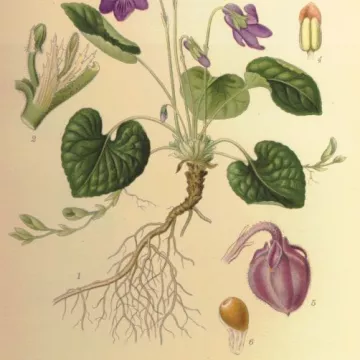
The sweet violet (Viola odorata) is one of the few plants classified in the “Essential Oils—Floral Family” category that does not contain a distillable essential oil in the traditional sense. Its absolute does exist—a very rare and expensive floral note containing ionone, used in luxury perfumery—but in herbal medicine, it is the whole plant (flowers and leaves) that is used: as herbal tea, syrup, or hydroalcoholic extract.
Its main active ingredients—mucilages, saponins, and flavonoids (particularly rutin)—are not found in a distilled essential oil. What makes the violet valuable in phytotherapy is precisely what distillation cannot extract.
What are the uses of the violet for respiratory comfort?
This is the best-documented use of the violet in the European phytotherapeutic tradition. The mucilages in the flowers and leaves coat irritated respiratory mucous membranes and facilitate the expulsion of phlegm, making it a mild expectorant particularly suited for dry, irritating coughs.
- Herbal tea: 1–2 tablespoons of dried flowers or leaves in 250 mL of water at 90°C, steep covered for 10 minutes—2–3 cups per day during episodes of dry cough
- Violet syrup: a traditional preparation still made by some pharmacies—concentrated mucilage, pleasant floral taste—suitable for children (ages 3 and up, with pediatrician’s approval)
- Respiratory Comfort Blend: violet + mallow + thyme — a classic herbal tea in phytotherapy for irritated upper respiratory tracts
What are the benefits of violet for the skin?
Its mucilages and flavonoids make it a soothing active ingredient for delicate skin—less well-known than calendula but just as effective.
Violet aqueous extract is used in natural cosmetics for its softening and soothing properties on sensitive and reactive skin. The mucilages form a protective surface film that reduces tightness and improves skin comfort.
- Violet hydrosol (when available): a gentle facial toner for highly reactive skin, dark circles, or puffy eyelids—apply as a compress for 5 minutes in the morning
- Poultice of crushed fresh leaves: traditionally used for minor skin irritations, mild itching, and moderate sunburn—the mucilage directly soothes the affected area
- Violet extract in cosmetics: often combined with cucumber or aloe vera in soothing formulas for sensitive skin
How can violet be used to support digestive comfort and relaxation?
Its profile of mucilages and flavonoids also acts on the digestive tract and the nervous system—with a gentleness suitable for all ages.
As an evening herbal tea, violet combines a mild calming effect on the nervous system (via its flavonoids) with a soothing action on the digestive tract. It’s the ideal herb for people looking for something gentler than valerian or passionflower, without a strong taste.
- Milddigestive comfort: herbal tea after meals—the mucilage coats the stomach lining, soothes feelings of irritation, and supports gentle digestion
- Relaxation and sleep blend: violet + linden + lavender flowers — a very mild evening herbal tea, suitable for sensitive individuals and the elderly
- Note: Violet does not have official HMPC-EMA recognition for these indications—use is based on long-standing herbal medicine tradition
What precautions should be taken with violet?
Violet is among the best-tolerated plants in traditional pharmacopoeia—precautions are limited but real.
- Allergy to the Violaceae family: rare but possible—perform a skin test before extensive external application if a history of allergies is known
- Large quantities of leaves: saponins may be mildly irritating at high doses—follow recommended herbal tea dosages
- Pregnant women: a mild herbal tea is generally well-tolerated; use concentrated extract only under medical supervision
- Medications: No major interactions have been documented, but report any herbal supplements to your doctor if you are currently undergoing treatment