Why Does Thyme’s Chemotype Make All the Difference?
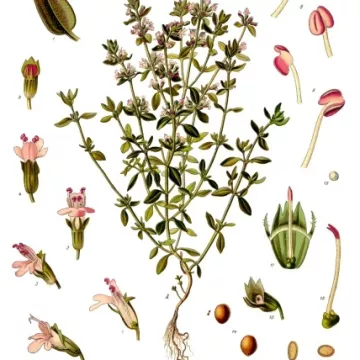
Thyme (Thymus vulgaris) is one of the few plants that exhibits several radically different chemotypes depending on its growing region and altitude. “Buying thyme” without specifying the chemotype is like ordering an essential oil without knowing which one—the profile and precautions are completely different.
- Thymol chemotype: 40–60% thymol—the most potent, the most dermocaustic—for active infections, intensive immune support—adults only, short-term and diluted use
- Carvacrol CT: profile similar to thymol, slightly different—same level of intensity and precautions
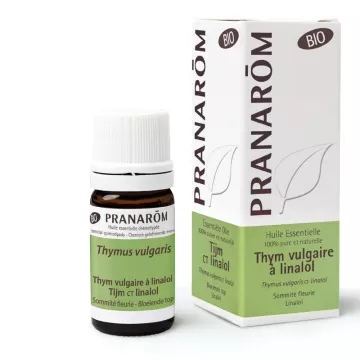
- Linalool essential oil (T. vulgaris linalool essential oil): 60–80% linalool—mild profile, similar to lavender—suitable for children and women outside the first trimester of pregnancy, long-term use—supports respiratory health and immunity without irritation
- CT thujanol: dominant thujanol-4 — intermediate profile, effective against viral infections — less dermocaustic than thymol — adults and adolescents
- As an herbal tea (dried leaves): EMA/HMPC-recognized use for respiratory comfort —the most accessible and safest form—no chemotype considerations in herbal tea
What are the uses of thyme for respiratory comfort?
This is the most well-documented indication—recognized by the EMA/HMPC for the traditional use of thyme leaf-based preparations.
The saponins and flavonoids in thyme facilitate expectoration—they thin bronchial secretions and support the elimination of mucus. The EMA recognizes this use as a herbal tea for the relief of mild coughs associated with a cold. In essential oil form, thymol and carvacrol are the most potent active ingredients against respiratory pathogens.
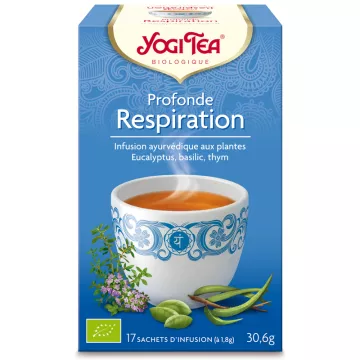
- Herbal tea: 1–2 c.c. of dried thyme in 250 mL of water at 90°C, steeped covered for 10 minutes—2–3 cups per day with honey—the mildest and best-tolerated form
- Linalool-type thyme essential oil (children > 3 months): light diffusion or a few drops in a vegetable oil applied to the chest—the only thyme essential oil suitable for pediatric use
- Thymol CT essential oil (adults): brief diffusion for 10–15 minutes max (irritating to mucous membranes) — combination of ravintsara + eucalyptus radiata + thymol CT essential oil — powerful respiratory trio
How to use thyme for oral hygiene?
Thymol is the gold standard active ingredient for oral antiseptics—it is found in many professional oral hygiene products.
- Mouthwash infusion: strong thyme infusion (3–4 c.c. in 250 mL, steeped for 15 min), cooled — gargle for 30 seconds twice daily — soothes irritated gums and freshens breath
- 1 drop of thyme CT thymol essential oil in 200 mL of lukewarm water: sanitizing mouthwash —do not swallow
- Thymol is found in professional dental products such as Dakin’s solution and certain dental cements—a testament to its proven antiseptic efficacy
Thyme tea vs. thyme essential oil—when should you choose one over the other?
The two forms are complementary—but not interchangeable.
Herbal tea delivers the water-soluble active ingredients (saponins, flavonoids, rosmarinic acid)—it is mild, well-tolerated, suitable for all ages (except infants), and can be taken several times a day. It is the preferred form for long-term support and prevention.
Essential oil is concentrated and more targeted—it acts more quickly on established infections but requires strict precautions depending on the concentration. At the first signs of a winter infection, CT thymol or CT thujanol essential oil provides rapid relief—but for a limited duration of no more than 10–14 days.
What precautions should be taken depending on the chemotype?
- CT thymol/carvacrol: dermocaustic—always dilute to 1–3%, never apply undiluted to the skin—contraindicated for pregnant women, infants, people with epilepsy, and people with asthma
- CT linalool: well tolerated, the only one safe for use in children—pregnant women: 2nd and 3rd trimesters under medical supervision
- Thujanol CT: moderate — adults and adolescents — pregnant women: not recommended
- Herbal tea: very well tolerated — avoid excessive consumption in cases of kidney failure, allergy to the Lamiaceae family, or severe hypertension
- High blood pressure: The essential oils thymol and carvacrol may slightly increase blood pressure—prefer linalool essential oil in cases of hypertension