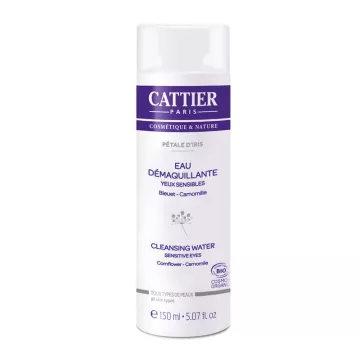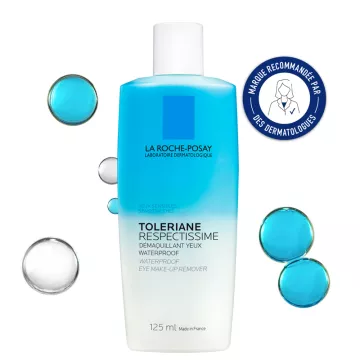
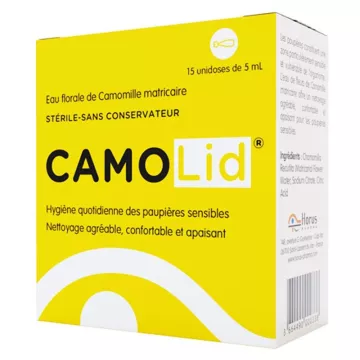
Sensitive eyes involve a range of corneal and conjunctival symptoms—redness, stinging, tearing, a foreign body sensation, and photophobia—whose causes are often combined. Dry eye (unstable tear film, TBUT < 10 seconds) is the most common cause. Digital eye strain results from reduced blinking (from 12 to 5 times per minute while looking at a screen) and exposure to high-energy visible (HEV) blue light (415–455 nm). Environmental allergens trigger an IgE-mediated reaction in the conjunctiva. Finally, benzalkonium chloride in eye drops can cause contact keratitis in regular users of eye drops. Each mechanism requires a specific response.
Lutein and zeaxanthin are the only carotenoids present in the human macula and lens—there, they form the macular pigment (DMOP), which physically filters blue wavelengths and neutralizes free radicals generated by photooxidation. Supplementation with 10 mg/day of lutein + 2 mg/day of zeaxanthin for 6 months significantly increases DMOP density and reduces glare and photophobia in several randomized studies—relevant for eyes sensitive to screen light and UV rays.
Vitamin A (retinol) regulates the differentiation of conjunctival goblet cells, which produce mucin (the mucous layer of the tear film). A deficiency causes conjunctival squamous metaplasia, which weakens the corneal epithelium and increases its sensitivity to irritants. A subclinical deficiency—common in diets low in animal products or orange-green vegetables—can worsen eye sensitivity without obvious systemic symptoms. Supplementation at 5,000 IU/day has been shown to restore mucin function.
The anthocyanosides in blueberries (Vaccinium myrtillus, 25% standardized extract, 160–320 mg/day) improve choroidal microcirculation by strengthening the walls of the perimacular capillaries. They also inhibit phosphodiesterase in photoreceptors, accelerating rhodopsin regeneration after intense light exposure—which is particularly relevant for eyes sensitive to glare. Their effect on visual comfort is clinically documented, with a reduction in eye strain after prolonged visual exertion.
The 20-20-20 rule is the gold standard preventive measure: every 20 minutes, look at an object 6 meters away for 20 seconds to allow for a full blink. Preservative-free artificial tears (AH single-dose packets) applied every 2 to 4 hours stabilize the tear film. Blue light filters (HEV-blocking lenses, Night Shift modes) reduce harmful spectral exposure. A relative humidity level of 40–60% in air-conditioned spaces prevents accelerated evaporation of the tear film. To assessvisual acuity, an annual eye exam can detect underlying refractive errors that exacerbate sensitivity.
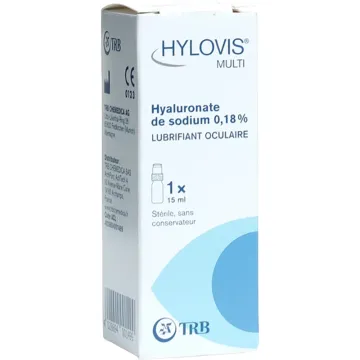
For sensitive eyes, preservative-free artificial tears (sterile single-dose vials containing hyaluronic acid, CMC, or carbomer) are preferable to multidose bottles containing benzalkonium chloride (BKC). BKC—a preservative found in most multidose eye drops—can cause superficial keratitis and worsen dryness in frequent users (>4 applications per day). High-molecular-weight HA artificial tears (> 1 MDa) offer superior viscosity and persistence—they stabilize the tear film for longer. For contact lens wearers, only artificial tears labeled “contact lens compatible” pose no risk of deposits on soft lens surfaces.