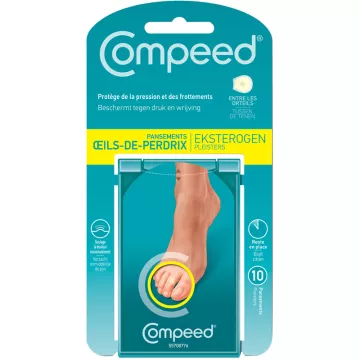
What is a partridge eye, and how can you recognize it?
A partridge eye is a soft interdigital corn—a localized hyperkeratosis that develops in the spaces between the toes, most commonly between the 4th and 5th toes. Its texture differs from that of a hard corn (heloma durum) found on the metatarsal heads or the dorsal surface of the toes: maceration caused by sweating keeps the area moist and soft, hence its name “soft corn” (heloma molle). Foot care products are available in the foot care line, and products for corns and warts can be found in the warts and corns section.
- Characteristic appearance: a whitish or grayish, soft, and macerated area in the space between the toes—often surrounded by a rim of hardened skin—with a keratotic center that is sometimes painful when lateral pressure is applied by adjacent toes
- Mechanism: Repeated pressure and friction between touching toes trigger a protective keratinocyte response—amplified by the moisture and heat of the interdigital space—along with mechanical constriction caused by shoes that are too tight, too loose (lateral slippage), or claw toes
- Distinguishing from a hard corn: hard corn (dorsal/plantar surface—dry, hard skin) vs. partridge’s eye (interdigital—soft, macerated skin)—different texture requiring appropriate care
- Distinguishing from a plantar wart: a partridge eye is a mechanical hyperkeratosis without an infectious agent—a plantar wart (HPV) has a grainy appearance with small black dots (thrombosed capillaries) and is contagious—the differential diagnosis should be made by a dermatologist or podiatrist in cases of doubt
What treatments are available to relieve and eliminate a corn?
Treatment combines keratolytic reduction of the lesion with the elimination of mechanical triggers. Without addressing the underlying causes (shoes, gait), recurrence is inevitable.
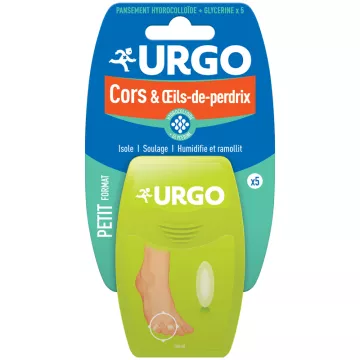
- Salicylic acid: the standard keratolytic agent—gradually softens and loosens the hyperkeratotic tissue—available as an ointment, poultices, or 10–40% solutions—apply precisely to the lesion while protecting healthy skin—reapply daily until resolved (1 to 3 weeks)
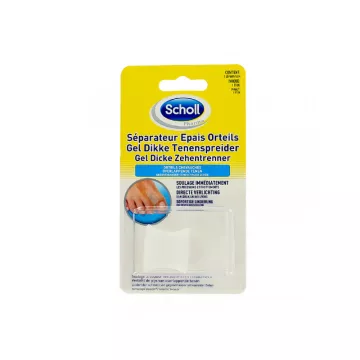
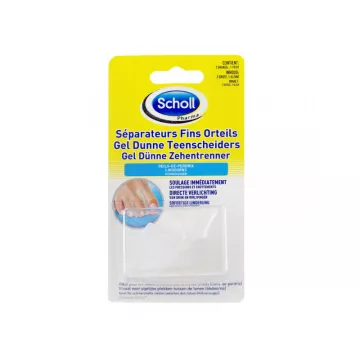
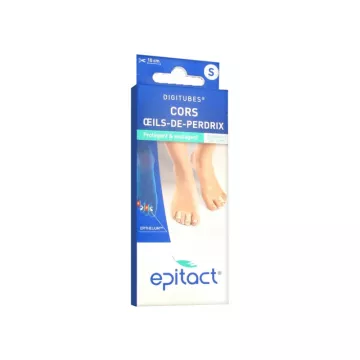
- Silicone toe separators: mechanically reduce contact pressure between the toes—foam or thermoformable silicone—keep in place inside the shoe during the day—available in the toe protector line
- Pedicure treatments: Consult a podiatrist for debridement (instrumental keratolytic removal using a drill or scalpel) of the lesion—a quick and painless procedure—recommended as soon as topical treatments prove insufficient or in cases of significant pain
- Softening foot baths: warm water (38 °C) with baking soda or mild soap for 10 minutes before any keratolytic treatment—softens the hyperkeratotic layer and improves penetration of active ingredients—do not scrub the interdigital space excessively (risk of injury)
- For associated plantar calluses, using an electric file or a pumice stone after a foot bath helps reduce adjacent areas of hyperkeratosis
How can you prevent recurrence and choose the right shoes?
- Proper footwear: wide toe box allowing the toes to move freely—flexible, breathable materials (leather, mesh)—avoid high heels and pointed toes (increase lateral compression of the toes)—shoes that fit the correct size (length AND width)
- Appropriate socks: cotton or bamboo (absorbent, limit maceration) — never too tight at the toes — toe-separated socks for recurrent cases
- Foot hygiene: daily cleaning + thorough drying between the toes (to prevent maceration and associated fungal infections) — moisturize the feet with a rich cream, but not between the toes (increased risk of maceration)
- Foot antiperspirants available in the foot antiperspirant line for people with plantar hyperhidrosis that exacerbates interdigital maceration
- Consult a podiatrist in cases of frequent recurrences (biomechanical correction, custom orthotic insoles) — and a dermatologist if there is diagnostic uncertainty regarding a plantar wart or an associated fungal infection (athlete’s foot)