NOTICE
ANSM - Updated on : 01/03/2023
Product name
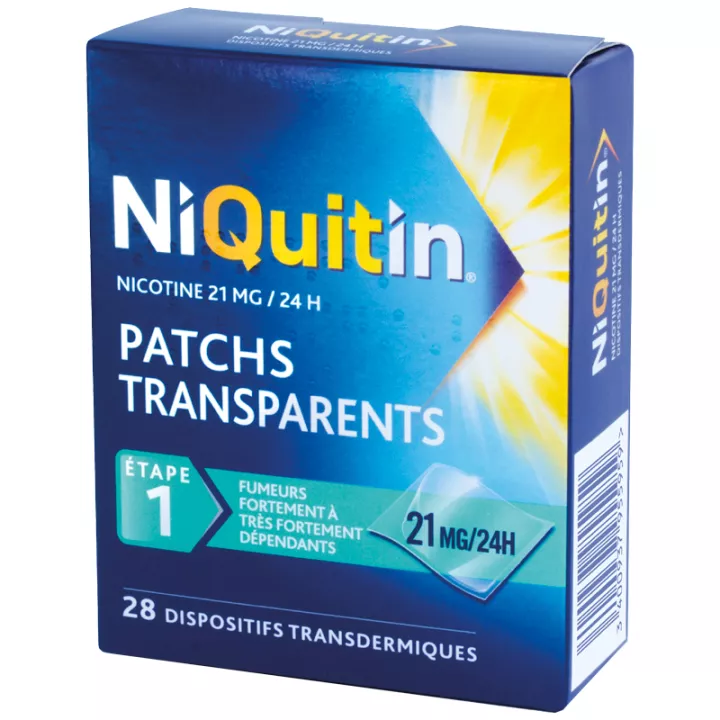
NIQUITIN 21 mg/24 hours, transdermal device
Nicotine
Box
Please read this leaflet carefully before taking this medicine, as it contains important information for you.
Always take this medicine exactly as instructed in this leaflet or by your doctor or pharmacist.
- Keep this leaflet. You may need to read it again.
- Ask your pharmacist for advice and information.
- If you experience any side effects, talk to your doctor or pharmacist. This also applies to any side effects not mentioned in this leaflet. See section 4.
- You should contact your doctor if you do not feel any improvement or if you feel less well.
KEEP OUT OF THE REACH OF CHILDREN.
What does this leaflet contain?
1. What is NIQUITIN 21 mg/24 hours, transdermal device and what is it used for?
2. What do I need to know before taking NIQUITIN 21 mg/24 hours, transdermal device?
3. How do I take NIQUITIN 21 mg/24 hours, transdermal device?
4. What are the possible side effects?
5. How do I store NIQUITIN 21 mg/ 24 hours, transdermal device?
6. Package contents and other information.
1. WHAT IS NIQUITIN 21 mg/24 hours, transdermal device AND WHAT IS IT USED FOR?
Drugs used in nicotine dependence - ATC code: N07BA01.
This drug is indicated for the treatment of tobacco dependence, to relieve nicotine withdrawal symptoms in subjects wishing to stop smoking.
You should consult your doctor if you do not feel any improvement or if you feel less well.
2. WHAT DO I HAVE TO KNOW BEFORE TAKING NIQUITIN 21 mg/24 hours, transdermal device?
Never take NIQUITIN 21 mg/24 hours, transdermal device:
- if you are allergic to the active substance or to any of the other ingredients of this medicine, as listed in section 6.
- if you do not smoke or if you are an occasional smoker.
- if you have a skin condition that may interfere with the use of a transdermal system.
If in doubt, ask your doctor or pharmacist.
Warnings and precautions
In order to successfully stop smoking, it is essential to quit completely. Read the health education advice carefully.
Certain diseases require medical examination and follow-up before using this medicine. For example, in the case of :
- cardiovascular disease, severe hypertension or heart failure
- cerebrovascular disorder or arteritis of the lower limbs
- diabetes
- hyperthyroidism or pheochromocytoma (adrenal gland disease leading to severe hypertension)
- severe hepatic and/or renal insufficiency,
- ulcer of the stomach or duodenum,
- history of convulsions.
Talk to your doctor before using NIQUITIN.
If you have stomach or duodenal ulcers or inflammation of the esophagus or throat (the passage between the mouth and stomach), nicotine replacement therapy may worsen your symptoms.
If you have diabetes, you should monitor your blood sugar levels more often than usual when you start using nicotine transdermal devices. Your insulin or medication requirements may change.
If you are in hospital because of a heart attack, severe heart rhythm disturbance or heart attack, you should try to stop smoking without using nicotine replacement therapy unless your doctor has recommended it.
If you have heart problems, you should consult a healthcare professional before using nicotine replacement therapy for gradual cessation or in combination.
If you experience skin redness, swelling or rash, you should stop using the transdermal device and consult a healthcare professional.
If you develop dermatitis, it is likely that you are having a reaction to the transdermal device.
If in doubt, ask your doctor or pharmacist.
Precautions for use
Certain signs indicate underdosing. If, despite treatment, you experience a sensation of "withdrawal", such as
- urge to smoke,
- irritability, sleep disorders,
- agitation,
- difficulty concentrating.
Consult your doctor or pharmacist. It may be necessary to adjust the dosage.
Certain signs may indicate overdosage: if signs of overdosage appear, i.e. :
- nausea, abdominal pain, diarrhea,
- hypersalivation,
- sweating, headache, dizziness, hearing loss,
- general weakness.
It is essential to adapt your treatment with the help of your doctor or pharmacist.
If you experience burning, tingling, itching or skin rashes when exposed to the sun, we recommend that you temporarily discontinue treatment until the symptoms have disappeared.
If you are gradually giving up smoking (e.g. by using nicotine transdermal devices before quitting) and are experiencing undesirable effects, you should stop smoking. If the effects do not subside, you should remove the transdermal device and resume use when you feel better.
(See section 4 "What are the possible side effects? ").
Taking this medicine may lead to dependence.
IF IN DOUBT, ASK YOUR DOCTOR OR PHARMACIST.
Children and adolescents
Keep the transdermal device out of the reach of children before and after use.
After use, it is recommended to fold the transdermal device on itself before throwing it away.
The therapeutic dose intended for adults could cause serious or even fatal poisoning in children.
Keep all medicines out of the reach and sight of children.
Other drugs and NIQUITIN 21 mg/24 hours, transdermal device
Smoking cessation, with or without this medication, may modify the action of certain other medications taken at the same time. Your doctor may need to adjust your dose.
Tell your doctor or pharmacist if you are taking, have recently taken or may take any other medication.
NIQUITIN 21 mg/24 hours, transdermal device with food and drink
Not applicable.
Pregnancy and breast-feeding
If you are pregnant or breast-feeding, think you may be pregnant or are planning to become pregnant, ask your doctor or pharmacist for advice before taking this medicine.
Pregnancy
It is very important to stop smoking during pregnancy, as it may slow down the growth of your baby. Delayed fetal growth, premature delivery and late fetal death have been observed in pregnant smokers.
Smoking cessation during pregnancy requires medical advice and follow-up. You should therefore consult the doctor who is monitoring your pregnancy, or your usual doctor, or a doctor at a center specializing in smoking cessation. If you are unable to stop smoking without nicotine replacement therapy, this medicine may be recommended by your doctor.
Breast-feeding
The use of this medicine should be avoided during breast-feeding, as nicotine passes into breast milk and may affect your child. However, if you wish to stop smoking and breastfeed your child, consult your doctor or a doctor at a center specializing in smoking cessation.
The use of intermittent doses of nicotine replacement therapy may minimize the amount of nicotine present in breast milk, compared with patches, as the time interval between taking the substitute and breast-feeding can be extended as much as possible.
Fertility
Smoking can affect fertility in both men and women. However, the specific contribution of nicotine to these effects in humans is not known.
Driving and use of machinery
Not applicable.
NIQUITIN 21 mg/24 hours, transdermal device contains: not applicable.
3. HOW DO I TAKE NIQUITIN 21 mg/24 hours, transdermal device?
Always take this medicine exactly as instructed in this leaflet or as directed by your doctor or pharmacist. Check with your doctor or pharmacist if in doubt.
Dosage
For adults and children over 15 years of age.
Pediatric population
Limited data are available on adolescents (15-17 years). The advice of a healthcare professional should be sought before using this product in adolescents (15-17 years).
Three patch sizes are available: 7, 15 and 22 cm2 corresponding to 3 different dosages: 7, 14 and 21 mg/24 hours.
Your degree of nicotine dependence will be assessed by the Fagerström test (see Health education advice) or by the number of cigarettes consumed per day. This will enable you to choose the right dosage for your needs.
The dose should be increased if you experience withdrawal symptoms. It should be reduced if you experience signs of overdosage: please reread the chapter on precautions for use, and don't hesitate to ask your pharmacist for advice.
Treatment is divided into 3 periods:
o Initial period: this lasts 3 to 4 weeks and will enable you to stop smoking.
o Treatment follow-up: this period consolidates smoking cessation and begins nicotine withdrawal.
o Therapeutic weaning: this period should enable you to stop taking the treatment.
On average, the entire treatment lasts 3 months.
However, the duration of treatment may vary according to individual response.
If you continue to experience cravings during treatment, or if your treatment has failed, CONSULT YOUR DOCTOR. Your doctor may advise you to combine NIQUITIN transdermal devices with oral substitutes (NIQUITIN 2 mg chewing gum or NIQUITIN 2 mg chewable tablets).
The total duration of treatment should not exceed 6 months.
- Complete cessation of smoking
|
|
Initial phase 3 to 4 weeks
|
Follow-up treatment 3 to 4 weeks
|
Smoking cessation 3 to 4 weeks
|
|
Fagerström test score of 5 or more or smoker of 20 or more cigarettes a day
|
NIQUITIN 21 mg/24 h
|
NIQUITIN 14 mg/24 h or NIQUITIN 21 mg/24 h
|
NIQUITIN 7 mg/24h or NIQUITIN 14 mg/24h then NIQUITIN 7 mg/24h*
|
|
Fagertröm test score less than 5 or Smoker of less than 20 cigarettes a day
|
NIQUITIN 14 mg/24 hr or increase to NIQUITIN 21 mg/24 hr
|
NIQUITIN 14 mg/24 hr or NIQUITIN 7 mg/24 hr**
|
NIQUITIN 7 mg/24 h or discontinuation**
|
* Depending on results of withdrawal symptoms.
** In case of satisfactory results.
- Stop gradually
If you find it difficult to stop smoking completely, CONSULT YOUR DOCTOR.
He or she may consider letting you smoke for the first 2 weeks of treatment with NIQUITIN transdermal devices. You can then start using NIQUITIN 21 mg/24 hours, transdermal device while you are still smoking. After 2 weeks, stop smoking and continue treatment as described below.
|
|
Preparing to quit
|
Initial phase
|
Treatment follow-up
|
Therapeutic weaning
|
|
Fagerström test score of 5 or more or smoker of 20 or more cigarettes a day
|
2 weeks
|
6 weeks
|
2 weeks
|
2 weeks
|
|
|
NIQUITIN 21 mg/24 h/d
|
NIQUITIN 21 mg/24 h/d
|
NIQUITIN 14 mg/24 h/d
|
NIQUITIN 7 mg/24 h/d
|
|
|
Preparing to stop
|
Initial phase
|
Treatment follow-up
|
Therapeutic weaning
|
|
Fagerström test score below 5 or smoker of fewer than 20 cigarettes a day
|
2 weeks
|
6 weeks
|
2 weeks
|
2 weeks
|
|
NIQUITIN 14 mg/24h/d or increase to NIQUITIN 21 mg/24 h* NIQUITIN 14 mg/24h/d or increase to NIQUITIN 21 mg/24 h
|
NIQUITIN 14 mg/24h/d or increase to NIQUITIN 21 mg/24 h* NIQUITIN 14 mg/24h/d or increase to NIQUITIN 21 mg/24 h* NIQUITIN 14 mg/24 h
|
NIQUITIN 7 mg/24h/d or increase to NIQUITIN 14 mg/24h *
|
NIQUITIN 7 mg/24 h/d or discontinuation of treatment
|
* Depending on results of withdrawal symptoms.
Mode and route of administration
Transdermal.
Open the sachet with a pair of scissors and remove the transdermal device.
Remove the pre-cut protective film.
Apply NIQUITIN immediately after opening to a clean, dry, hair-free skin surface, preferably in the morning on waking.
Do not apply to red, irritated or damaged skin.
To ensure perfect adhesion, press firmly against the skin with the palm of your hand for 10 seconds.
The device should remain in place for 24 hours.
An area of skin used for one device should not be used for a new device for at least 7 days.
The device should be kept in its closed protective pouch until use.
It is essential to fold the device onto itself, place it in the pouch from which you took your new transdermal device after use and dispose of it in a safe place, out of the reach of children or pets.
Any used or unused device should be kept out of the reach of children.
During handling, avoid contact with eyes and nose, and always wash hands with water only after application.
Do not cut the transdermal device.
In the event of prolonged bathing in the sea or swimming pool, you have 2 options:
- before bathing, remove the transdermal device and immediately replace it on its backing. It can then be re-adhered to dry skin,
- cover the transdermal device with a waterproof adhesive bandage for the duration of the bath.
In the event of a short shower, the transdermal device can be kept in place, avoiding directing the shower jet onto it.
Duration of treatment
Reducing tobacco consumption should gradually lead to complete cessation.
This should be attempted as soon as possible within 6 months of starting treatment. If after 6 months from the start of treatment, the attempt to stop smoking completely has failed, it is recommended that you seek advice from a healthcare professional to consider an alternative strategy.
If you have taken more NIQUITIN 21 mg/24 hours, transdermal device than you should have
In case of accidental overdose, or if a child has sucked or applied a transdermal device, CONTACT A PHYSICIAN OR EMERGENCY DEPARTMENT.
Severe intoxication may occur, manifested by hypotension, weak and irregular pulse, respiratory distress, prostration, cardiovascular collapse and convulsions.
If you have used too many transdermal devices, you may start to feel unwell, dizzy and ill. Remove the devices, wash your skin with water and dry it, then consult a doctor immediately.
If you forget to take NIQUITIN 21 mg/24 hours, transdermal device
Not applicable.
If you stop taking NIQUITIN 21 mg/24 hours, transdermal device
Not applicable.
If you have any further questions about the use of this medicine, please ask your doctor or pharmacist.
4. WHAT ARE THE POSSIBLE SIDE EFFECTS?
Like all medicines, this drug may cause undesirable effects, but they do not occur systematically in everyone.
Undesirable effects are listed below by frequency of occurrence.
Very common (affects more than 1 in 10 people)
- skin reactions at the site of application of the transdermal device,
- sleep disorders, including insomnia and irregular sleep patterns,
- nausea, vomiting,
- headache,
- dizziness.
Common (affects between 1 in 10 and 1 in 100 people)
- nervousness,
- tremor,
- shortness of breath,
- coughing,
- sore or swollen throat,
- indigestion,
- stomach pains,
- diarrhea
- constipation,
- sweating,
- dry mouth,
- joint, muscle, chest or limb pain,
- fatigue and general weakness,
- palpitation (feeling your heart beat),
Very rare (affects less than 1 in 10,000 people),
- skin photosensitivity,
- symptoms of a severe allergic reaction including sudden wheezing, chest tightness, skin rash, general feeling of weakness.
You may experience slight redness and itching, burning and tingling of the skin where the transdermal device was placed. This disappears rapidly after removal of the transdermal device. Rarely, a more severe reaction at the application site may occur. If this occurs, discontinue use of the transdermal device and notify your doctor.
Reporting side effects
If you experience any side effects, please tell your doctor or pharmacist. This also applies to any side effects not mentioned in this leaflet. You can also report adverse reactions directly via the national reporting system: Agence nationale de sécurité du médicament et des produits de santé (ANSM) and the network of Regional Pharmacovigilance Centers.
By reporting adverse reactions, you are helping to provide more information on drug safety.
5. HOW TO CONSERVE NIQUITIN 21 mg/24 hours transdermal device?
Keep out of sight and reach of children.
Do not use this medicine after the expiration date indicated on the packaging after EXP. The expiration date refers to the last day of that month.
Store at a temperature not exceeding 30°C.
Do not dispose of any medicine down the drain or in the household waste. Ask your pharmacist to dispose of any medicines you no longer use. These measures will help protect the environment.
6. CONTENTS AND OTHER INFORMATION
What NIQUITIN 21 mg/24 hours, transdermal device, contains
- The active substance is :
Nicotine........................................................................................................................... 114.00 mg
For one 22 cm2 transdermal device.
- Other components are :
Ethylene/vinyl acetate copolymer (40% AV)
Occlusive backing: ethylene, vinyl acetate, polyethylene terephthalate.
Flow control membrane: polyethylene film.
Contact adhesive: polyisobutylene.
Removable protective layer: siliconized polyester film.
What NIQUITIN 21 mg/24 hours, transdermal device is and what it contains
This medicine is presented as transdermal devices in sachets; boxes of 7, 14 or 28.
Not all presentations may be marketed.
Marketing authorization holder
LABORATOIRE PERRIGO FRANCE
20, RUE ANDRE GIDE
92320 CHATILLON
Marketing authorization holder
LABORATOIRE PERRIGO FRANCE
20, RUE ANDRE GIDE
92320 CHATILLON
Manufacturer
FAMAR A.V.E ANTHOUSSA PLANT
ANTHOUSSA AVENUE 7
ANTHOUSSA ATTIKI
15344
GREECE
oU
LTS LOHMANN THERAPIE-système AG
LOHMANNSTR.2
ANDERNACH
RHEINLAND-PFALZ
55626
GERMANY
Product names in member states of the European Economic Area
Not applicable.
The last date on which this leaflet was revised was :
[to be completed subsequently by the holder].
Other
Detailed information on this drug is available on the ANSM (France) website.
Health education advice :
|
Quitting smoking as soon as possible has immediate health benefits. It's never too late to quit, even if you've smoked a lot for a long time.
|
As soon as you stop smoking
- you will no longer absorb the irritating and toxic substances of cigarettes,
- you'll notice certain improvements: gradual disappearance of headaches, coughing, throat irritation and shortness of breath,
- you'll often enjoy the satisfaction of better sleep, food flavors and smells, and improved physical performance,
- reduce your risk of developing lung cancer or cardiovascular disease. In the case of heart or arterial disease (angina pectoris, arteritis of the lower limbs), it is particularly important to succeed in quitting smoking.
What is tobacco dependence?
Tobacco addiction is twofold:
- Psychological dependence:
Smoking a cigarette involves a ritual of automatic, repetitive gestures associated with particular circumstances (pleasure, response to stress, intellectual stimulation, support for morale, need for the gesture of conviviality). This is psychological and behavioral dependence.
- Physical dependence:
The body's need for nicotine is due to the effects of this substance on the nervous system. This is physical dependence. Failure to satisfy this need leads to a sensation of craving (see description in the chapter "How to overcome your physical dependence").
Nicotine substitutes are designed to treat this dependence.
How to overcome your psychological dependence?
- To increase your chances of success, you need to stop smoking completely:
o choose a day when you feel most confident about quitting.
o Throw away your last pack of cigarettes, your lighter and put away your ashtrays.
o In the case of a smoking couple, it's best for both partners to quit at the same time.
- Let your family and colleagues know that you're quitting smoking. Ask them to respect your decision (not to smoke near you, not to offer you any more cigarettes).
- Be prepared for the urge to smoke. It may come on suddenly and intensely, especially in the first few weeks after you've stopped smoking, but it shouldn't last more than 3 or 4 minutes.
You need to plan what you will do in this case and act very quickly to avoid "cracking", for example
o drinking a large glass of water
o chew gum,
o count to 100,
o take a few deep breaths,
o leaving the room,
o change activity...
- Avoid situations associated with smoking (coffee, aperitifs, etc.), avoid temptations (sit with non-smokers). Find ways to compensate for smoking (hobbies, sports, cultural activities, etc.).
How can you overcome your physical dependence?
If you're addicted to nicotine, you may need to use nicotine substitutes to succeed.
To assess your level of dependence, we suggest you take the Fagerström test.
FAGERSTROM TEST
|
How soon after waking up do you smoke your first cigarette?
- within 5 minutes: 3
- 6 to 30 minutes: 2
- from 31 to 60 minutes: 1
- after 60 minutes: 0
|
|
|
Do you find it difficult not to smoke in places where smoking is prohibited?
- yes: 1
- no: 0
|
|
|
Which cigarette of the day would you find most difficult to give up?
- the first: 1
- another: 0
|
|
|
How many cigarettes do you smoke a day?
- 10 or less: 0
- 11 à 20: 1
- 21 à 30: 2
- 31 or more: 3
|
|
|
Do you smoke more in the morning than in the afternoon?
- yes: 1
- no: 0
|
|
|
Do you smoke when you're so sick you have to stay in bed most of the day?
- yes: 1
- no: 0
|
|
|
TOTAL POINTS
|
|
score from 0 to 2: you are not addicted to nicotine. You can stop smoking without needing a nicotine replacement. However, if you're worried about quitting, ask your pharmacist or doctor for advice.
score of 3 to 4: you are mildly dependent on nicotine.
score 5 to 6: you are moderately dependent on nicotine. The use of nicotine substitutes will increase your chances of success. Ask your pharmacist or doctor for advice on the best treatment for you.
score from 7 to 10: you are strongly or very strongly dependent on nicotine. The use of nicotine substitutes is recommended to help you overcome this nicotine dependence. This treatment must be used in sufficient and appropriate doses.
Ask your pharmacist or doctor for advice, possibly in the context of a specialized smoking cessation consultation.
Withdrawal symptoms may persist for a long time, and treatment should be of sufficient duration, usually one to three months.
If, despite treatment, you experience a persistent "craving" sensation, such as
- the urge to smoke
- irritability, sleep disturbances
- restlessness or impatience,
- difficulty concentrating.
Consult your doctor or pharmacist, as dose adjustments may be necessary.
How can we help you?
- Support from healthcare professionals
The support, advice and follow-up provided by your doctor or pharmacist will be invaluable during the first six months of quitting smoking. You can also turn to a specialized smoking cessation consultation, especially if you've already failed.
- Psychological support
Quitting smoking requires a supportive family and social environment. If you're worried that the difficulties are too great, psychological support or temporary treatment can help.
- Diet
In the months following smoking cessation, you may notice a moderate weight gain. If you have any concerns in this area, you can speak to a health professional who will be able to advise you.
Why have you started smoking again?
Think of this relapse as an accident along the way, as a normal learning event: a relapse is not a failure.
Analyze the reasons why you started smoking again.
- Physical dependence
This may not have been properly taken into account, or it may have reappeared after several months, for example, during prolonged stays in smoky atmospheres.
- Because of excessive weight gain
You may need to modify your eating habits a little before your next attempt to stop smoking.
- Because of a drop in motivation, because of a painful event or a difficult period, because of psychological difficulties that have arisen during the quitting process (depression, anxiety...), because of a lack of energy, because of a lack of energy or because of a lack of energy..), or because of a very tempting situation. Understand the reason for the relapse, so you can prevent it if possible the next time you try.
In all cases, don't hesitate to ask a healthcare professional for advice, or seek out a specialized smoking cessation consultation.
|
If you've started smoking again, don't be discouraged. Experience shows that your chances of success increase after one or more quit attempts.
|