NOTICE
ANSM - Updated on : 20/10/2023
Product name
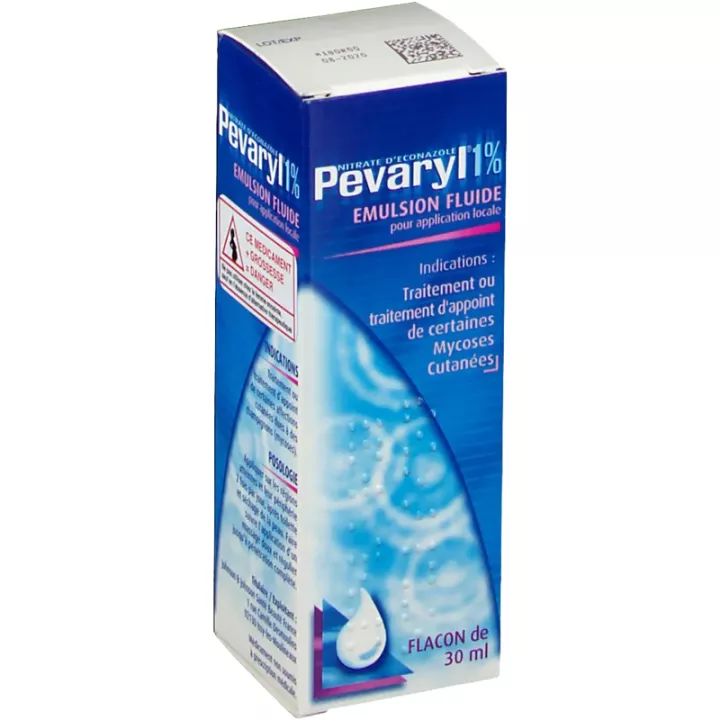
PEVARYL 1%, fluid emulsion for cutaneous application
Deconazole nitrate
Box
Please read this leaflet carefully before using this medicine, as it contains important information for you.
You must always use this medicine in strict accordance with the information provided in this leaflet or by your doctor or pharmacist.
- Keep this leaflet. You may need to read it again.
- Ask your pharmacist for advice and information.
- If you experience any side effects, talk to your doctor or pharmacist. This also applies to any side effects not mentioned in this leaflet. See section 4.
- You should contact your doctor if you do not feel any improvement or if you feel less well.
What does this leaflet contain?
1. What is PEVARYL 1%, fluid emulsion for cutaneous application and what is it used for?
2. What do I need to know before using PEVARYL 1%, emulsion fluide pour application cutanée?
3. How do I use PEVARYL 1%, emulsion fluide pour application cutanée?
4. What are the possible side effects?
5. How should I store PEVARYL 1%, emulsion for cutaneous application?
6. Package contents and other information.
1. WHAT IS PEVARYL 1%, fluid emulsion for cutaneous application AND WHAT IS IT USED FOR?
Pharmacotherapeutic class: LOCAL ANTIFUNGAL IMIDAZOLE DERIVATIVES, ATC code: D01AC03.
This medicine contains an antifungal agent (active against fungi) of the imidazole family.
It is indicated for the treatment of certain mycoses of the skin (skin disorders caused by fungi).
Candidiasis :
- Mycoses of mucous membranes and semi-mucous membranes: vulvitis, balanitis, anitis, candidiasis of the seat.
- Mycoses of fragile skin: children, face.
For wool fold infections, oral antifungal treatment is necessary to treat any digestive and/or vaginal outbreaks, and thus avoid any recurrence.
Dermatophytes :
- Treatment of hair mycoses: folliculitis, kerion, sycosis.
2. WHAT DO I HAVE TO KNOW BEFORE USING PEVARYL 1%, emulsion fluid for cutaneous application?
Never use PEVARYL 1%, fluid emulsion for cutaneous application:
- if you are allergic to deconazole nitrate or any of the other ingredients listed in section 6.
Warnings and precautions
Talk to your doctor or pharmacist before using PEVARYL 1%, emulsion fluide pour application cutanée.
Be careful with PEVARYL 1%, fluid emulsion for cutaneous application:
- in children,
- on large areas of skin,
- on damaged skin,
- in situations where the local docclusion phenomenon may recur (e.g. elderly subjects, bedsores, submammary lesions).
In such cases, it is essential to follow the recommendations and dosage indicated in the package leaflet, as the drug penetrates the skin more easily.
- You should stop using this product if you develop an allergy (recognizable by redness, pimples) or irritation.
- Do not apply to the eyes, mouth or nose.
- Candidiasis: do not use soaps with acidic pH (pH favors Candida multiplication).
- This product contains benzoic acid and may cause local irritation. Benzoic acid may increase the risk of dicterus (yellowing of the skin and eyes) in neonates (up to 4 weeks of age).
- This medicine contains butylated hydroxyanisole (E320) and may cause local skin reactions (e.g. contact dermatitis) or irritation of the eyes and mucous membranes.
- This medicine contains a fragrance containing the following substances: 3-Methyl-4-(2,6,6-trimethyl-2-cyclohexen-1-yl)-3-buten-2-one, benzyl alcohol, benzyl benzoate, benzyl salicylate, cinnamal, cinnamic alcohol, citral, citronellol, coumarin, d-limonène, eugenol, farnesol, geraniol, cinnamic hexyl aldehyde, hydroxycitronellal, isoeugenol, lilial and linalool. These substances may cause allergic reactions.
Children and teenagers
Not applicable.
Other medicinal products and PEVARYL 1%, fluid emulsion for cutaneous application
Tell your doctor or pharmacist if you are taking, have recently taken or may take any other medicines.
Tell your doctor if you are taking a blood-thinning medication, the antivitamins K (such as acenocoumarol, fluindione, warfarin), as PEVARYL may modify the action of antivitamins K in some people. You should therefore monitor your INR (blood tests) frequently. Depending on your situation, your doctor may also decide to modify the dose of your antivitamin K during or after treatment with PEVARYL.
PEVARYL 1%, fluid emulsion for cutaneous application with food and drink
Not applicable.
Pregnancy and breast-feeding
In view of the limited but possible systemic passage of PEVARYL after dermal application, and based on clinical experience, the use of PEVARYL 1% emulsion for cutaneous application is not recommended during pregnancy or breast-feeding, without the advice of your doctor.
Do not apply to the breasts while breast-feeding.
If you are pregnant or breastfeeding, think you may be pregnant or are planning to become pregnant, ask your doctor or pharmacist for advice before taking this medicine.
Driving and use of machinery
Not applicable.
PEVARYL 1%, fluid emulsion for cutaneous application contains benzoic acid and butylated hydroxyanisole (E320).
3. HOW DO I USE PEVARYL 1%, fluid emulsion for cutaneous application?
Always use this medicine exactly as instructed in this leaflet or as directed by your doctor or pharmacist. Check with your doctor or pharmacist if in doubt.
Dosage
Apply PEVARYL to the skin 2 to 3 times a day, up to a maximum of 3 applications per day. Treatment should be continued for 2 to 4 weeks.
Method of administration
For EXTERNAL USE ONLY: applied directly to the skin.
1. Clean affected area and surrounding area, then dry skin thoroughly before application.
2. Massage gently and evenly until the fluid emulsion for cutaneous application is completely absorbed.
Regular use of this product throughout the treatment period is crucial to its success.
If there is no improvement, consult your doctor.
If you have accidentally swallowed PEVARYL 1%, fluid emulsion for cutaneous application :
Consult a physician for treatment appropriate to the side effects that may occur as a result of swallowing.
If you accidentally squirt PEVARYL 1%, emulsion fluide pour application cutanée into your eyes:
Wash with clean water or saline solution.
If this does not help, consult a doctor.
Instructions for opening the bottle:
The bottle comes with a child-resistant cap and should be opened as follows:
Press the cap while turning counter-clockwise.
If you have used more PEVARYL 1%, emulsion fluid for cutaneous application than you should have
Not applicable.
If you forget to use PEVARYL 1%, emulsion fluid for cutaneous application
Not applicable.
If you stop using PEVARYL 1%, emulsion fluid for cutaneous application
Not applicable.
If you have any further questions about the use of this medicine, please ask your doctor or pharmacist.
4. WHAT ARE THE POSSIBLE SIDE EFFECTS?
Like all medicines, this drug may cause undesirable effects, but they do not occur systematically in everyone.
Common side effects (1 to 10 out of 100 users) are :
- itching,
- burning sensation,
- pain at the application site.
Uncommon adverse reactions (1 to 10 out of 1,000 users) are :
- redness,
- discomfort
- swelling at the application site.
Undesirable effects for which the frequency is not determined are :
- allergy (hypersensitivity),
- swelling of the throat or face (angioedema),
- skin rash,
- urticaria,
- blisters,
- peeling skin (exfoliation).
If you notice any side effects not mentioned in this leaflet, or if any side effects become serious, please tell your doctor or pharmacist.
Reporting side effects
If you experience any side effects, please tell your doctor or pharmacist. This also applies to any side effects not mentioned in this leaflet. You can also report adverse reactions directly via the national reporting system: Agence nationale de sécurité du médicament et des produits de santé (ANSM) and the network of Regional Pharmacovigilance Centers.
By reporting adverse reactions, you are helping to provide more information on drug safety.
5. HOW TO CONSERVE PEVARYL 1%, emulsion fluid for cutaneous application?
Keep out of sight and reach of children.
Do not use after the expiration date indicated on the box. The expiration date refers to the last day of that month.
No special storage precautions are required.
Do not dispose of any medicine down the drain or in the household waste. Ask your pharmacist to dispose of any medicines you no longer use. This will help protect the environment.
6. CONTENTS AND OTHER INFORMATION
What PEVARYL 1%, fluid emulsion for cutaneous application, contains
- The active substance is :
Deconazole nitrate............................................................................................................ 1.0 g
per 100 g demulsion.
- Other ingredients are :
Ethylene glycol stearates and macrogols 300 and 1500 (Téfose 63), liquid kerosene, unsaturated polyglycolysed glycerides (Labrafil M 1944 CS), anhydrous colloidal silica (Aérosil 200), benzoic acid, fragrance (essential oils of rose, jasmine, iris, sandalwood, ylang-ylang, coriander, vetyver, linalool, cinnamic alcohol, cinnamic aldehyde), butylated hydroxyanisole (E320), purified water.
What PEVARYL 1%, emulsion fluide pour application cutanée is and what it contains
This medicine comes in the form of a fluid emulsion for cutaneous application. 30 ml bottle.
Marketing authorization holder
KARO PHARMA AKTIEBOLAG
BOX 16184
103 24 STOCKHOLM
SWEDEN
Marketing authorization holder
ALLOGA FRANCE
ZAC DE CHAPOTIN SUD
69970 CHAPONNAY
Manufacturer
JANSSEN PHARMACEUTICA N.V
TURNHOUTSEWEG 30
B-2340 BEERSE
BELGIUM
or
Temmler Italia S.R.L.
Via Delle Industrie, 2 20061
Carugate (MI)
ItaliE
Drug names in member states of the European Economic Area
Not applicable.
The last date on which this leaflet was revised was :
[to be completed subsequently by the holder].
Other
Detailed information on this drug is available on the ANSM (France) website.