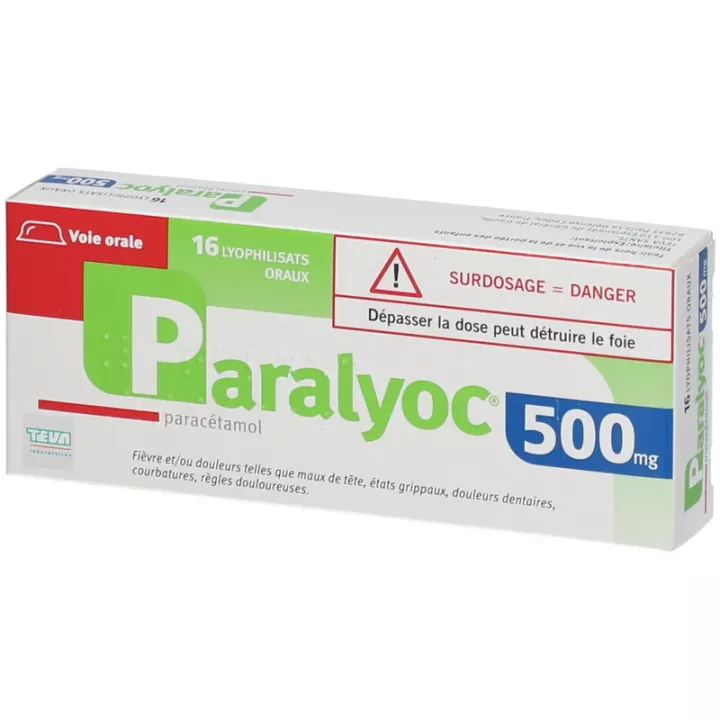

Buy Paralyoc Paracetamol, a convenient and effective oral lyophilized powder for relieving pain and fever in children ages 2 to 15. Order your medication now from our online pharmacy.

Paralyoc Paracetamol is much more than just a pain reliever and fever reducer. It is a valuable ally for quickly and effectively relieving common symptoms such as headaches, toothaches, flu-like symptoms, and aches and pains in children ages 2 to 15. Its innovative oral lyophilisate format makes it a practical and easy-to-administer choice, even for the youngest children.
Paralyoc 250 mg is formulated with acetaminophen, an active ingredient known for its analgesic and antipyretic properties. Each lyophilized dose contains 250 mg of acetaminophen microencapsulated in T-grade ethylcellulose. In addition, its other ingredients, such as ammonium glycyrrhizinate and lactose, help optimize its effectiveness while ensuring good tolerability.
This medication is specially formulated for children weighing between 13 and 50 kg, offering a solution tailored to their specific needs. Thanks to its oral lyophilized form, it dissolves quickly in the mouth, making it ideal for children who have trouble swallowing traditional tablets.
Paralyoc Paracetamol is the perfect choice for relieving pain and reducing fever, helping your children quickly regain their energy and well-being. Its versatility makes it a must-have in your family medicine cabinet.
Directions: Allow the oral lyophilisate to dissolve in the mouth without chewing. For children who have difficulty taking it this way, it can be dissolved in a small amount of liquid such as water, milk, or fruit juice.
Share your feedback on the usage instructions and dosage of Paralyoc Paracetamol with our partner, Verified Reviews, after your purchase.
The dosage of Paralyoc Paracetamol varies depending on the child’s weight. It is crucial to weigh the child in order to administer the appropriate dose. The recommended daily dose is approximately 60 mg/kg per day, divided into 4 or 6 doses, with at least a 4-hour interval between each dose.
It is essential to follow the recommended doses and not to exceed the maximum dosage. If in doubt, consult your doctor or pharmacist.
Precautions for use: Be sure to allow at least a 4-hour interval between doses, whether for children or adults. In cases of severe kidney disease, doses must be spaced at least 8 hours apart. Treatment with Paralyoc Paracetamol is limited to 3 days for fever and 5 days for pain. If symptoms persist beyond this period or worsen, consult a healthcare professional.
Contraindications: Do not use Paralyoc Paracetamol if you have a known allergy to paracetamol or any of the other ingredients in the medication, if you have severe liver disease or phenylketonuria, or in children weighing less than 13 kg. Avoid combining this medication with other products containing acetaminophen to ensure you do not exceed the recommended daily dose.
If you find the taste unpleasant, you may opt for 500 mg paracetamol in a scoreable tablet to be swallowed with a glass of water.
Ingredients:
Paralyoc Paracetamol is available in two versions, containing 250 mg or 500 mg of paracetamol per oral lyophilisate. Find it at the best price in our online pharmacy for a fast and effective solution to pain and fever in children.
In conclusion, Paralyoc Paracetamol offers a practical and effective solution for relieving pain and fever in children. Its oral lyophilized form, weight-based dosing, and effectiveness make it an ideal choice for the whole family. Order now and give your children relief
Pharmacovigilance Report an adverse drug reaction(s)
NOTICE
ANSM - Updated on : 08/07/2022
Product name
PARALYOC 250 mg, oral lyophilisate
Paracetamol
Box
Please read this leaflet carefully before taking this medicine, as it contains important information for you.
You must always take this medicine exactly as instructed in this leaflet or by your doctor, pharmacist or nurse.
- Keep this leaflet. You may need to read it again.
- Ask your pharmacist for advice and information.
- If you experience any side effects, talk to your doctor, pharmacist or nurse. This also applies to any side effects not mentioned in this leaflet. See section 4.
- You should contact your doctor if you do not feel any improvement, or if you feel worse after 3 days in the case of fever, or 5 days in the case of pain.
What does this leaflet contain?
1. What is PARALYOC 250 mg, oral lyophilisate and what is it used for?
2. What do I need to know before taking PARALYOC 250 mg, oral lyophilisate?
3. How do I take PARALYOC 250 mg, oral lyophilisate?
4. What are the possible side effects?
5. How should PARALYOC 250 mg oral lyophilisate be stored?
6. Package contents and other information.
1. WHAT IS PARALYOC 250 mg, oral lyophilisate AND WHAT IS IT USED FOR?
Pharmacotherapeutic class: OTHER ANTALGICS AND ANTIPYRETICS - ATC code: N02BE01.
PARALYOC is an oral lyophilisate (i.e. a tablet that melts in the mouth). It contains paracetamol.
It is used in cases of pain and/or fever, such as headaches, flu, toothache, aches and pains, and painful menstruation.
This presentation is reserved for children from 13 to 50 kg (approx. 2 to 15 years): please read the "Dosage" section of the package leaflet carefully.
Other paracetamol presentations are available for children of different weights: ask your doctor or pharmacist for advice.
You should contact your doctor if you do not feel any improvement or if you feel less well after 3 days in the case of fever, or 5 days in the case of pain.
2. WHAT DO I HAVE TO KNOW BEFORE TAKING PARALYOC 250 mg, oral lyophilisate?
Never take PARALYOC 250 mg, lyophilisat oral :
- if you are allergic to paracetamol or any of the other ingredients of this medicine, as listed in section 6.
- if you suffer from severe liver disease.
- in children weighing less than 13 kg (approx. 2 years).
IF IN DOUBT, ASK YOUR DOCTOR OR PHARMACIST FOR ADVICE.
Warnings and precautions
In case of overdose, or if you take too much by mistake, consult your doctor immediately.
This medicine contains paracetamol. Other medicines contain paracetamol. To avoid exceeding the recommended daily dose, do not combine them (see "Dosage").
Tablets and capsules should not be taken by children under 6 years of age, as they may swallow incorrectly and choke.
If you need to use PARALYOC 250 mg for a child under 6 years of age, you must dissolve the lyophilisate in a small amount of drink before giving it to your child.
- If pain persists for more than 5 days or fever for more than 3 days, or in the event of insufficient efficacy or any other sign, do not continue treatment without consulting your doctor.
- Before starting treatment with this medicine, check that you are not taking any other medicines containing paracetamol.
- Tell your doctor if you have liver or kidney disease, or if you drink alcohol.
- Tell your doctor if you are taking other medicines containing paracetamol.
- PARALYOC should be used with caution in cases of malnutrition, particularly low glutathione levels, or dehydration.
Ask your doctor, pharmacist or nurse before taking PARALYOC 250 mg, oral lyophilisate.
Children
Not applicable.
Other medicines and PARALYOC 250 mg, oral lyophilisate
If your doctor prescribes a blood test to check uric acid levels, tell the laboratory that you have taken this medicine.
Tell your doctor or pharmacist if you are taking :
- flucloxacillin (antibiotic), as there is a serious risk of blood and plasma abnormalities (metabolic acidosis with high anion gap), which must be treated urgently and may occur in particular in cases of severe renal failure, sepsis or other conditions.sepsis (when bacteria and their toxins circulate in the bloodstream, causing organ damage), malnutrition, chronic alcoholism and if the maximum daily doses of paracetamol are used.
Tell your doctor or pharmacist if you are taking, have recently taken or may take any other medicines.
PARALYOC 250 mg, oral lyophilisate with food, drink and alcohol
Not applicable.
Pregnancy, breast-feeding and fertility
If you are pregnant or breastfeeding, think you may be pregnant or are planning to become pregnant, ask your doctor or pharmacist for advice before taking this medicine.
Under normal conditions of use, paracetamol can be used during pregnancy and while breast-feeding.
If necessary, PARALYOC 250 mg, oral lyophilisate may be used during pregnancy. You should use the lowest possible dose to relieve pain and/or fever, and take it for the shortest possible time. Contact your doctor if the pain and/or fever does not subside, or if you need to take the medication more frequently.
Driving and using machines
Not applicable.
PARALYOC 250 mg, lyophilisat oral contains lactose and laspartam.
This medicine contains 6 mg daspartam per lyophilisat.
Laspartam contains a source of phenylalanine. May be dangerous for people with phenylketonuria (PKU), a rare genetic disorder characterized by accumulation of phenylalanine that cannot be eliminated properly.
This medicine contains lactose. If your doctor has informed you that you are intolerant to certain sugars, contact him/her before taking this medicine.
3. HOW DO I TAKE PARALYOC 250 mg, oral lyophilisate?
Always take this medicine exactly as instructed in this leaflet or as directed by your doctor, pharmacist or nurse. Check with your doctor, pharmacist or nurse if in doubt.
This presentation is reserved for adults and children from 13 kg to 50 kg (approx. 2 to 15 years).
Use in children and adolescents
Paracetamol dosage depends on the child's weight; ages are given for information only.
If you don't know your child's weight, weigh him/her to determine the most appropriate dose.
Paracetamol is available in a wide range of dosages, enabling treatment to be adapted to each child's weight.
The recommended daily dose of paracetamol is around 60 mg/kg per day, divided into 4 or 6 doses, i.e. around 15 mg/kg every 6 hours or 10 mg/kg every 4 hours.
For children weighing 13 to 20 kg (approx. 2 to 7 years), the recommended dosage is 1 oral 250 mg lyophilisate per dose, repeated if necessary after 6 hours, but not exceeding 4 oral lyophilisates per day.
For children weighing 21 to 25 kg (approx. 6 to 10 years), the dosage is 1 lyophilisate 250 mg per dose, repeated if necessary after 4 hours, up to a maximum of 6 oral lyophilisates per day.
For children weighing 26 to 40 kg (approx. 8 to 13 years), the dosage is 2 lyophilisates 250 mg per dose, repeated if necessary after 6 hours, up to a maximum of 8 oral lyophilisates per day.
For children weighing 41 to 50 kg (approx. 12 to 15 years), take 2 lyophilisates 250 mg each, and repeat if necessary after 4 hours, up to a maximum of 12 oral lyophilisates per day.
Always take at least 4 hours apart.
If you feel that the effect of this medicine is too strong or too weak, consult your doctor or pharmacist.
Method of administration
This medicine is taken orally.
Allow the oral lyophilisate to melt in the mouth (do not chew) or drink immediately after complete dissolution in a small quantity of beverage (water, milk, fruit juice).
Children under 6 years of age should not take tablets or capsules, as they may swallow incorrectly and choke.
What's more, if your child has a fever of over 38.5°C, you can improve the effectiveness of treatment by taking the following steps:
- uncover your child,
- give him/her something to drink,
- do not leave your child in a hot place.
Frequency of administration
Systematic dosing avoids oscillations in pain or fever.
In children, they should be taken at regular intervals, including at night, preferably 6 hours apart, and at least 4 hours apart.
In adults, they should be spaced at least 4 hours apart.
In cases of severe kidney disease (severe renal failure), doses should be taken at least 8 hours apart.
Duration of treatment
The duration of treatment is limited to :
- 5 days in case of pain,
- 3 days in case of fever.
If pain persists for more than 5 days or fever for more than 3 days, or if they worsen, do not continue treatment without consulting your doctor or pharmacist.
If you have taken more PARALYOC 250 mg, oral lyophilisate than you should have
Consult your doctor or pharmacist immediately.
If you forget to take PARALYOC 250 mg, oral lyophilisate
Do not take a double dose to make up for the single dose you forgot to take.
If you stop taking PARALYOC 250 mg, oral lyophilisate
Not applicable.
If you have any further questions about the use of this medicine, please ask your doctor, pharmacist or nurse.
4. WHAT ARE THE POSSIBLE SIDE EFFECTS?
Like all medicines, this drug may cause undesirable effects, but they do not occur systematically in everyone.
Very rarely reported adverse reactions (affecting less than one user in 10,000):
- Serious skin reactions (such as skin detachment which can rapidly spread very severely to the whole body, destruction of the skin). Treatment must be stopped immediately, your doctor must be informed and paracetamol-containing drugs must never be taken again.
Undesirable effects reported with undetermined frequency:
- Skin rash or redness, or an allergic reaction manifested by sudden swelling of the face and neck, or sudden malaise with a drop in blood pressure. Treatment must be stopped immediately, your doctor must be informed and you must never take paracetamol-containing drugs again.
- Biological changes requiring blood tests have been observed: abnormally low levels of certain white blood cells or blood cells such as platelets, which may lead to nose or gum bleeding. In this case, consult a doctor.
- Liver damage
Reporting side effects
If you experience any side effects, please tell your doctor, pharmacist or nurse. This also applies to any side effects not mentioned in this leaflet. You can also report adverse reactions directly via the national reporting system: Agence nationale de sécurité du médicament et des produits de santé (ANSM) and the network of Centres Régionaux de Pharmacovigilance.
By reporting adverse reactions, you are helping to provide more information on drug safety.
5. HOW TO CONSERVE PARALYOC 250 mg, oral lyophilisate?
Keep out of sight and reach of children.
Do not use this medicine after the expiration date indicated on the box after EXP. The expiration date refers to the last day of this month.
No special storage precautions.
Do not dispose of any medicine with your household waste . Ask your pharmacist to dispose of any medicines you no longer use. These measures will help protect the environment.
6. CONTENTS AND OTHER INFORMATION
What PARALYOC 250 mg oral lyophilisate contains
- The active substance is :
Paracetamol........................................................................................................................ 250 mg
in the form of an ethylcellulose microencapsulated product with titre T
per oral lyophilisate.
- The other components are : Ammonium glycyrrhizinate, aspartam (E951), ethylmaltol, polysorbate 80, xanthan gum, dextran 70, lactose.
What PARALYOC 250 mg, oral lyophilisate is and what it contains
This medicine comes in the form of an oral lyophilisate. Box of 10.
Marketing authorization holder
TEVA SANTE
100-110 ESPLANADE DU GENERAL DE GAULLE
92931 PARIS LA DEFENSE CEDEX
Marketing authorization holder
TEVA SANTE
100-110 ESPLANADE DU GENERAL DE GAULLE
92931 PARIS LA DEFENSE CEDEX
Manufacturer
GALIEN LPS
22 RUE EDME LABORDE
PARC DACTIVITE NEVERS SAINT ELOI
58000 NEVERS
Product names in member states of the European Economic Area
Not applicable.
The last date on which this leaflet was revised was :
[to be completed subsequently by the holder]
{month YYYY}.
Other
Detailed information on this drug is available on the ANSM (France) website.
Health education advice :
WHAT TO DO IN CASE OF FEVER
Normal body temperature varies from person to person, ranging from 36.5°C to 37.5°C. A rise in temperature above 38°C can be considered a fever.
This medicine is intended for adults and children from 13 kg to 50 kg (approx. 2 to 15 years).
If the symptoms of fever are too troublesome, you can take this paracetamol-containing medicine at the recommended dosage.
To avoid the risk of dehydration, remember to drink frequently.
With this medication, fever should fall rapidly. Nevertheless :
- if other unusual signs appear,
- if fever persists for more than 3 days or worsens,
- if headaches become severe, or if vomiting occurs,
CONSULT YOUR DOCTOR IMMEDIATELY.
WHAT TO DO IN CASE OF PAIN?
The intensity of pain perception and the ability to resist it vary from one person to another.
If there is no improvement after 5 days of treatment,
- if the pain is violent, unexpected and comes on suddenly (particularly a strong pain in the chest) and/or recurs regularly,
- if it is accompanied by other signs such as general malaise, fever, unusual swelling of the painful area, reduced strength in a limb,
- if it wakes you up at night,
CONSULT YOUR DOCTOR IMMEDIATELY.
Ce médicament est un antalgique et un antipyrétique qui contient du paracétamol.
Il est utilisé pour faire baisser la fièvre et pour soulager la douleur.
Les prix mentionnés ne tiennent pas compte des « honoraires de dispensation » du pharmacien.
| p lyoph | p lyoph | |
| Paracétamol | 250 mg | 500 mg |
| Aspartam | + | + |
| Lactose | + | + |
Ce médicament ne doit pas être utilisé en cas de maladie grave du foie.
Le paracétamol est présent seul ou en association avec d'autres substances dans de nombreux médicaments : assurez-vous de ne pas prendre simultanément plusieurs médicaments contenant du paracétamol, car une prise conjointe entraîne un risque de surdosage qui peut être toxique pour le foie.
Une posologie supérieure à 3 g par jour ou un traitement prolongé nécessitent un avis médical dans les situations suivantes : alcoolisme chronique, malnutrition chronique, jeûne, amaigrissement récent, anorexie, insuffisance rénale, maladie du foie, déficit en G6PD et chez les personnes âgées ou pesant moins de 50 kg. Dans tous les cas, ne dépassez jamais la posologie prescrite par votre médecin ou conseillée par votre pharmacien.
Si cet antalgique est utilisé pour traiter des maux de tête fréquents, évitez de le prendre tous les jours, au risque de voir s'installer un mal de tête permanent nécessitant une prise en charge médicale.
La prise de paracétamol peut fausser les résultats des dosages du taux de sucre (glycémie) ou d'acide urique (uricémie) dans le sang.
Des précautions sont nécessaires en cas de phénylcétonurie (présence d'aspartam).
La consommation de boissons alcoolisées est déconseillée pendant le traitement.
Ce médicament peut interagir avec les antibiotiques contenant de la flucloxacilline (disponibles uniquement à l'hôpital).
En cas de traitement par un anticoagulant oral et par du paracétamol aux doses maximales (4 g par jour) pendant au moins 4 jours, une surveillance accrue du traitement anticoagulant sera éventuellement nécessaire.
Informez par ailleurs votre médecin ou votre pharmacien si vous prenez des médicaments potentiellement toxiques pour le foie ou un médicament inducteur enzymatique tel que le phénobarbital, la phénytoïne, la carbamazépine, le topiramate ou la rifampicine.
Les études scientifiques actuellement disponibles n'ont pas mis en évidence de problème particulier lors de l'utilisation du paracétamol chez la femme enceinte. Cependant, il doit être utilisé à la dose efficace la plus faible et pendant la durée la plus courte possible.
Aux doses usuelles, l'usage de ce médicament est possible pendant l'allaitement.
Ce médicament peut être pris indifféremment pendant ou entre les repas. Respecter un intervalle de 4 à 6 heures entre 2 prises. En cas d'insuffisance rénale, l'intervalle entre 2 prises doit être de 8 heures minimum.
Les comprimés (lyophilisats) doivent impérativement être dissous dans de l'eau, du lait ou du jus de fruit pour les enfants de moins de 6 ans (afin d'éviter un risque de fausse route). Ils peuvent être sucés chez les plus de 6 ans.
Dans les douleurs sévères de l'adulte et notamment dans l'arthrose, la posologie maximale peut être portée à 1 g de paracétamol, 4 fois par jour, uniquement sur prescription médicale.
La dose quotidienne maximale de paracétamol chez l'enfant est de 80 mg par kg, en 4 prises minimum, sans dépasser 3 g par jour.
Dans le traitement de la fièvre chez l'enfant, lorsque le paracétamol est utilisé à la dose de 60 mg par kg et par jour, l'adjonction d'aspirine ou son usage en alternance avec le paracétamol est inutile, car l'aspirine ne permet pas d'obtenir une baisse supplémentaire de la fièvre.
Des sueurs abondantes accompagnent généralement la baisse de température lors du traitement des fièvres élevées. Ce phénomène est normal.
Très rares : réaction cutanée grave imposant l'arrêt immédiat du traitement.
Fréquence indéterminée : réaction allergique, éruption cutanée, urticaire, anomalie de la numération formule sanguine, lésion du foie.
Médicament qui agit contre la douleur. Les antalgiques agissent soit directement sur les centres de la douleur situés dans le cerveau, soit en bloquant la transmission de la douleur au cerveau.
Synonyme : analgésique.
Médicament utilisé pour abaisser la température du corps lors des accès de fièvre.
Usure du cartilage, responsable de douleurs articulaires et d'une limitation des mouvements.
Consultez l'article : Arthrose et rhumatismes
Apparition de boutons ou de plaques sur la peau. Ces lésions peuvent être dues à un aliment, à un médicament, et traduire une allergie ou un effet toxique. De nombreux virus peuvent également provoquer des éruptions de boutons : celles de la rubéole, de la roséole et de la rougeole sont les plus connues.
La fréquence d'un effet indésirable est décrite dans les documents officiels de la manière suivante :
Incapacité des reins à éliminer les déchets ou les substances médicamenteuses. Une insuffisance rénale avancée ne se traduit pas forcément par une diminution de la quantité d'urine éliminée. Seuls une prise de sang et le dosage de la créatinine peuvent révéler cette maladie.
Le lactose est un sucre que l'on retrouve dans le lait et certains de ses dérivés. Pour le digérer, l'intestin doit être capable de sécréter une enzyme appelée lactase. De nombreuses personnes perdent la capacité à produire cette lactase à l'âge adulte. Le lactose passe alors dans l'intestin sans avoir été digéré et sa présence provoque des troubles intestinaux : diarrhée, ballonnements, gaz, etc. Certains médicaments contiennent du lactose utilisé comme excipient (composant sans activité thérapeutique). Les personnes qui ne digèrent pas le lactose peuvent, lorsqu'elles prennent ce type de médicament, souffrir d'effets indésirables intestinaux.
Poudre résultant du dessèchement rapide (à basse température et sous vide) d'une substance dissoute dans de l'eau (par exemple le café soluble). Comme médicaments, les lyophilisats peuvent être dissous dans un solvant pour la préparation d'une solution injectable, auriculaire, nasale, etc. ou être présentés sous forme d'un comprimé à dissoudre dans un verre d'eau, à sucer ou à laisser fondre sous la langue.
La numération mesure le nombre de globules rouges (hématies), de globules blancs (leucocytes) et de plaquettes dans le sang. La formule sanguine précise le pourcentage des différents globules blancs : neutrophiles, éosinophiles, basophiles, lymphocytes, monocytes.
Abréviation : NFS.
Maladie héréditaire qui se caractérise par l'absence d'une enzyme et qui conduit à l'accumulation dans le sang d'un produit toxique. Son dépistage est systématique à la naissance. Le traitement repose sur un régime alimentaire spécifique pendant la petite enfance.
Quantité et répartition de la dose d'un médicament en fonction de l'âge, du poids et de l'état général du malade.
Réaction due à l'hypersensibilité de l'organisme à un médicament. Les réactions allergiques peuvent prendre des aspects très variés : urticaire, œdème de Quincke, eczéma, éruption de boutons rappelant la rougeole, etc. Le choc anaphylactique est une réaction allergique généralisée qui provoque un malaise par chute brutale de la tension artérielle.
Consultez l'article : Peut-on être allergique aux médicaments ?
La majorité des médicaments sont des substances chimiques étrangères à l'organisme, qui peuvent donc induire des réactions allergiques ou toxiques touchant notamment la peau. Certaines réactions cutanées, heureusement rarissimes, sont particulièrement graves : il s'agit notamment du syndrome de Stevens-Johnson et du syndrome de Lyell. Ces réactions surviennent de quelques jours à 2 mois après le début du traitement. Ces réactions cutanées toxiques sont caractérisées par la destruction brutale de la couche superficielle de la peau et des muqueuses. Elles débutent par l'apparition de taches rouges ou foncées, associée à des douleurs cutanées et muqueuses (buccales, oculaires, génitales, anales) et de la fièvre. L'évolution des lésions permet de confirmer le diagnostic : elles se couvrent de vésicules ou de véritables bulles, imitant une brûlure, qui confluent et se déchirent au moindre frottement. Toute suspicion d'une réaction cutanée de ce type justifie un avis médical urgent, en appelant le 15 si nécessaire, et l'arrêt immédiat des traitements commencés depuis moins de 60 jours.
Il existe d'autres réactions cutanées toxiques graves, telles que la pustulose exanthématique aiguë généralisée ou le DRESS (Drug Reaction with Eosinophilia and Systemic Symptoms) ; ces réactions affectent la peau mais épargnent les muqueuses.
Éruption de boutons sur la peau, dont l'origine est le plus souvent allergique. Les boutons ressemblent à des piqûres d'orties et leur couleur varie du rose pâle au rouge. L'urticaire peut apparaître ou disparaître en quelques minutes, et provoque d'intenses démangeaisons ; elle peut être localisée ou généralisée à la totalité de la surface cutanée.