NOTICE
ANSM - Updated on : 25/08/2025
Product name
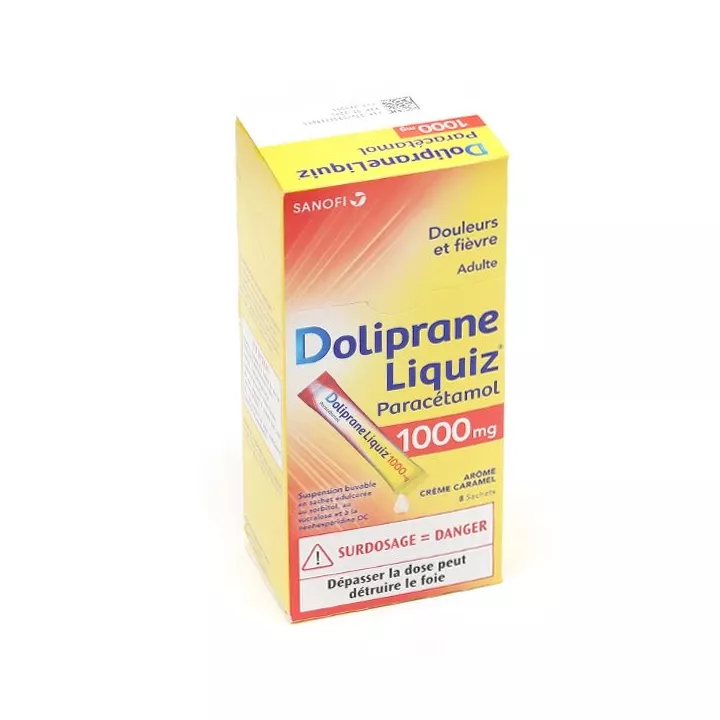
DOLIPRANELIQUIZ 1000 mg, oral suspension in sachet sweetened with sorbitol, sucralose and neohesperidine DC
Paracetamol
Sidebar
Please read this leaflet carefully before taking this medicine, as it contains important information for you.
Always take this medicine exactly as it is prescribed by your doctor or pharmacist.
- Keep this leaflet. You may need to read it again.
- Ask your pharmacist for any advice or information you may need.
- If you experience any side effects, talk to your doctor or pharmacist. This also applies to any side effects not mentioned in this leaflet. See section 4.
- You should contact your doctor if pain persists for more than 5 days, or fever for more than 3 days, or if there are any other signs of insufficient efficacy.
What does this leaflet contain?
1. What is DOLIPRANELIQUIZ 1000 mg, drinkable suspension in sachet, sweetened with sorbitol, sucralose and neohesperidine DC, and what is it used for?
2. What do I need to know before taking DOLIPRANELIQUIZ 1000 mg, oral suspension in sachet sweetened with sorbitol, sucralose and neohesperidin DC?
3. How should I take DOLIPRANELIQUIZ 1000 mg, Oral suspension in sachet sweetened with sorbitol, sucralose and neohesperidin DC?
4. What are the possible side effects?
5. How should DOLIPRANELIQUIZ 1000 mg oral suspension in sachet sweetened with sorbitol, sucralose and neohesperidin DC be stored?
6. Package contents and other information.
1. WHAT IS DOLIPRANELIQUIZ 1000 mg, suspension buvable en sachet sweetened with sorbitol, sucralose and neohesperidine DC AND WHAT IS IT USED FOR?
Pharmacotherapeutic class - ATC code: N02BE01
DOLIPRANELIQUIZ 1000 mg, drinkable suspension in sachet contains paracetamol. Paracetamol is an analgesic (pain reliever) and an antipyretic (fever reducer).
This medicine is indicated for adults and children weighing 50 kg or more (around 15 years of age) to reduce fever and/or relieve mild to moderate pain (e.g. headaches, flu-like symptoms, toothache, aches and pains, painful menstruation, painful attacks of arthrosis).
Carefully read "Dosage" in section 3.
For children under 50 kg, other paracetamol presentations are available: ask your doctor or pharmacist for advice.
2. WHAT DO I HAVE TO KNOW BEFORE TAKING DOLIPRANELIQUIZ 1000 mg, drinkable suspension in sachet sweetened with sorbitol, sucralose and neohesperidine DC?
Never take DOLIPRANELIQUIZ 1000 mg, oral suspension in sachet sweetened with sorbitol, sucralose and neohesperidin DC :
- If you are allergic to paracetamol or to any of the other components of this medicine listed in section 6.
- If you have severe liver disease .
If in doubt, ask your doctor or pharmacist.
Warnings and precautions
Talk to your doctor or pharmacist before taking DOLIPRANELIQUIZ 1000 mg, oral suspension in sachet sweetened with sorbitol, sucralose and neohesperidine DC :
- if you are an adult weighing less than 50 kg,
- if you have kidney or liver disease,
- if you are elderly,
- if you regularly drink alcohol or have recently stopped drinking alcohol,
- in cases of chronic malnutrition, fasting, emaciation, anorexia or cachexia (low reserves or hepatic glutathione deficiency),
- in cases of dehydration,
- in case of Glucose-6-Phosphate Dehydrogenase (G6PD) deficiency (may lead to hemolytic anemia),
- in Gilbert's syndrome (non-hemolytic familial jaundice).
In the event of acute viral hepatitis, discontinue treatment and consult your doctor.
Long-term, incorrect and/or high-dose use of this drug in patients with chronic headaches may cause headaches to develop or worsen. Do not increase your dose of painkillers, but consult your doctor.
During treatment with DOLIPRANELIQUIZ 1000 mg, oral suspension in sachet sweetened with sorbitol, sucralose and neohesperidine DC, inform your doctor immediately:
If you have any serious medical conditions, including severe kidney failure or sepsis (when bacteria and their toxins circulate in the blood, causing organ damage), or if you are malnourished, chronically alcoholic or also taking flucloxacillin (an antibiotic). A serious condition called metabolic acidosis (an abnormality of the blood and body fluids) has been reported in patients who regularly take paracetamol for a prolonged period or who take paracetamol in combination with flucloxacillin. Symptoms of metabolic acidosis may include: severe breathing difficulties with rapid, deep breathing, drowsiness, nausea and vomiting.
Children and adolescents
In children being treated with paracetamol, the combination with another fever-reducing drug (antipyretic) is justified only if it is effective. The combination should only be initiated and monitored by a physician.
Other medicines and DOLIPRANELIQUIZ 1000 mg, oral suspension in sachet sweetened with sorbitol, sucralose and neohesperidine DC
Tell your doctor or pharmacist if you are taking, have recently taken or may take any other medicines, including medicines obtained without a prescription.
This medicine contains paracetamol. Other medicines contain paracetamol.
Check that you are not taking any other medicines containing paracetamol, including medicines obtained without a prescription.
Do not combine them, so as not to exceed the recommended daily dose.
Consult your doctor or pharmacist:
- if you are taking any medicines that are potentially toxic to the liver. The toxicity of paracetamol could be increased.
- if you or your child have been prescribed a uric acid or blood sugar test, as paracetamol may alter the results.
- if you are taking a drug that slows clotting (oral anticoagulants). At high doses, DOLIPRANELIQUIZ 1000 mg, drinkable suspension in sachet may increase the action of your anticoagulant. If necessary, your doctor will adjust the dosage of your anticoagulant.
- if you are taking flucloxacillin (antibiotic), as there is a serious risk of blood and body fluid abnormalities (known as metabolic acidosis), which requires emergency treatment (see section 2).
DOLIPRANELIQUIZ 1000 mg, suspension buvable en sachet sweetened with sorbitol, sucralose and neohesperidine DC with alcohol
Consumption of alcoholic beverages during treatment is not recommended.
Pregnancy, breast-feeding and fertility
If you are pregnant or breastfeeding, think you may be pregnant or are planning to become pregnant, ask your doctor or pharmacist for advice before taking any medicine.
Pregnancy and breast-feeding
If required, this drug may be used during pregnancy and lactation.
You should use the lowest possible dose to relieve pain and/or fever, and take it for the shortest possible time. Contact your doctor if the pain and/or fever do not subside, or if you need to take the medication more frequently.
Fertility
It is possible that paracetamol may impair fertility in women, reversible on discontinuation of treatment.
Driving and use of machinery
Paracetamol has no or negligible effect on the ability to drive vehicles and use machines.
DOLIPRANELIQUIZ 1000 mg, suspension buvable en sachet sweetened with sorbitol, sucralose and neohesperidine DC contains sorbitol, sodium benzoate, sodium and propylene glycol.
- This medicine contains 4897.2 mg sorbitol per 12 ml sachet, equivalent to 408.1 mg/ml.
- Sorbitol is a source of fructose. If your doctor has informed you that you (or your child) have an intolerance to certain sugars, or if you have been diagnosed with hereditary fructose intolerance (HFI), a rare genetic disorder characterized by the inability to break down fructose, talk to your doctor before taking this medication.
- Sorbitol may cause gastrointestinal discomfort and a mild laxative effect.
- This medicine contains 36 mg sodium benzoate per 12 ml sachet, equivalent to 3 mg/ml. Sodium benzoate may increase the risk of dicterus (yellowing of the skin and eyes) in neonates (up to 4 weeks of age).
- This medicine contains 29.3 mg sodium (main component of table salt) per 12 ml sachet. This is equivalent to 1.47% of the maximum recommended daily allowance for an adult.
- This product contains 26.88 mg propylene glycol per 12 ml sachet, equivalent to 2.24 mg/ml.
3. HOW DO I TAKE DOLIPRANELIQUIZ 1000 mg, oral suspension in sachet sweetened with sorbitol, sucralose and neohesperidine DC?
Always take this medicine exactly as instructed in this leaflet or as directed by your doctor or pharmacist. Check with your doctor or pharmacist if in doubt.
Dosage
Warning : this presentation contains 1000 mg (1 g) paracetamol per sachet: do not take 2 sachets at a time.
For adults and children weighing 50 kg or more (approx. 15 years).
Use the lowest effective dose for the shortest possible duration. Use the 1000 mg dose for pain and/or fever not relieved by a 500 mg dose of paracetamol.
Dosage depends on weight; age is given for information only. If you don't know your child's weight, you should weigh him/her to determine the most appropriate paracetamol dosage. The recommended daily dose of paracetamol should be divided into several doses, without exceeding the maximum indicated in the table below.
|
Weight
(approximate age)
|
Maximum dose
per dose
|
Interval between two doses
|
Maximum dose
per day
|
|
Adults and children over 50 kg
(approx. 15 years)
|
1000 mg
or 1 g
(1 sachet)
|
4 hours minimum
|
3000 mg per day
or 3 g
(3 sachets)
|
Caution: To avoid the risk of overdosing, check that paracetamol is not included in the composition of other medicines, including over-the-counter products. Respect the maximum recommended dose or the dose prescribed by your doctor: a higher dose will not relieve your pain any more, but may have serious consequences for your liver.
Adults weighing less than 50 kg, chronic malnutrition, dehydration, the elderly: ask your doctor or pharmacist for advice.
Hepatic insufficiency, chronic alcoholism and Gilbert's syndrome: never exceed 2000 mg (2 g) paracetamol per day.
Renal insufficiency: Dosage must be adapted to the degree of renal insufficiency. Consult your doctor before taking this medication.
If you feel that the effect of this medicine is too strong or too weak, do not exceed the dose. Ask your doctor or pharmacist for advice.
Method of administration
Oral administration.
This medicine is ready-to-use. After opening the sachet, swallow the suspension undiluted.
If necessary, the suspension can be diluted with water.
Duration of treatment
Frequent or prolonged use without medical supervision is not recommended.
Unless medically indicated, treatment duration is limited to 5 days for pain and 3 days for fever.
If symptoms persist or worsen beyond this period, or if new symptoms appear, discontinue treatment and consult your doctor immediately.
If you have taken more DOLIPRANELIQUIZ 1000 mg than you should have
Stop treatment and consult immediately your doctor or seek medical attention immediately.
Overdose can be fatal.
Overdosage can cause liver damage, brain inflammation, coma and even death, particularly in high-risk populations such as young children and the elderly, and in certain situations (liver or kidney disease, chronic alcoholism, chronic malnutrition, fasting, recent weight loss, Gilbert's syndrome and in patients treated concomitantly with certain drugs). Cases of inflammation of the pancreas (causing severe abdominal and back pain), increased damylase levels in the blood, kidney failure and a simultaneous reduction in red blood cells, white blood cells and platelets have also been reported.
Within the first 24 hours, the main symptoms of toxicity are nausea, vomiting, paleness, malaise, sweating, loss of appetite and abdominal pain.
If you forget to take DOLIPRANELIQUIZ 1000 mg
Do not take a double dose to make up for the single dose you forgot to take.
If you stop taking DOLIPRANELIQUIZ 1000 mg
Not applicable.
If you have any further questions about the use of this medicine, please ask your doctor or pharmacist.
4. WHAT ARE THE POSSIBLE SIDE EFFECTS?
Like all medicines, this drug may cause undesirable effects, but they do not occur systematically in everyone.
Rare adverse reactions Rare side effects: may affect up to 1 in 1,000 people.
- skin redness, rash, urticaria. Stop taking paracetamol immediately, tell your doctor and never take paracetamol again.
- blood spots on the skin (purpura). Stop treatment immediately and inform your doctor. Treatment may be reintroduced only on the advice of your doctor.
- diarrhea, abdominal pain.
Very rare side effects May affect up to 1 in 10,000 people.
- severe skin reactions. Treatment should be stopped immediately, your doctor informed, and paracetamol-containing drugs should never be taken again.
- biological changes requiring blood tests: abnormally low levels of certain white blood cells (leukopenia, neutropenia) or of certain blood cells such as platelets (thrombocytopenia), which may lead to nose or gum bleeding. In this case, consult a physician.
Undesirable effects of undetermined frequency frequency cannot be estimated from available data
- skin rash or redness, or allergic reaction manifested by sudden swelling of the face and neck which may cause difficulty in breathing (angioedema), or sudden malaise with a drop in blood pressure (anaphylactic shock). Stop taking paracetamol immediately, tell your doctor and never take paracetamol again.
- Liver abnormalities.
- Rounded, itchy, red patches of rash with a burning sensation, leaving coloured spots which may appear in the same places if the drug is taken again (fixed erythema pigmentosa), difficulty in breathing (bronchospasm), particularly if you have already experienced difficulty in breathing with other drugs such as non-steroidal anti-inflammatory drugs or acetylsalicylic acid. In this case, consult a physician.
- in patients with serious illnesses taking paracetamol (see section 2).
Reporting side effects
If you experience any side effects, please tell your doctor, pharmacist or nurse. This also applies to any side effects not mentioned in this leaflet. You can also report adverse reactions directly via the national reporting system: Agence nationale de sécurité du médicament et des produits de santé (ANSM) and the network of Centres Régionaux de Pharmacovigilance - Website: https://signalement.social-sante.gouv.fr/
By reporting adverse reactions, you contribute to providing more information on drug safety.
5. HOW TO CONSERVE DOLIPRANELIQUIZ 1000 mg, oral suspension in sachet sweetened with sorbitol, sucralose and neohesperidine DC?
Keep out of sight and reach of children.
Do not use this medicine after the expiration date indicated on the packaging after "EXP". The expiration date refers to the last day of that month.
No special storage precautions.
Do not dispose of any medicine in the garbage. Ask your pharmacist to dispose of any medicines you no longer use. These measures will help protect the environment.
6. CONTENTS AND OTHER INFORMATION
What DOLIPRANELIQUIZ 1000 mg oral suspension in sachet sweetened with sorbitol, sucralose and neohesperidine DC contains:
- The active substance is :
Paracetamol001000 mg (1 g)
For 1 sachet of 12 ml
- The other components are :
70% non-crystallizable sorbitol (E420), xanthan gum, sodium chloride, sucralose, sodium benzoate (E211), crème caramel* flavoring, potassium sorbate, neohesperidine dihydrochalcone, citric acid anhydrous, purified water.
*Compositionof crème caramel flavor: acetylmethylcarbinol, butyric acid, delta-decalactone, diacetyl, ethyl butyrate, vanillin and propylene glycol (E1520).
What is DOLIPRANELIQUIZ 1000 mg, oral suspension in sachet, sweetened with sorbitol, sucralose and neohesperidine DC, and what does it contain?
This medicine is available as a drinkable suspension in 12 ml sachets.
Boxes of 8 or 100 sachets.
Not all presentations may be marketed.
Marketing authorizationholder
OPELLA HEALTHCARE France SAS
157 AVENUE CHARLES DE GAULLE
92200 NEUILLY-SUR-SEINE
FRANCE
Marketing authorizationholder
OPELLA HEALTHCARE France SAS
157 AVENUE CHARLES DE GAULLE
92200 NEUILLY-SUR-SEINE
FRANCE
Manufacturer
A. NATTERMANN & CIE GMBH
NATTERMANNALLEE 1
50829 COLOGNE
GERMANY
Product names in member states of the European Economic Area
Not applicable.
The last date on which this leaflet was revised was :
[to be completed subsequently by the holder]
{MM/YYYY} {month YYYY}.
Other
Detailed information on this drug is available on the ANSM (France) website.
Health education advice :
WHAT TO DO IN CASE OF FEVER :
Normal body temperature varies from person to person, ranging from 36.5°C to 37.5°C. A rise in temperature above 38°C can be considered a fever, but it is not advisable to treat fever with medication below 38.5°C.
This medicine is reserved for adults and children weighing 50 kg or more (approx. 15 years).
If the symptoms of fever are too troublesome, you can take this paracetamol-containing medicine at the recommended dosage.
To avoid the risk of dehydration, remember to drink frequently.
With this medication, fever should fall rapidly. Nevertheless :
- if other unusual signs appear,
- if fever persists for more than 3 days, or if it worsens,
- if headaches become severe, or if vomiting occurs,
CONSULT YOUR DOCTOR IMMEDIATELY.
WHAT TO DO IN CASE OF PAIN :
The intensity of pain perception and the ability to resist it vary from person to person.
- If there is no improvement after 5 days of treatment,
- if the pain is violent, unexpected and comes on suddenly (particularly a strong pain in the chest) and/or, on the contrary, recurs regularly,
- if it is accompanied by other signs such as general malaise, fever, unusual swelling of the painful area or reduced strength in a limb,
- if it wakes you up at night,
CONSULT YOUR DOCTOR IMMEDIATELY.