When should you use this reparative cream for dry feet?
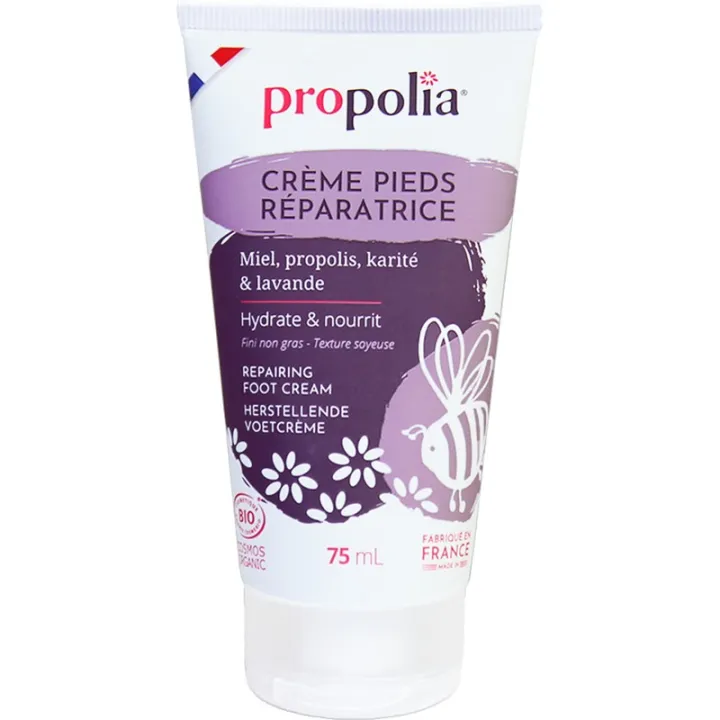
Propolia Repairing Foot Cream combines, in a light emulsion, shea butter, aloe vera juice, coconut and jojoba oils, honey, and propolis wax, blended with floral water and fine lavender essential oil. It addresses the specific needs of dry feet: the soles and heels, which lack sebaceous glands, tend to dry out faster than the rest of the body.
When massaged in daily, this cream moisturizes and nourishes dry feet, cracked heels, and rough areas prone to calluses. Shea butter and plant-based oils restore the skin’s protective barrier, while glycerin and aloe vera lock in moisture in the outer layers of the epidermis—where the restorative formula focuses its action. With repeated use, feet regain comfort and beauty.
Its creamy texture absorbs easily without leaving a sticky residue: the non-greasy finish allows you to put your shoes back on without leaving marks on your socks or sandals. The silky texture makes for a pleasant massage, and the subtle lavender note leaves a discreet, soothing scent.
It’s ideal for people who spend their days on their feet, walk a lot, or wear open-toed shoes when the weather warms up—when heels become marked and calloused. It’s also perfect for the end of winter, after weeks of wearing closed-toe shoes and being around heating that dries out the skin.
To ensure the cream reaches skin that’s free of dead skin cells, we recommend alternating its use with Akileïne Exfoliating Cream once or twice a week. Its exfoliating granules remove dead skin cells that have built up on the heel; the Propolia cream, applied afterward, nourishes the thinner skin, which absorbs it more effectively.
How do you apply this foot cream?
Directions for Use
Apply a small amount of cream to clean, dry skin, then massage each foot, focusing on the heels and toes, until fully absorbed. Reapply as needed.
Share your feedback on the usage instructions and dosage for Propolia Repairing Foot Cream with our partner “Verified Reviews” after your purchase.
Precautions
- For external use only. Do not apply around the eyes or on mucous membranes; in case of contact with the eyes, rinse thoroughly with clean water.
- Do not apply to broken skin, open wounds, or open cracks that are bleeding or oozing, nor to infected areas.
- Massage in completely and do not leave any cream between the toes: moisture trapped in the spaces between the toes promotes maceration.
- Diabetes, circulatory disorders in the legs (arterial disease), or loss of sensation in the feet (neuropathy): consult a doctor or podiatrist before using any foot care product, and examine your feet daily for any unnoticed injuries.
- Do not use if you have a known allergy to propolis, honey, beeswax, or any other bee product, or if you are allergic to Peruvian balsam or rosin, which can cause cross-reactions with propolis.
- Contains fine lavender essential oil and fragrance allergens (coumarin, geraniol, limonene, linalool): if you have sensitive skin, test on a small area 48 hours before first use.
- Pregnant or breastfeeding women, children under 3 years of age: consult a healthcare professional before use due to the essential oil.
- Redness, itching, or a burning sensation after application: discontinue use and rinse with water.
- If a crack worsens, is painful when pressure is applied, or shows signs of infection (warmth, spreading redness, discharge), or if there is peeling between the toes or thickened nails: consult a doctor or a podiatrist.
- Store away from heat and light. Use within 12 months after opening. Keep out of reach of children.
What are the ingredients in this honey and propolis foot care product?
Ingredients
Aqua (Water), Lavandula Angustifolia (Lavender) Flower Water*, Butyrospermum Parkii (Shea) Butter*, Cocos Nucifera (Coconut) Oil*, Aloe Barbadensis Leaf Juice*, Glycerin**, Cetearyl Alcohol, Simmondsia Chinensis Seed Oil*, Glyceryl Stearate, Jojoba Esters, Mel (Honey)*, Propolis Cera*, Lavandula Angustifolia (Lavender) Oil*, Helianthus Annuus (Sunflower) Seed Oil, Helianthus Annuus (Sunflower) Seed Wax, Xanthan Gum, Tocopherol, Sodium Stearoyl Glutamate, Potassium Sorbate, Sodium Benzoate, Citric Acid, Alcohol**, Polyglycerin-3, Coumarin, Geraniol, Limonene, Linalool.
*Ingredients from organic farming. **Processed from organic ingredients. 99% of the total is of natural origin; 51% of the total ingredients are from organic farming. COSMOS ORGANIC-certified organic cosmetics by Ecocert Greenlife.
Product Details
75 ml tube.
Our expert advice on Propolia foot cream for dry feet
Before buying a foot cream, first check the list of precautions: those regarding diabetes and circulation or sensitivity issues take precedence over all others, because in these cases, a cracked heel is never just a matter of comfort. Another common misconception we often hear is that a moisturizing cream can dissolve a thick callus. It softens it without removing it; its role is to keep the skin supple once the callus has been removed.
Consistency matters more than quantity. A thin layer every evening, after washing, yields better results than a thick layer applied occasionally, and it takes several weeks for a very rough heel to soften. Once the skin has regained its suppleness, applying the cream every two or three days is often enough to maintain it.
FAQ
Can I apply Propolia Repairing Foot Cream to my elbows and knees?
Yes. Its rich formula is also suitable for other areas where the skin thickens and dries out, such as the elbows and knees. Massage it in the same way until it is fully absorbed.
Can I wear socks after applying Propolia Repairing Foot Cream in the evening?
Yes. Putting on a pair of cotton socks after application keeps the cream in contact with the skin overnight and protects your sheets. This is especially recommended for very dry heels; for daily care, the cream absorbs on its own.
What’s the difference between Propolia Repairing Foot Cream and a body moisturizer?
A body moisturizer is formulated for thin skin and absorbs quickly. Propolia Repairing Foot Cream is designed for the thick skin on the soles and heels: it’s richer in shea butter and plant oils to nourish an area where the skin renews slowly and cracks easily.