NOTICE
ANSM - Updated on : 25/07/2023
Product name
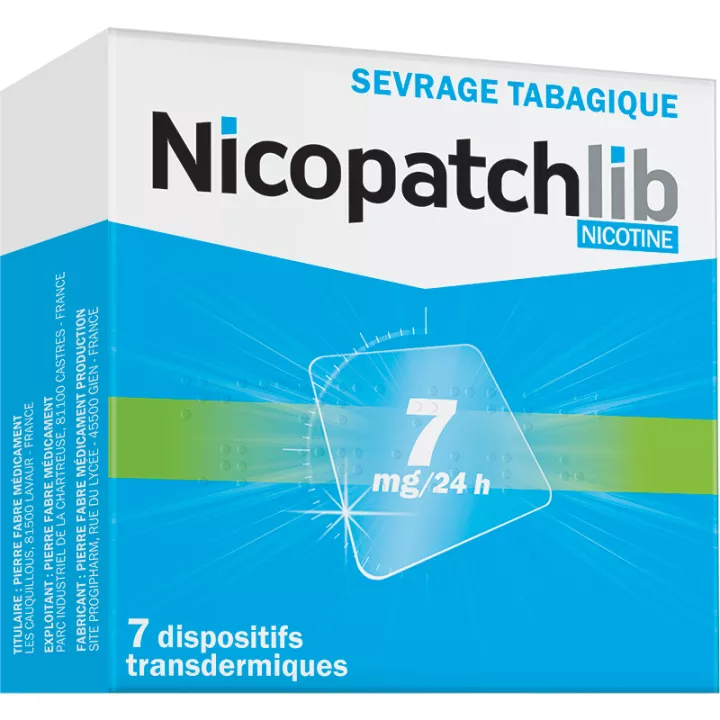
NICOPATCHLIB 7 mg/24 h, transdermal device
Nicotine
Box
Please read this leaflet carefully before using this medicine, as it contains important information for you.
You must always use this medicine in strict accordance with the information provided in this leaflet or by your doctor or pharmacist.
- Keep this leaflet. You may need to read it again.
- Ask your pharmacist for advice and information.
- If you experience any side effects, talk to your doctor or pharmacist. This also applies to any side effects not mentioned in this leaflet. See section 4.
- You should contact your doctor if you do not feel any improvement or if you feel less well after 6 months.
What does this leaflet contain?
1. What is NICOPATCHLIB 7 mg/24 h, transdermal device and what is it used for?
2. What do I need to know before using NICOPATCHLIB 7 mg/24 h, transdermal device?
3. How do I use NICOPATCHLIB 7 mg/24 h, transdermal device?
4. What are the possible side effects?
5. How do I keep NICOPATCHLIB 7 mg/24 h, transdermal device?
6. Package contents and other information.
1. WHAT IS NICOPATCHLIB 7 mg/24 h, transdermal device AND WHAT IS IT USED FOR?
NICOPATCHLIB 7 mg/24 h, transdermal device is used to help you stop smoking.
For adults and adolescents over 15 years of age only.
When you are suddenly deprived of the nicotine provided by tobacco, you may experience unpleasant sensations known as withdrawal symptoms. This indicates that you were addicted to nicotine.
This medicine is a patch (transdermal device) that contains the medicine in the part that sticks to your skin. When you apply it, it slowly releases nicotine into the body, relieving withdrawal symptoms and making smoking cessation easier. This helps prevent relapse in smokers motivated to quit.
You should speak to a doctor if your desire to smoke is not overcome after 6 months of treatment with this medication.
Carefully read the health education advice at the end of the leaflet.
2. WHAT DO I HAVE TO KNOW BEFORE USING NICOPATCHLIB 7 mg/24 h, transdermal device?
Never use NICOPATCHLIB 7 mg/24h, transdermal device:
- if you do not smoke or if you are an occasional smoker.
- if you are allergic to nicotine or to any of the other ingredients of this product, as listed in section 6.
Warnings and precautions
Ask your health care professional for help and advice:
- If you are diabetic. When you start taking this medication, you should monitor your blood sugar levels more often than usual, as your dose of diabetes medication may need to be adjusted.
- If you have recently had a heart attack, unstable or worsening angina including Prinzmetal's angina, severe cardiac arrhythmias, uncontrolled hypertension or a recent stroke.
- If you have skin disease covering a large area of your skin.
- If you have liver or kidney disease, as you may be more susceptible to adverse reactions.
- If you suffer from hyperthyroidism or pheochromocytoma (a tumour of the adrenal glands that can alter blood pressure), as nicotine may aggravate your symptoms.
- If you have a stomach or duodenal ulcer, as nicotine may aggravate your symptoms.
In case of association with another nicotine substitute, it is recommended to seek medical advice.
Children
The therapeutic dose intended for adults could cause serious or even fatal intoxication in young children. Patches, whether used or unused, must be kept out of sight and reach of children at all times.
After use, fold the patch onto itself before discarding.
Other drugs and NICOPATCHLIB 7 mg/24 h, transdermal device
Smoking cessation, with or without this medication, may modify the action of certain other medications taken at the same time.
Dose adjustments by your doctor may be necessary if you are taking the following medications:
- treatment of asthma (theophylline),
- treatment of schizophrenia (clozapine),
- treatment of Parkinson's disease (ropinirole),
- treatment of diabetes (insulin),
- substitution treatment for opiate dependence (methadone).
Tell your doctor or healthcare professional if you are taking, have recently taken or may take any other medication.
NICOPATCHLIB 7 mg/24 h, transdermal device with food, drink and alcohol
Not applicable.
Pregnancy and breast-feeding
Pregnancy
It's very important to stop smoking during pregnancy, as it can harm your baby. In addition to low birth weight, smoking can also cause premature birth or stillbirth. The best thing to do is to stop smoking without the aid of medication. If you are unable to do so, this medication may be recommended to help you, as the risk to your baby is much lower than that associated with continued smoking. Nicotine in any form can harm your unborn child. Consequently, this medicine should only be used after consultation with the healthcare professional monitoring your pregnancy or with your general practitioner, or with a doctor at a center specializing in smoking cessation.
Breast-feeding
This medicine and smoking while breast-feeding should be avoided, as nicotine passes into breast milk and may harm your baby. If you have not succeeded in giving up smoking, it is preferable to use lozenges or other oral forms of nicotine rather than patches. This medicine should only be used on the advice of your doctor.
Driving vehicles and using machines
This medicine has no known effect on the ability to drive vehicles and use machines when used at the recommended dose.
NICOPATCHLIB 7 mg/24 h, transdermal device contains
Not applicable.
3. HOW DO I USE NICOPATCHLIB 7 mg/24 h, transdermal device?
For adults and adolescents over 15 years of age only.
NICOPATCHLIB, transdermal device should not be used in smokers under 18 years of age without the advice of a healthcare professional.
Always use NICOPATCHLIB exactly as instructed in this leaflet, or as directed by your doctor or pharmacist. Check with your doctor or pharmacist if in doubt.
Three strengths of this medicine are available: NICOPATCHLIB 7 mg/24 h, NICOPATCHLIB 14 mg/24 h and NICOPATCHLIB 21 mg/24 h.
The right dosage for you depends on the number of cigarettes you smoke a day, or your score on the Fagerström test (see back of leaflet), which measures your nicotine dependence. Your score on this test will enable you to choose the dosage that best suits your needs.
The NICOPATCHLIB dosage you use will change over the course of your treatment as your nicotine dependence evolves. Sometimes the nicotine dose contained in your medication is too low for you, sometimes it's too high.
The dose should be increased if you experience signs of "craving":
- if you still feel a strong urge to smoke,
- if you feel irritable,
- if you have trouble sleeping,
- if you become agitated or impatient,
- if you have difficulty concentrating.
Ask your doctor or pharmacist for advice. It may be necessary to change the dosage.
The dose should be reduced in the event of signs of overdosage:
- if you experience nausea (vomiting), abdominal pain or diarrhoea,
- excessive salivation,
- sweating,
- headaches, dizziness, reduced hearing or vision,
- general weakness.
It is essential to adapt the treatment with the help of your doctor's or pharmacist's advice.
Standard treatment consists of 3 phases:
1/ Initial phase: to help you quit smoking.
2/ Treatment follow-up: this phase consolidates smoking cessation and begins nicotine withdrawal.
3/ Therapeutic withdrawal: this phase helps you to stop taking the treatment.
The entire treatment lasts an average of 3 months, but this may vary according to individual response. It is recommended not to use NICOPATCHLIB beyond 6 months. However, some "ex-smokers" may require a longer treatment period to avoid relapse.
|
|
Initial phase
3 to 4 weeks
|
Treatment follow-up
3 to 4 weeks
|
Treatment withdrawal
3 to 4 weeks
|
|
Fagerström test score of 5 or more
or
Smokers of 20 or more cigarettes a day
|
NICOPATCHLIB 21 mg/24 h
|
NICOPATCHLIB 14 mg/24 h** or
or
NICOPATCHLIB 21 mg/24 h
|
NICOPATCHLIB 7 mg/24 h** or
or
NICOPATCHLIB 14 mg/24 h
then
NICOPATCHLIB 7 mg/24 h
|
|
Fagerström test score less than 5
or
Smokers of less than 20 cigarettes a day
|
NICOPATCHLIB 14 mg/24 h
or increase to NICOPATCHLIB 21 mg/24 h*.
|
NICOPATCHLIB 7 mg/24 h** or
or
NICOPATCHLIB 14 mg/24 h
|
treatment discontinued**
or
NICOPATCHLIB 7 mg/24 h
|
* according to results on withdrawal symptoms
** in case of satisfactory results
If you continue to experience cravings during treatment, or if your treatment has failed, talk to your healthcare professional. He or she may advise you to combine the patch with an oral form of nicotine substitute (lozenge, gum, etc.) containing a maximum of 2 mg nicotine. Patches and another form of nicotine substitute may only be used at the same time under medical supervision. Use an oral form every time you feel the urge to smoke despite treatment with a patch. The number to use per day varies and depends on your needs. Generally, 5 to 6 a day are sufficient. During withdrawal, gradually reduce the number of oral forms used per day.
Instructions for use
Where to apply the patch
Select an area of dry skin, free from skin lesions (cuts, scratches or bruises) and where hairiness is rare: outer arm, shoulder blade, chest, hip. Avoid mobile areas such as joints, which are subject to rubbing by clothing.
How to apply the patch
|
1. Wash your hands before applying the patch.
2. Open the sachet with scissors, following the dotted lines.
3. Remove patch from bag. Do not cut the patch.
4. Remove part of the protective film covering the sticky side of the patch. This is the side that contains the medication and will be in contact with your skin. Avoid touching the sticky side with your fingers.
5. Apply the patch to the selected area, then remove the remaining protective film.
6. To ensure perfect adhesion, press the patch firmly onto the skin with your palm or fingers for around 10 seconds.
7. Then press all four edges with your fingers to ensure that the transdermal device adheres properly.
8. During handling, avoid contact with eyes and nose, and wash hands after application.
9. The patch should remain in place for 24 hours.
|
|
When to change the patch
Change NICOPATCHLIB transdermal device every 24 hours (preferably in the morning shortly after showering). Choose a different place to apply the next patch, avoiding if possible using the same site for a few days.
NICOPATCHLIB generally adheres well. If, however, your patch comes off, apply a new patch to a new area of clean, dry skin where hair is scarce, and continue with the original schedule. You can also leave the new patch on for 24 hours, if you wish to change the time of application.
How do I remove the patch?
To remove NICOPATCHLIB, loosen one edge and pull gently on the device.
If the patch is resistant, remove it while taking a shower.
If any glue residue remains, gently wash the affected area with warm, soapy water, rubbing with your fingers in a circular motion.
How do I dispose of the patch?
When you peel the patch from your skin, fold it back on itself, with the side that was in contact with your skin facing inwards, before disposing of it in a safe place to prevent children from gaining access to it.
When swimming for long periods, cover the patch with a waterproof bandage for the duration of your swim.
For short showers, the patch can be kept in place. Avoid directing the shower jet onto it.
Frequency of use
Use one patch per 24 hours.
Duration of treatment
Duration of treatment is approximately 3 months, but may vary according to individual response. Treatment duration is limited to 6 months.
If your withdrawal symptoms worsen or do not improve, or if the craving persists, or if you have difficulty stopping the drug, consult your doctor.
Use in children
Not applicable
If you have used more NICOPATCHLIB 7 mg/24 h, transdermal device than you should have
In the event of accidental overdose, or if a child has sucked on or applied a patch, remove it immediately, wash skin with soap and water, and contact a doctor or the nearest hospital emergency department.
In addition to signs of overdosage requiring dose reduction only (see list above dosage table), severe intoxication may occur, with the following symptoms:
- irregular pulse,
- respiratory discomfort (breathing difficulties and lung discomfort),
- prostration (total exhaustion and inability to move),
- cardiovascular collapse (possible heart attack or drop in blood pressure),
- convulsions.
If you forget to use NICOPATCHLIB 7 mg/24 h, transdermal device
Apply a patch as soon as possible and continue your treatment as normal. Do not use two patches at the same time.
If you stop using NICOPATCHLIB 7 mg/24 h, transdermal device
Not applicable.
If you have any further questions about the use of this drug, please consult your health care practitioner.
4. WHAT ARE THE POSSIBLE SIDE EFFECTS?
Like all medicines, this product may cause undesirable effects, but they do not occur systematically in everyone.
Application site reactions are the most frequent side effects of this drug. The majority of these skin reactions are mild to moderate in intensity, and regress rapidly after removal of the patch. In the event of a severe skin reaction, or one that persists for several days, it is advisable to stop treatment and consult your doctor or pharmacist to find another form of nicotine substitute to help you stop smoking.
In the event of urticaria, skin rash, itching (sometimes generalized), sudden swelling of the face and/or mouth and/or throat and/or difficulty in swallowing and/or difficulty in swallowing, it is advisable to stop treatment and consult your doctor or pharmacist.If you experience any of the following symptoms, stop using this product and contact your doctor immediately. These may be symptoms of a severe allergic reaction (angioedema).
The other side effects listed below are classified according to the probability with which they may occur.
Very common (affecting more than 1 in 10 people): redness and itching at the application site (where you stick your patch), insomnia.
Common (affecting 1 to 10 people in 100): small raised pimples called papules and burning sensations at the application site. These effects are generally the result of applying the patch to the same spot on the skin every day. By changing the application site daily, any irritation naturally disappears and discomfort is reduced to a minimum.
Other common effects may include constipation, diarrhea, stomach ache, nausea, vomiting, dry mouth, increased sweating, headache, dizziness, irritability, muscle pain, paresthesia (numbness or tingling that may spread beyond the application site), fatigue or abnormal dreams. These effects are often moderate, may be due to smoking cessation, and disappear spontaneously and rapidly after removal of the patch.
Other effects observed with other nicotine patches on the market include palpitations (irregular, rapid heartbeat).
If you are taking this product in combination with an oral nicotine replacement product, please refer to the package insert for each product.
Smoking cessation itself can cause symptoms such as dizziness, headaches, sleep disturbances, coughs and colds. Depression, irritability, anxiety, restlessness, increased appetite and insomnia may also be associated with smoking cessation. Mouth ulcers may be related to smoking cessation and not to your treatment.
Reporting side effects
If you experience any side effects, please tell your doctor or pharmacist. This also applies to any side effects not mentioned in this leaflet. You can also report adverse reactions directly via the national reporting system: Agence nationale de sécurité du médicament et des produits de santé (ANSM) and the network of Centres Régionaux de Pharmacovigilance By reporting adverse reactions, you are helping to provide more information on drug safety.
5. HOW TO CONSERVE NICOPATCHLIB 7 mg/24 h, transdermal device?
Keep out of sight and reach of children.
Do not use NICOPATCHLIB after the expiration date indicated on the sachet and box after EXP. The expiration date refers to the last day of that month.
No special storage precautions are required.
Do not freeze.
Do not dispose of any medicine in the garbage. Ask your pharmacist to dispose of any medicines you no longer use. These measures will help protect the environment.
6. CONTENTS AND OTHER INFORMATION
What NICOPATCHLIB 7 mg/24 h, transdermal device contains
- The active substance is nicotine.
Each 10 cm² patch contains 15 mg nicotine, delivering 7 mg nicotine per 24 hours.
- The other components are : vinylacetate acrylate copolymer, methyl methacrylate-dimethacrylate copolymer, thylene glycol film, polyethylene glycol film.thylene glycol, polyethylene terephthalate film, siliconized polyester film, white printing ink: white.
What NICOPATCHLIB 7 mg/24 h, transdermal device is and what it contains
The patches are translucent, square-shaped with rounded corners. Each device is packaged in its own protective pouch.
Available in boxes of 7, 14 or 28 patches. Certain presentations may not be marketed.
Marketing authorization holder
PIERRE FABRE MEDICAMENT
LES CAUQUILLOUS
81500 LAVAUR
Marketing authorization holder
PIERRE FABRE MEDICAMENT
PARC INDUSTRIEL DE LA CHARTREUSE
81100 CASTRES
Manufacturer
PIERRE FABRE MEDICAMENT PRODUCTION
Site Progipharm, Rue du Lycée
45500 Gien
Product names in member states of the European Economic Area
This medicinal product is authorized in the member states of the European Economic Area under the following names: In accordance with current regulations.
[To be completed subsequently by the holder].
The last date on which this leaflet was revised was :
[to be completed at a later date by the registrant]
Other
Detailed information on this drug is available on the ANSM (France) website.
Health education advice :
|
Quitting smoking as soon as possible has immediate health benefits. It's never too late to quit, even if you've smoked a lot for a long time.
|
As soon as you stop smoking :
- you will no longer absorb the irritating and toxic substances of cigarettes;
- you'll notice certain improvements, such as the gradual disappearance of headaches, coughing, throat irritation and shortness of breath;
- you'll often enjoy the satisfaction of better sleep, food flavors and smells, and improved physical performance;
- reduce your risk of developing lung cancer or cardiovascular disease.
- In the case of heart or arterial disease (angina pectoris, arteritis of the lower limbs), it is particularly important to succeed in quitting smoking.
What is tobacco dependence?
Tobacco addiction is twofold:
Psychological dependence:
Smoking a cigarette involves a ritual of automatic, repetitive gestures associated with particular circumstances (pleasure, response to stress, intellectual stimulation, support for morale, need for the gesture of conviviality). This is psychological and behavioral dependence.
Physical dependence:
The body's need for nicotine is due to the effects of this substance on the nervous system. This is physical dependence. Failure to satisfy this need leads to cravings. Nicotine substitutes are designed to treat this dependence.
How can you overcome your psychological dependence?
- To increase your chances of success, you need to stop smoking completely:
- choose a day when you feel most motivated to quit;
- throw away your last pack of cigarettes, your lighter and put away your ashtrays;
- in a couple who smoke, it's preferable for both partners to quit at the same time.
- Let your family and colleagues know that you're quitting smoking. Ask them to respect your decision (not to smoke near you, not to offer you any more cigarettes).
- Be prepared for the urge to smoke. It may come on suddenly and intensely, especially in the first few weeks after you've stopped smoking, but it shouldn't last more than 3 or 4 minutes. You need to plan what you will do in this case and act very quickly to avoid "cracking", such as:
- drinking a large glass of water
- chewing gum
- count to 100 ;
- take a few deep breaths;
- leave the room;
- change activity...
- Avoid situations associated with smoking (coffee, aperitifs...), avoid temptations (sit with non-smokers).
Find ways to compensate for smoking (hobbies, sports, cultural activities, etc.).
How can you overcome your physical dependence?
If you're addicted to nicotine, you may need to use nicotine substitutes to succeed.
To assess your level of dependence, we suggest you take the Fagerström test.
FAGERSTRÖM TEST
|
How soon after waking up do you smoke your first cigarette?
|
Your score
|
|
|
- within 5 minutes: 3
|
|
|
|
- from 6 to 30 minutes: 2
|
|
|
|
- from 31 to 60 minutes: 1
|
|
|
|
- after 60 minutes: 0
|
|
|
Do you find it difficult not to smoke in places where it's forbidden?
|
|
|
|
- yes : 1
|
|
|
|
- no : 0
|
|
|
Which cigarette of the day would be the most difficult for you to give up?
|
|
|
|
- the first: 1
|
|
|
|
- another: 0
|
|
|
How many cigarettes do you smoke a day?
|
|
|
|
- 10 or less : 0
|
|
|
|
- 11 à 20 : 1
|
|
|
|
- 21 à 30 : 2
|
|
|
|
- 31 or more: 3
|
|
|
Do you smoke more in the morning than in the afternoon?
|
|
|
|
- yes : 1
|
|
|
|
- no : 0
|
|
|
Do you smoke when you are so ill that you have to stay in bed most of the day?
|
|
|
|
- yes : 1
|
|
|
|
- no : 0
|
|
|
TOTAL POINTS
|
|
- Score from 0 to 2: you are not addicted to nicotine.
You can stop smoking without needing a nicotine substitute. However, if you're worried about quitting, ask your pharmacist or doctor for advice.
- Score of 3 to 4: you are mildly dependent on nicotine.
- Score 5 to 6: you are moderately dependent on nicotine.
The use of nicotine substitutes will increase your chances of success. Ask your pharmacist or doctor for advice on the best treatment for you.
- Score of 7 to 10: you are strongly or very strongly dependent on nicotine.
The use of nicotine substitutes is recommended to help you overcome this nicotine dependence. This treatment must be used in sufficient and appropriate doses. Ask your pharmacist or doctor for advice, possibly in the context of a specialized smoking cessation consultation.
Withdrawal symptoms may persist for a long time, and treatment should be of sufficient duration, usually one to three months.
If, despite treatment, you experience a persistent "craving" sensation, such as
- the urge to smoke
- irritability, sleep disturbances
- restlessness or impatience,
- difficulty concentrating,
consult your doctor or pharmacist, as dose adjustments may be necessary.
How can we help you?
- Support from healthcare professionals
The support, advice and follow-up provided by your doctor or pharmacist will be invaluable during the first six months of quitting smoking. You can also turn to a specialized smoking cessation consultation, especially if you've already failed.
- Psychological support
Quitting smoking requires a supportive family and social environment. If you're worried that the difficulties are too great, psychological support or temporary treatment can help.
- Diet
In the months following smoking cessation, you may notice a moderate weight gain. If you have any concerns in this area, you can speak to a health professional who will be able to advise you.
Why have you started smoking again?
Think of this relapse as an accident along the way, as a normal learning experience: a relapse is not a failure.
Analyze the reasons why you started smoking again.
- Physical dependence
This may not have been properly taken into account, or it may have reappeared after several months, for example, during prolonged stays in smoky atmospheres.
- Because of excessive weight gain
You may need to modify your eating habits a little before your next attempt to stop smoking.
- Because of a drop in motivation, because of a painful event or a difficult period, because of psychological difficulties that have arisen during the quitting process (depression, anxiety...), because of a lack of energy, because of a lack of energy or because of a lack of energy..), or because of a very tempting situation. Understand the reason for the relapse, so you can prevent it if possible the next time you try.
In all cases, don't hesitate to ask a healthcare professional for advice, or seek out a specialized smoking cessation consultation.
If you've started smoking again, don't be discouraged. Experience shows that your chances of success increase after one or more quit attempts.