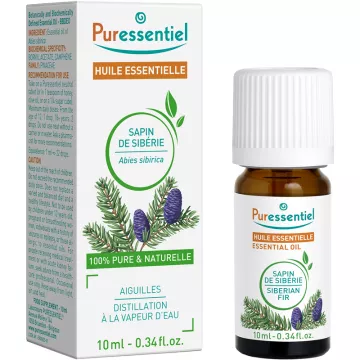
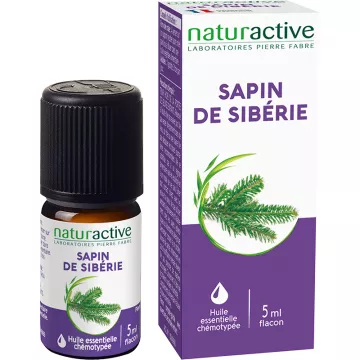
Siberian fir (Abies sibirica) essential oil is extracted from the needles and twigs of this conifer found in the boreal forests of Russia and Mongolia. Its biochemical profile—rich in bornyl acetate (40–55%), camphene (10–20%), and α-pinene—gives it a fresher, lighter, and more menthol-like aroma than balsam fir (A. balsamea), which has a sweeter, more balsamic scent. It is the ideal choice for extended diffusion and relaxation spaces. Explore our aromatherapy selection.
What sets the Siberian fir apart?
The three main firs used in aromatherapy have distinct biochemical and olfactory profiles.
- Abies sibirica (Siberia): bornyl acetate 40–55% + camphene 10–20% + α-pinene — fresh, slightly minty, airy, and light aroma — ideal for extended diffusion
- Abies balsamea (Canada): bornyl acetate 50–65% + less camphene — a warmer, sweet, balsamic aroma — the standard for intensive respiratory care
- Abies alba (Europe): bornyl acetate 30–45% + pronounced α-pinene — fresh, slightly resinous aroma — used in both herbal medicine and aromatherapy
- The camphene content of Siberian fir gives it its characteristic menthol note and a cooler effect on the mucous membranes than its cousins
- It is often the most affordable fir essential oil—the Siberian boreal forests provide an abundant supply
Siberian fir and respiratory comfort?
Like other species of the genus Abies, Siberian fir supports respiratory health.
- Mucolytic expectorant: bornyl acetate thins bronchial secretions—providing a cooler, lighter sensation than balsam fir, thanks to camphene
- Mild nasal decongestant: camphene contributes to a sensation of nasal freshness, helpful for seasonal congestion
- Airborne antiseptic when diffused: α-pinene has been shown to disinfect the air—helping to prevent winter illnesses
- Inhalation: 3 drops in a bowl of hot water, 10 min — upper respiratory tract
- Chest application: 2–3% in a vegetable oil, massage 2 to 3 times a day—see our winter ailments line
Siberian fir for extended diffusion?
Its light, fresh scent makes it an ideal essential oil for long-term diffusion—a specific advantage over other firs.
- Fresh, airy top note—less heavy than the balsam fir’s woody note—easier to tolerate for several hours
- Long-lasting diffusion in workspaces, wellness rooms, and practitioners’ offices—8–10 drops in an ultrasonic diffuser, 20–30 minutes every 2 hours
- “Arctic Fresh Air” blend: Siberian fir (5) + eucalyptus radiata (3) + peppermint (2)—a fresh, invigorating combination
- “Winter Zen” Blend: Siberian fir (4) + Atlas cedar (3) + true lavender (3) — a balance of freshness and woody warmth
- Spa and wellness use: Siberian fir + spruce + Scots pine — an olfactory immersion in the boreal forest
Siberian fir and muscle comfort?
The camphene in Siberian fir enhances the muscle-relaxing properties during massage.
- Camphene is a monoterpene with documented muscle-relaxing properties—supports muscle comfort during post-exercise massage
- Apply diluted to 3–5% in arnica or St. John’s wort oil to areas of muscle tension
- Characteristic sensation of muscular freshness thanks to camphene—a “cooling” effect followed by a warming sensation during massage
- Combine with cypress essential oil and wintergreen for sports recovery blends
Precautions and contraindications?
Same as for other species of the genus Abies —a few precautions specific to camphene.
- Pregnant women: avoid—monoterpenes and camphene cross the placental barrier
- Children under 6 years of age: avoid direct inhalation—camphene may irritate young mucous membranes
- People with asthma: use for short periods (10–15 min) with good ventilation—camphene may cause bronchospasms
- Allergy to the Pinaceae family: skin test recommended (cross-reactivity with other firs, pines, and spruces)
- Dilute to 2–5% for topical use—high concentrations of camphene may be mildly irritating to sensitive skin