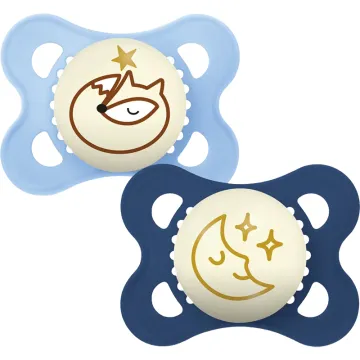
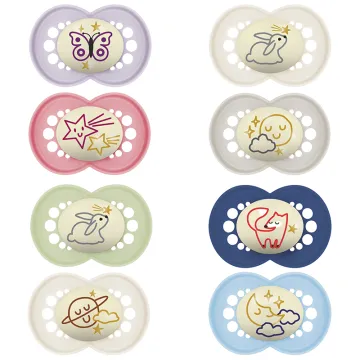
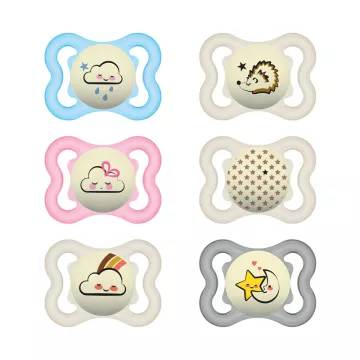
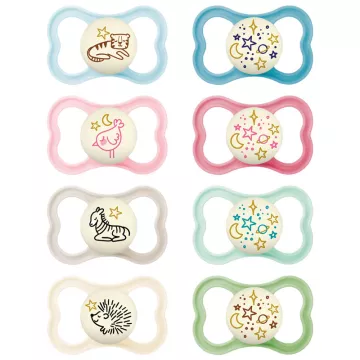
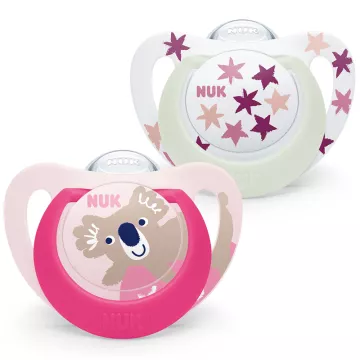
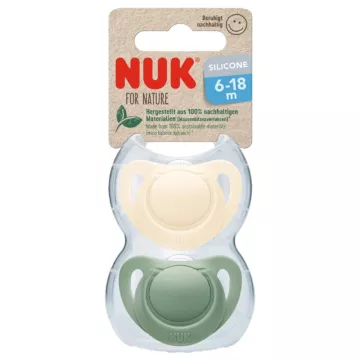
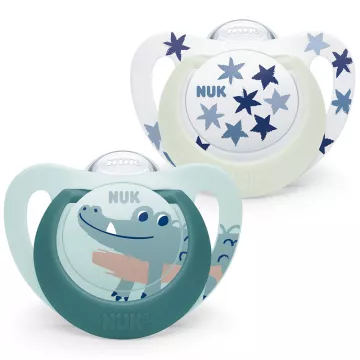
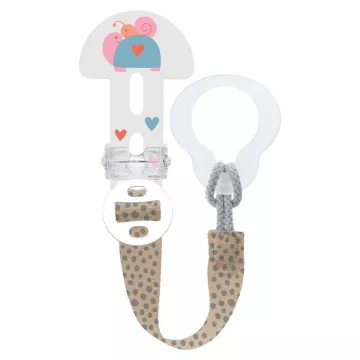
A nightlight pacifier is a pacifier specifically designed to accompany infants and young children during sleep. Its main feature is its glow-in-the-dark collar or ring, which absorbs light during the day and then glows softly in the dark. This soft glow makes it easier for babies to find their pacifier if it falls out during the night, and allows parents to locate it without turning on the bedroom light.
Beyond this glow feature, the night pacifier incorporates the characteristics of a standard anatomical or orthodontic pacifier: a nipple adapted to the mouth’s shape, a rim that meets safety standards (EN 1400 standard, ventilation holes, ergonomic ring), and a soft silicone or latex material. For infants in general, additional resources are available.
The night pacifier offers several practical benefits for family nights. The glow-in-the-dark feature makes nighttime awakenings much easier: a baby who wakes up briefly can find their pacifier—which has fallen onto the bed—on their own, without crying or alerting their parents. This independence helps the baby fall back asleep quickly and reduces the need for nighttime interventions.
In terms of soothing, non-nutritive sucking provides comfort that helps the baby fall asleep and return to sleep after brief, natural awakenings. The pacifier thus becomes part of a reassuring bedtime routine. Several studies have also documented a protective effect of using a pacifier at bedtime against sudden infant death syndrome (SIDS), which is why its use is considered safe in prevention guidelines. For infant colic in general, specific resources are available.
A pacifier at night can help improve sleep quality, though it is not a miracle solution. Its soothing effect is real: non-nutritive sucking activates relaxation mechanisms, releases feel-good hormones, and aids in falling asleep for babies who accept the pacifier. The fact that it’s easy to find if it falls out prevents the baby from waking up completely and promotes continuous sleep cycles.
Several factors work together to influence a baby’s sleep quality: a consistent sleep schedule, a quiet and dark environment, an appropriate temperature (18–20 °C in the bedroom), safe sleeping on the back, and gradually weaning the baby off sleep associations as they grow. The pacifier is part of this overall approach rather than a replacement for it.
Several essential precautions govern nighttime use:
Never force a pacifier on your baby: if the baby refuses it, other soothing methods (holding, cuddling, a comfort blanket suitable for babies 6 months and older) are perfectly acceptable.
Several criteria guide the choice of a suitable nighttime pacifier:
Having 2 to 3 identical pacifiers to rotate makes cleaning easier and allows you to slip several into the crib to increase the chances that your baby will find one during the night.
Impeccable hygiene is essential for the child’s health and safety. Initial sterilization before first use is mandatory (boiling water for 5 minutes or a sterilizer). On a daily basis, washing with hot soapy water and rinsing thoroughly with clean water is sufficient. Regular sterilization (1 to 2 times a week) is recommended for newborns and should always be done after an infectious illness.
A few additional hygiene rules:
To activate the glow-in-the-dark feature, simply expose the pacifier to daylight or a lamp for a few minutes before bedtime.
Introducing a pacifier to a baby who has never used one before requires patience and flexibility. Several tips can help with acceptance: Offer it during a calm moment, ideally at bedtime when the baby is relaxed but drowsy; try different shapes and materials if the first one isn’t accepted; don’t insist if the baby initially refuses, and try again a few days later; don’t force the pacifier into the baby’s mouth.
For breastfed babies, waiting until breastfeeding is well established (3 to 6 weeks) reduces the risk of nipple-pacifier confusion. If the pacifier falls out at night, quietly putting it back in without fully waking the baby is best. Specific resources are available forbreastfeeding in general.
Pediatric dentists recommend gradual weaning between the ages of 2 and 4 at the latest. Prolonged use beyond this age can contribute to dental malocclusions (anterior open bite, high-arched palate), delayed language development, impaired articulation, and recurrent middle ear infections.
Several weaning strategies have proven effective: first, limit use to bedtime, then to naps only, and finally stop completely; involve the child in the process (a “goodbye” ceremony, exchanging the pacifier for a symbolic gift, “sending it to the pacifier fairy”); offering a comforting substitute object (security blanket, stuffed animal); avoiding harsh methods (sudden withdrawal, bitter coatings) that may cause anxiety and compensatory behaviors.
A consultation with a pediatric dentist around age 2–3 helps assess any potential oral health impact and guide the weaning schedule. Your pharmacist remains a valuable resource to support these various stages, in addition to regular pediatric follow-up care.