Carbo Vegetabilis for the Relief of Digestive Disorders
Carbo Vegetabilis is a homeopathic remedy used to relieve digestive disorders such as gastroenteritis, diarrhea, and traveler’s diarrhea. Although it can provide relief for these conditions, it is essential to consult a homeopathic healthcare professional for personalized treatment tailored to your condition. Take care of your digestive well-being with Carbo Vegetabilis.
French Name: CHARBON VEGETAL OFFICINAL
Registered medication: EH00434
Origin: Plant-based
Carbo Vegetabilis is a homeopathic remedy used to treat certain symptoms of gastroenteritis. It also acts as an antiseptic when prescribed to treat bedsores and skin conditions. In pulmonology, it is frequently combined with allopathic vasodilator therapy to help patients breathe more easily. In cardiology, it promotes blood purification to prevent cyanosis.
Indications and Dosage
Homeopathic remedies in globule doses can be used for various symptoms; therefore, it is not possible to specify the indications and dosage for a particular preparation.
The homeopathic physician selects the appropriate remedy, dilution, and dosage based on the patient’s health condition and characteristic symptoms.
Carbo Vegetabilis: A Homeopathic Remedy for Digestive Disorders
Carbo Vegetabilis is a homeopathic remedy traditionally used to treat digestive disorders such as gastroenteritis, diarrhea, and traveler’s diarrhea. In this article, we will explore the common uses of this homeopathic remedy to relieve these digestive system conditions.
Gastroenteritis: Relief from Digestive Discomfort
Gastroenteritis, characterized by symptoms such as nausea, vomiting, diarrhea, and abdominal cramps, can be very uncomfortable. Carbo Vegetabilis is often recommended in homeopathy to help relieve these symptoms. It is valued for its ability to soothe an irritated stomach and reduce digestive disturbances.
Diarrhea: Restoring Intestinal Balance
Frequent diarrhea, particularly when accompanied by loose stools and abdominal cramps, can lead to dehydration and weakness. Carbo Vegetabilis is used in homeopathy to help restore intestinal balance. It is known for its gentle action on the digestive system, thereby promoting a faster recovery.
Traveler’s Diarrhea: Prevention and Treatment of Intestinal Disorders While Traveling
Traveler’s diarrhea is a common condition among those who travel to regions where water or food may be contaminated. Carbo Vegetabilis is sometimes recommended in homeopathy to prevent or treat travel-related intestinal disorders. It is valued for its soothing effect on the digestive system, which can help minimize the risk of turista.
Directions for Use
Remove the tab, turn the tube upside down, and gently pull the cap.
Place all the globules in the dose under the tongue.
It is recommended not to touch the homeopathic globules with your fingers.
The globules in the single-dose tubes are taken all at once by allowing them to dissolve slowly under the tongue. If a single dose is unavailable, take 10 globules of the same dilution.
Do not consume astringent substances—such as coffee, tobacco, camphor, mint, or chamomile—within half an hour before taking homeopathic remedies.
Use a mint-free toothpaste (such as Homéodent by Boiron).
Professional Consultation: The Key to Proper Use
As with any homeopathic remedy, it is essential to consult a homeopathic healthcare professional to determine the appropriate remedy, dilution, and dosage for your health condition and symptoms. Each case is unique, and a qualified practitioner will be able to tailor the treatment to your individual needs.
Packaging and Quantity
Translucent single-dose globule tube (allows you to see the remaining globules).
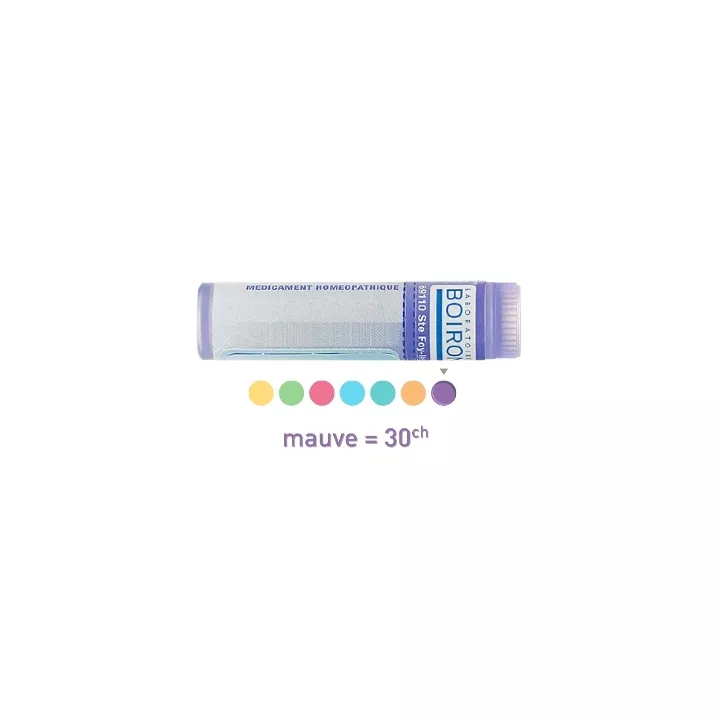
Each tube color corresponds to a dilution:
Yellow 4CH, Green 5CH, Red 7CH, Blue 9CH, Sea Green 12CH, Orange 15CH, Purple 30CH
Weight: 1 g.
Precautions for Use
Warning
Contains sucrose.
Store homeopathic medicines away from light, heat, moisture, and any sources of fumes or fragrances.
Administering homeopathic globules to infants and children
For globules or alcohol-based drops, dissolve them in 100 ml of water. Since globules take a long time to dissolve, you should prepare your mixture in advance.
Homeopathy and Pregnancy
Homeopathic remedies have no chemical toxicity, no contraindications, no interactions with other medications, and no adverse effects related to the amount ingested. Pregnant women can use them without any known risk to themselves or their unborn child, but it is best to seek advice.
Frequency of Homeopathic Use
For acute conditions, it is recommended to take homeopathic remedies every hour until symptoms improve. Once symptoms improve, doses should be spaced out to 3 or 4 times a day, then gradually discontinued.
For chronic conditions, remedies in low dilutions (greater than 9CH) are taken 1 to 2 times a day, while constitutional remedies are taken once a week or even once a month. This decision is up to the homeopath.
What to Do If There Is No Improvement Within 24 Hours
Certain conditions cannot be treated with homeopathy through self-medication alone. Their severity requires medical advice, which can be provided by a homeopathic physician. This physician will determine whether your condition can be treated with homeopathy alone or whether your treatment should be supplemented with allopathic medicine.